
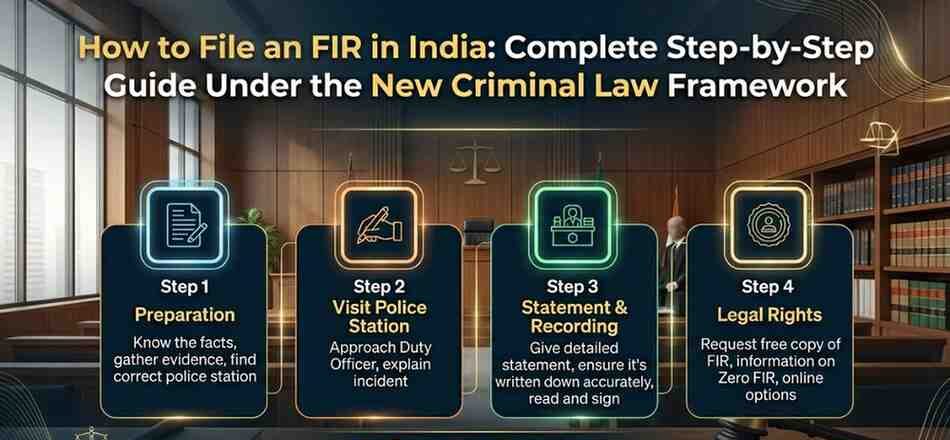
Learn how to file an FIR in India with this detailed guide under the new criminal law framework (BNSS 2023). Understand the filing process, Zero FIR, online FIR procedures, legal sections, citizen rights, latest criminal law updates, and frequently asked questions
Introduction
A crime report often begins with a single document known as an FIR or First Information Report. It serves as the official starting point of a police investigation into serious offences. Filing an FIR helps law enforcement record the incident and initiate legal action.
India’s criminal procedure system underwent major reform with the introduction of the Bharatiya Nagarik Suraksha Sanhita (BNSS), which replaced the earlier criminal procedure framework. The updated law introduced modern procedures, including electronic reporting, recognition of Zero FIR, and digitized processes aimed at improving access to justice.
This guide explains the FIR process in simple language and is written as original content for educational and informational use.
What is an FIR?
A First Information Report is the first formal record prepared by police after receiving information about a cognizable offence.
A cognizable offence refers to crimes where police can begin an investigation immediately without prior permission from a court.
Common examples include:
- Murder
- Kidnapping
- Robbery
- Theft
- Sexual offences
- Serious assault
- Cyber fraud
- Acid attacks
The FIR becomes an important legal document because it forms the initial basis for investigation and later judicial proceedings.
Legal Provision for FIR Under the New Criminal Law
Under the new criminal procedure law, FIR registration and reporting procedures are governed by:
Section 173 of BNSS, 2023
The provision broadly recognizes:
- Oral complaints
- Written complaints
- Electronic communication
- Free copy of FIR to complainant
- Zero FIR registration
- Special protection measures for women and vulnerable individuals
The purpose of these changes is to reduce delays and simplify reporting.
Step-by-Step Process to File an FIR
Step 1: Visit the Nearest Police Station
You can approach the closest police station to report a cognizable offence. You do not always need to identify the police station having exact territorial jurisdiction because the concept of Zero FIR exists.
Documents or materials that may help include:
- Identity proof
- Address proof
- Photographs
- Videos
- Medical reports
- Screenshots
- Witness details
- Supporting documents
Evidence is helpful but lack of documents does not automatically prevent reporting of a crime.
Step 2: Clearly Explain the Incident
Provide information carefully and accurately.
Important details usually include:
- Date of occurrence
- Time of incident
- Location
- Nature of offence
- Description of events
- Information regarding accused persons if known
- Witness information
- Details of injuries or loss
Keep statements factual and avoid assumptions.
Step 3: Police Officer Records Your Statement
If information is provided verbally, the police officer records the details in writing.
After recording:
- The officer should read the contents back to you.
- Verify all names, dates and facts.
- Request corrections if something is inaccurate.
Small mistakes at this stage can create confusion later during investigation.
Step 4: Read Before Signing
Before signing the FIR:
- Read the complete document carefully
- Confirm that information is accurate
- Ask for corrections where necessary
Never sign incomplete or blank documents.
Step 5: Obtain Your FIR Copy
After registration, you have the right to receive a copy of the FIR free of cost.
Verify the following:
- FIR number
- Date of registration
- Police station details
- Name of officer recording the complaint
Keep this document safely because it may be needed later.
Understanding Zero FIR
Zero FIR allows a person to file an FIR at any police station, even if the incident happened elsewhere.
Example:
Suppose a person from Delhi experiences a robbery while traveling in another state. Instead of spending time locating the correct jurisdiction, they can immediately file a complaint at the nearest police station.
The police station records the FIR and later transfers it to the police station having proper jurisdiction.
The purpose of Zero FIR is to avoid unnecessary delays during urgent situations.
Can FIR Be Filed Online?
Modern legal reforms recognize electronic communication for reporting offences.
Depending on local systems and state procedures, reporting may happen through:
- Police websites
- Cybercrime reporting systems
- Email submissions
- Digital complaint portals
Electronic complaints may require later verification and procedural confirmation.
Latest Criminal Law Developments
Recent reforms in criminal procedure focus on modernization and accessibility.
Some important developments include:
- Digital reporting systems
- Electronic communication recognition
- Expansion of Zero FIR practices
- Increased use of technology in investigations
- Video-based procedural recording in specific situations
- Stronger focus on cyber-related offences
These developments aim to improve transparency and speed within the criminal justice process.
What to Do if Police Refuse to Register an FIR
If registration is refused, available options may include:
- Submit a written complaint to the Superintendent of Police.
- Preserve copies of all submissions.
- Approach the appropriate Magistrate through legal procedure.
- Seek legal assistance if required.
Refusal merely because of jurisdiction issues may not be appropriate in cognizable cases.
Rights of a Person Filing an FIR
A complainant generally has several important rights:
- Right to receive a free copy of FIR
- Right to correct factual errors
- Right to file Zero FIR
- Right to respectful treatment
- Right to legal representation
- Right to special assistance for women and persons with disabilities
Awareness of these rights can help citizens navigate legal procedures more effectively.
Conclusion: How to File an FIR in India
An FIR acts as the first legal step toward initiating criminal investigation and obtaining legal protection. The newer criminal law framework emphasizes accessibility, digital procedures and quicker reporting mechanisms. Understanding the filing process and your rights can help ensure that legal action begins without unnecessary delays.
Frequently Asked Questions: How to File an FIR in India
Can a person file an FIR on behalf of someone else?
Yes. Any individual who has information regarding a cognizable offence can report it, even if they are not the direct victim.
Is an FIR required for every complaint?
No. Certain non-cognizable matters follow different procedures and may not immediately require an FIR.
Is there any fee for filing an FIR?
No. Registration of an FIR and obtaining its copy is free.