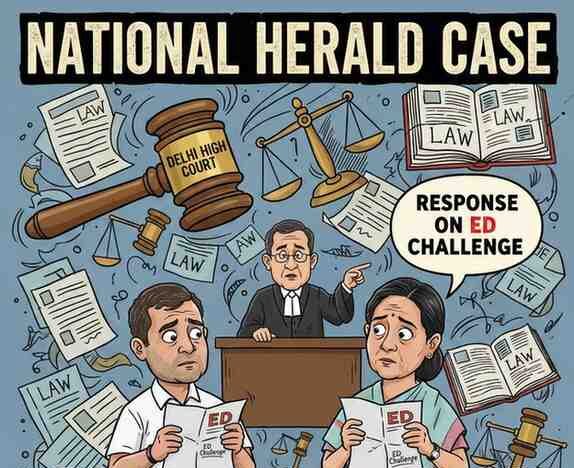
National Herald Case: A Delhi court has declined to take cognizance of the Enforcement Directorate’s (ED) case under the Prevention of Money Laundering Act (PMLA), filed in a fresh ‘complaint’ in the National Herald case, giving reprieve to Congress chief Sonia Gandhi and Rahul Gandhi.
Introduction: Why We’re Hearing About The National Herald Case Again
After a Delhi court declined to admit a fresh complaint by the Enforcement Directorate (ED) under the Prevention of Money Laundering Act (PMLA), the National Herald case has returned to the headlines. The move has provided some legal reprieve to senior Congress leaders Sonia Gandhi and Rahul Gandhi, who are among the accused.
This isn’t the end of the case, nor is it an exoneration. Rather, it suspends the criminal action at its beginning because of defects that appear on the face of the information. This decision requires a careful look at the case’s history, the law involved, and what exactly the court decided.
What Is the National Herald Matter?
The National Herald case is related to AJL, which had brought out the now-defunct National Herald newspaper. Over the years, AJL’s debts mounted, and it ceased publishing regularly, but it still owned highly lucrative immovable properties across India.
Later, a company called Young Indian Private Limited came into the picture. Young Indian gained control over AJL and its assets. Sonia Gandhi and Rahul Gandhi are shareholders of Young Indian.
The charges allege that this takeover enabled assets worth millions to change ownership without full payment, resulting in allegations of financial impropriety, fraud, and money laundering.
How Did the Enforcement Directorate Join the Investigation?
The ED is empowered to investigate money laundering violations under the PMLA. The ED said the transfer of AJL’s assets, allegedly conducted in an illegal manner, amounts to money laundering, as the transactions were projected as legitimate property.
On this basis, the ED investigated, interrogated the accused, and finally filed a complaint before a special court in Delhi.
But money laundering cases do not stand alone. They have to be linked to a predicate (scheduled) offence, like cheating or criminal breach of trust, which must be covered by a valid FIR.
What Did the Delhi Court Rule?
Refusal to Take Cognizance Explained
The Delhi court declined to apply its mind to the ED’s complaint. In simple legal terms, ‘taking cognizance’ means when a court legally acknowledges that it has received information about an offence and starts to act on it.
By declining cognizance, the court effectively said:
“The case can’t be pursued in its current posture.”
This is a procedural ruling—not an indication of guilt or innocence.
Why Did the Court Decline to Take Cognizance?
Absence of Predicate Offence
The required element under PMLA was missing in the ED’s complaint. Specifically:
- There must be a scheduled offence and an FIR to file a money laundering case.
- The ED relied on a private complaint instead of a regular FIR when filing.
- Without a predicate offence, the PMLA case does not legally exist.
The court ruled that proceeding otherwise would violate legal principles.
Who Are the Accused?
The accused include:
- Sonia Gandhi
- Rahul Gandhi
- Young Indian Private Limited
- Other individuals associated with AJL and Young Indian
The allegations revolve around control and ownership of AJL’s assets.
What Relief Did Sonia and Rahul Gandhi Get?
Temporary, Not Permanent Relief
The court’s order offers temporary relief:
- No summons issued
- No trial initiated
- No charges framed
However, the relief is not permanent. The ED can still:
- File an appeal
- Fix procedural issues
- File a new complaint with proper legal support
Does This End the Case?
No. The National Herald matter is far from over.
This decision pertains only to the pending ED complaint. Other legal options remain available, including:
- Fresh investigations
- Appeals in higher courts
- Proceedings based on duly registered FIRs
While the current prosecution is paused, the case remains legally active.
Why This Case Matters Legally
Reinforcing Due Process
The ruling highlights an important principle:
Investigating agencies must follow proper procedure, especially in major financial crimes.
PMLA is a powerful law, but courts insist it must be used lawfully and carefully, respecting procedural safeguards.
Political Reactions and Public Debate
As expected, the decision sparked strong political responses:
- Gandhi supporters called it a victory for the rule of law.
- Critics said the relief was temporary and the case would continue.
- Legal experts emphasized that courts were not halting investigations, only demanding that they follow due process.
The case remains politically sensitive because of the stature of those involved.
Understanding Key Legal Terms
- Cognizance: When a court formally accepts a case for hearing.
- Predicate Offence: The underlying crime that must exist before a money laundering case can begin.
- PMLA: The Prevention of Money Laundering Act, a law aimed at preventing the use of illegally earned money.
What Happens Next?
Possible next steps:
- ED may challenge the order in a higher court.
- It may file a revised complaint with proper documents.
- Other agencies may investigate further.
- Continued scrutiny of AJL and Young Indian’s transactions.
The legal journey is far from over.
FAQs: National Herald Case
Did the court clear Sonia and Rahul Gandhi of all charges?
No. The court only rejected the ED’s complaint on technical grounds.
What is the core issue?
The absence of a valid predicate offence at the time of filing the complaint.
Why is this case significant?
It involves prominent political figures and raises issues of financial transparency and legal procedure.
Conclusion
The Delhi court’s order in the National Herald case grants Sonia and Rahul Gandhi a reprieve, but it doesn’t conclude the case. It underscores the importance of due process, especially in money laundering matters.
The verdict reminds us that while investigative agencies have broad powers, they must act within the law. As the case unfolds, it will continue to be a major legal and political issue in India.