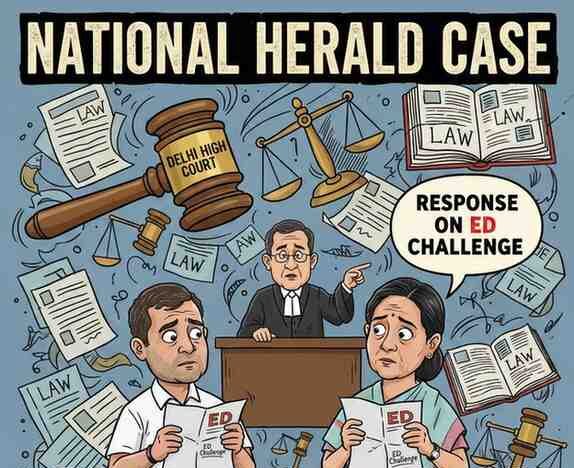
The Delhi High Court has ordered Sonia Gandhi, Rahul Gandhi, and others to file a reply to a petition by the Enforcement Directorate (ED) that is against the local court’s order in the National Herald money laundering case.
Introduction
The National Herald case, a long-standing judicial examination, came back into the spotlight when the Delhi High Court sent notices to Congress leaders Sonia Gandhi, Rahul Gandhi, and others. The ED has moved an application in opposition to an order passed by the trial court, which declined to take cognizance of the prosecution complaint under the PMLA, by that court.
It is a major question that the case becomes only of importance due to those political figures, but the case also poses a crucial legal question. Can the ED start a money laundering investigation in the absence of a registered FIR for a scheduled offence?
What Prompted the Delhi High Court’s Intervention?
Justice Ravinder Dudeja of the Delhi High Court issued notices to the Gandhis and the other accused. The notice pertains to:
- The ED’s main petition challenging the trial court’s order
- The agency’s interim plea seeking a stay on the December 16 order
The High Court’s move doesn’t imply guilt or innocence but indicates that the trial court’s legal reasoning warrants deeper judicial scrutiny.
Trial Court’s Key Findings: Why Cognisance Was Refused
The controversy stems from the December 16 order, in which the trial court declined to take cognizance of the ED’s complaint. Key takeaways include
- No FIR for a Scheduled Offence
- Under the PMLA, a “scheduled offence” must form the basis for money laundering proceedings.
- The ED’s case lacked an FIR.
- The CBI never formally registered the alleged scheduled offence.
- Therefore, the prosecution’s complaint was deemed “impermissible in law.”
- Investigation Based on a Private Complaint
- The case was initially brought about by a private complaint made by BJP leader Subramanian Swamy and not an FIR by the police. Although a summons was served in 2014, the CBI has not registered any FIR regarding the alleged offence.
- Legal Flaw Overrides Merits
- The court decided that since the case had a fundamental legal defect, the arguments regarding the allegations’ merits were unnecessary.
ED’s Stand Before the High Court
Represented by Solicitor General Tushar Mehta, the ED argued that:
- Its probe and prosecution under the PMLA are legally valid.
- The absence of an FIR shouldn’t automatically invalidate its proceedings.
- The trial court’s interpretation could have serious implications for future money laundering investigations.
The ED also sought a stay on the order, warning that allowing it to stand could set a problematic precedent for enforcement actions nationwide.
Who Represented the Gandhis?
Senior advocates Abhishek Singhvi and R.S. Cheema represented Sonia Gandhi, Rahul Gandhi, and other accused individuals. They contended that:
- PMLA proceedings cannot exist in isolation.
- Without a scheduled offence registered through an FIR, the ED has no jurisdiction.
Their stance is closely aligned with the trial court’s reasoning.
Background of the National Herald Case
The Allegations:
The ED has accused Sonia Gandhi, Rahul Gandhi, the late Congress leaders Motilal Vora and Oscar Fernandes, Suman Dubey, Sam Pitroda, and a private company—Young Indian—of criminal conspiracy and money laundering.
The Core Allegation:
According to the ED:
- Properties worth ₹2,000 crore belonging to Associated Journals Limited (AJL), the publisher of National Herald, were allegedly acquired illegally.
- Young Indian, where Sonia and Rahul Gandhi allegedly held 76% shares, gained control of AJL by converting a ₹90 crore loan into equity—allegedly “fraudulently” acquiring the company’s assets.
Why This Case Matters Legally
Interpretation of the PMLA
The main issue is if it is necessary to have an FIR as the first step of the money laundering investigation.
An intervention supporting the Enforcement Directorate (ED) may open the way for the investigation, while the decision to uphold the lower court’s order may limit the application of the PMLA.
Influence on the Next Investigations
The condition of the trial court’s order will imply that the ED investigations have to be more closely coordinated with the police and CBI.
In such situations, procedural errors may be used as excuses to put an end to the cases that attract public attention, even before the actual investigation has begun.
Political and Constitutional Implications
Given the involvement of senior opposition leaders, the case has major political significance and implications for the balance between investigative agencies and citizens’ rights.
What Happens Next?
The Delhi High Court has directed the Gandhis and other accused to respond to the ED’s plea. After hearing both sides, the court will decide:
- Whether the trial court’s order should be stayed
- Whether the ED’s complaint can proceed
- How the PMLA should be interpreted in such scenarios
Given its complexity, the matter is expected to undergo extensive hearings.
Frequently Asked Questions on National Herald Case
What is the National Herald case about?
It concerns allegations that Congress leaders and Young Indian illegally acquired assets worth around ₹2,000 crore belonging to Associated Journals Limited, publisher of National Herald.
Why did the trial court reject the ED’s chargesheet?
Because it wasn’t based on an FIR for a scheduled offence under the PMLA.
What is the ED challenging in the Delhi High Court?
The ED is contesting the trial court’s refusal to take cognizance of its complaint and is seeking a stay on that order.
Conclusion
The Delhi High Court demanding a response from Sonia Gandhi, Rahul Gandhi, and others is a significant development in the National Herald case. More than just political stories, it’s about a crucial legal issue that may change the way money laundering laws are used—and possibly misused—in the country. The repercussions will be felt by investigating agencies as well as within the broader interpretation of the PMLA.