
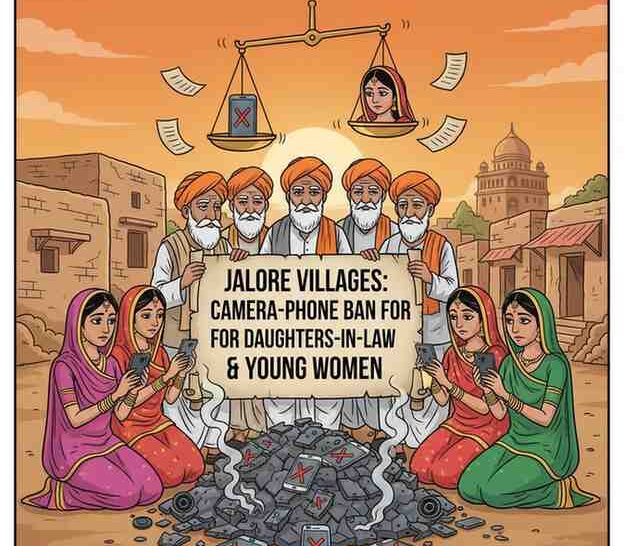
The Jalore villages of Rajasthan ban smartphones with cameras for daughters-in-law and young women from January 26. The community-enforced ban on smartphones with cameras for daughters-in-law and young women raises questions over constitutional rights, gender discrimination, and digital freedom in India.
Rajasthan Community Smartphone Ban: Full Story
In January, a cluster of villages in the Jalore district of Rajasthan made headlines when they banned smartphones with cameras for daughters-in-law and young women. The ban, which reportedly will take effect on Jan. 26, covers only women and not men, provoking immediate outrage across the country along with legal debates and social media backlash.
It was decided in a “community” meeting (‘khap-style gathering’), and it does not have any backing from a formal government order or law. However, the social enforcement of this rule has raised serious questions about women’s rights, constitutional freedoms, and the rule of law in India.
What Is the Smartphone Ban, Exactly?
According to local reports:
- Smartphones with cameras, especially for newly married daughters-in-law, are prohibited.
- Simple phones without cameras are permitted.
- The rule is not legally written but enforced through community pressure and social stigma.
The stated reasons include:
- Preventing “misuse” of social media
- Protecting “family honor.”
- Avoiding online relationships or elopements
Critics argue these reasons stem from patriarchal control rather than public welfare.
Why Has This Ban Set Off a Viral Debate Across India?
The issue has gained traction because it touches several sensitive areas:
- Gender discrimination
- Digital freedom
- Women’s autonomy
- Constitutional legality
- Rural vs urban value clashes
Hashtags condemning the ban have trended on social media, while lawyers, activists, and politicians have questioned how a private community can override fundamental rights.
Is the Smartphone Ban Legal?
Short Answer: No.
The ban has no legal standing under Indian law.
Key Constitutional Violations:
- Article 14 – Right to Equality: The rule applies only to women, making it discriminatory.
- Article 19(1)(a) – Freedom of Speech and Expression: Smartphones are modern communication tools. Restricting access curbs free expression.
- Article 21 – Right to Life and Personal Liberty: The Supreme Court has repeatedly emphasized that personal autonomy and dignity fall under Article 21.
- Right to Privacy (Puttaswamy Judgment): Denying digital access intrudes upon private decision-making.
Community groups cannot curtail constitutional rights, even under the guise of social consent.
Can Such Community Rules Be Punished?
Yes, if imposed through coercion.
Possible legal consequences include:
- Criminal intimidation (IPC/BNS provisions)
- Unlawful assembly
- Violation of women’s rights laws
- Police action under preventive laws
- Human rights commission intervention
If a woman is threatened, fined, or socially boycotted for defying the ban, those responsible may face criminal prosecution.
Impact on Women and Society
Digital Exclusion
Smartphones are vital for:
- Banking and UPI
- Accessing government schemes
- Education
- Emergency communication
Banning them isolates women digitally and economically.
Reinforcement of Patriarchy
The ban:
- Treats women as potential wrongdoers
- Assumes constant surveillance is needed
- Normalizes control over women’s choices
A Dangerous Precedent
If unchecked, similar informal restrictions could spread to:
- Education
- Employment
- Mobility
- Voting choices
Government and Legal Response
While no official law supports this ban:
- Legal experts have said it’s unenforceable.
- Women’s rights groups are urging state action.
- Police have clarified there’s no legal validity.
- Authorities may intervene if formal complaints are lodged.
Why This Case Matters Nationally
This issue reflects India’s broader struggle between
- Tradition vs Constitution
- Community control vs. individual rights
- Moral policing vs. rule of law
The Supreme Court has consistently held that social morality cannot override constitutional morality.
FAQs: Rajasthan Smartphone Ban in Jalore Villages
Is this an official government order?
No. It’s a community decision with no legal authority.
Can villages legally ban smartphones for women?
No. Only laws made by Parliament or state legislatures can impose restrictions, and even those must comply with the Constitution.
Can women challenge this ban?
Yes. They can approach:
Local police
District administration
State Women’s Commission
The High Court under writ jurisdiction
Does this ban violate fundamental rights?
Yes. It infringes Articles 14, 19, and 21 of the Constitution.
Conclusion
The Rajasthan smartphone ban controversy isn’t just about mobile phones—it’s about women’s freedom in a digital age. While communities may claim cultural reasoning, the Constitution does not permit gender-based restrictions imposed through social or moral pressure.