
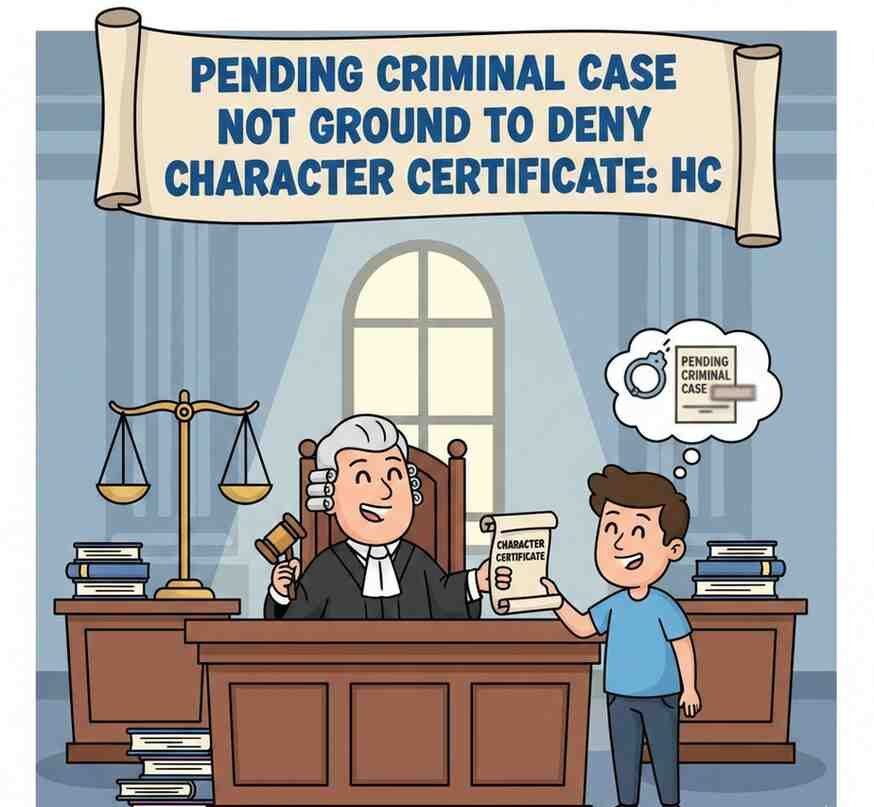
The Punjab & Haryana High Court ruled that a character certificate cannot be denied merely due to a pending criminal case, reaffirming the presumption of innocence.
In a major setback to the police, which had refused a character certificate to one of its personnel because a criminal case was pending against him, the Punjab and Haryana High Court has held that such a refusal amounts to a denial of an individual’s rights. The Court settled once and for all that pending cases are not the equivalent of guilt, and administrative authorities must accord the presumption of innocence (which is a fundamental principle under criminal law) its due significance.
Detailed Explanation of the Judgement
What Is a Character Certificate?
A character certificate is an official document typically issued by police or local administration. It is commonly required for:
- Government and private jobs
- Passport or visa applications
- Educational admissions
- Police or defence recruitment
- Verification for contracts or licenses
The certificate, in most cases, tells the extent of any criminal history a person may have.
The Issue For the Court
Officials were hesitant to provide character certificates due to:
- An FIR had also been lodged, or
- A criminal trial was waiting to open
The affected individuals argued that:
- They had not been convicted.
- The case was pending in investigation or trial, and
- The denial of the certificate was doing them harm by way of their ability to earn a living and hope for future employment.
High Court’s Key Observations
The Punjab & Haryana High Court has laid down the following key points:
Presumption of Innocence
The Court reaffirmed that:
- All individuals are considered innocent until proven guilty in a court of law.
- A pending criminal case doesn’t mean someone is guilty, and officials can’t treat that person like he or she has already been convicted.
Administrative Authorities Have Limited Powers
The Court held that:
- A police or administrative officer cannot go beyond his prescribed duty of judging what is moral and what is legal.
- They are in large part concerned with facts and do not weigh either a person’s character or guilt.
Distinction Between “Disclosure” and “Denial”
The ruling makes a key distinction:
- For those journalists who are writing stories, authorities may say a case is pending (if the rules allow).
- But they cannot reject the certificate altogether simply on that ground.
Impact on Fundamental Rights
The Court gave great weight to the deprivation of a character certificate, which was wrong:
- Right to livelihood (Article 21)
- Right to equality (Article 14)
This denial can serve to inhibit one’s employment, education, and ability to travel, causing unnecessary harm without a legal basis.
How the Court Ultimately Ruled
- You can’t refuse to sign a character certificate just because someone has a criminal case against them.
- A response must support a conviction, not an accusation.
- Any administrative action must be fair, reasonable, and within the law
Why This Judgment Is Important
Protects Ordinary Citizens
A lot of people are accused in false cases or of minor offences. This decision ensures that they will have to suffer the disadvantage of losing before having been presumed guilty in a court.
Helps Combat Lack of Police Discretion
The verdict checks arbitrariness and helps maintain consistency in administrative behavior.
Reinforces Constitutional Values
It reinforces the values of justice, dignity, and due process.
Useful to Job Seekers & Students
Those seeking government jobs, passports, or admissions are among the beneficiaries of this clarity.
Conclusion
The decision by the Punjab & Haryana High Court is a historic reassertion of justice and constitutional morality. It is intended to make sure that mere accusations do not serve as substitutes for proof and people are not punished by the bureaucrats before the courts pass judgment. In upholding the right to obtain character certificates, the judgment secures dignity, opportunity, and justice for millions of citizens.
Frequently Asked Questions (FAQs) Character Certificate and Pending Criminal Cases
Can police refer to a pending case in the certificate?
Yes. If the law permits, authorities can supply accurate information about a case that is ongoing but cannot refuse to issue it merely because of that.
Does this ruling extend to a conviction?
No. The ruling only affects pending cases. If there has been a conviction, the state can refuse or give no certificate within the law.
What about if the pending case is heinous (like murder or terrorism)?
The Court did not establish a per se exception in cases of grave crime. But individual statutory rules for some sensitive jobs (such as defence or intelligence work) could still be relevant.
Does this ruling apply to all of India?
This judgement is applicable to Punjab & Haryana only. Yet, the judgement is highly persuasive, and it can be relied upon by HC’s and authorities all over India.