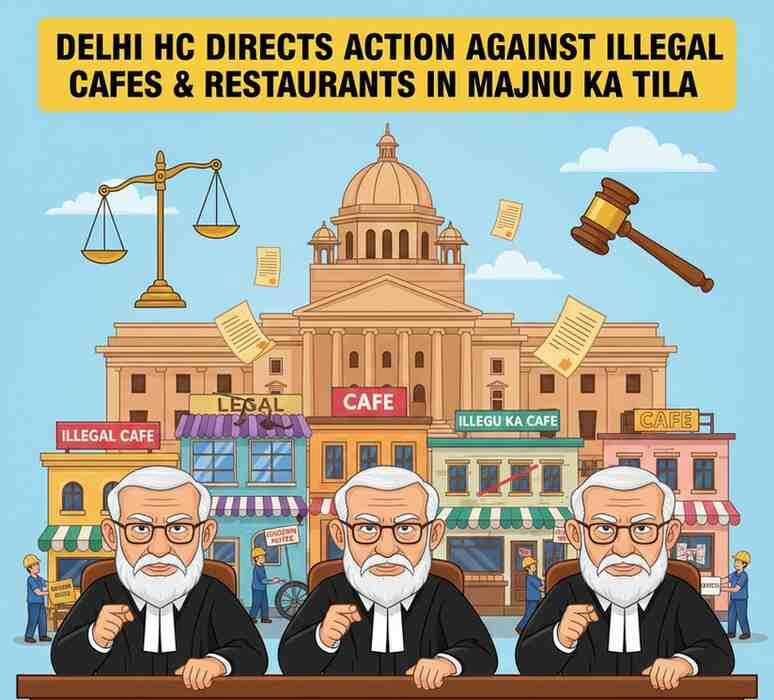
Delhi HC directs statutory authorities to take action against unauthorized cafes and restaurants operating in Majnu Ka Tila for infringement of building bye-laws, fire safety norms, and zoning regulations. A legal analysis of the order, related laws, and their broader implications.
Introduction
The Delhi High Court has given a clear message to municipal and planning authorities, asking them to start demolition activity against unauthorized cafes, bars, and restaurants running in the Majnu ka Tila area in North Delhi. The Court’s intervention itself is evidence of grave concerns on the facets of public safety, unauthorized constructions, and state failure in implementing laws.
The order was issued on a PIL that complained of rampant breach of building laws, fire safety rules, and land use by commercial establishments in the area.
Background of the Case
“Majnu Ka Tila has now developed into a high-density commercial area and has become a major hub for students, tourists, and residents. Over time, many eateries have emerged in residential or unauthorized buildings that lack even the basic approvals required by law.”
The petitioner came to the High Court with a case that:
- Buildings were being used commercially without consent
- Buildings were constructed above the allowable height
- Fire rules and evacuation norms flouted
- There was an absence of timely enforcement efforts by the authorities
Legal Issues Addressed by the Court
Illegal construction and misuse of premises
Under Indian urban planning legislation, commercial activity cannot be carried out without the sanction of the local authorities.
Relevant legal principles:
- Approved building plans must be followed
- Permission is required to turn residential property into commercial use
- Illegal dining in unauthorized top floors, basements, or terrace-restaurants is prohibited
Running eateries without such approval is considered illegal construction and misuse of property, inviting sealing or demolition action under the municipal laws.
Contravention of the National Building Code (NBC)
Safety norms have been prescribed in the National Building Code of India, which apply to all commercial buildings, namely.
- Adequate staircases and emergency exits
- Structural stability
- Ventilation and lighting
- Crowd management and accessibility
The bench said a large number of establishments did not meet even the basic safety norms, posing risks to lives.
Non-Compliance with Fire Safety Laws
Businesses open to the public must have Fire Safety Clearance and maintain:
- Fire extinguishers
- Alarm systems
- Clear evacuation routes
- Periodic safety inspections
Not having these protections in place is against fire safety law and can leave owners open to criminal prosecution and financial charges if an accident occurs.
Zoning and Environmental Concerns
Majnu Ka Tila is located near the Yamuna River floodplain, which has stringent land usage and environmental regulations.
Unauthorized commercial use in such areas:
- Disrupts urban planning
- Violates zoning regulations
- Increases ecological and disaster risks
The Court stated that economic activity cannot override environmental and planning legislation.
Court’s Directions
- Although the High Court had not specifically ordered the closure of any particular institutions, it gave explicit and binding mandates:
- Complaints should be scrutinized by statutory authorities
- Illegal structures and activities must be dealt with under the law
- Fire safety and building norms need to be enforced
- Action should be taken promptly, preferably within a specified period
The onus of carrying out the enforcement squarely falls upon the DDA, MCD, and Fire Services.
Legal Significance of the Order
Reaffirmation of Rule of Law
The Court reiterated that commercial success does not legitimize illegality. Businesses must operate within the law.
Public Safety as a Constitutional Value
The judgment is in line with the judiciary’s consistent position that the right to life includes safety in public spaces.
Accountability of Authorities
The inaction of municipal bodies against violators could prompt judicial intervention and contempt proceedings.
Impact on Business Owners
Owners operating without approvals could face:
- Sealing of premises
- Demolition of illegal portions
- Cancellation of licenses
- Monetary penalties
- Potential criminal prosecution in case of accidents
Establishments following the law are unaffected.
Conclusion
The order of the Delhi High Court in the Majnu Ka Tila case is a reminder that urban development must balance economic growth with legality, safety, and environmental integrity. The decision underscores that no business can operate outside the law, no matter how popular.
Frequently Asked Questions (FAQs) Delhi HC Order on Illegal Cafes in Majnu Ka Tila
How did the Delhi High Court come to interfere in Majnu Ka Tila?
The Bench stepped in after a PIL cited serious safety hazards due to unauthorized construction, lack of fire preparedness, and regulatory failure.
Is every cafe in Majnu Ka Tila illegal?
No. Only those operating without the necessary permits or violating building and safety codes face action.
Which laws govern such violations?
-Municipal and urban planning statutes
-National Building Code
-Fire safety legislation
– Zoning and land-use regulations
Is the High Court empowered to direct the immediate closure of eateries?
The Court generally orders authorities to act. Closure or sealing is conducted by statutory bodies under the law.