
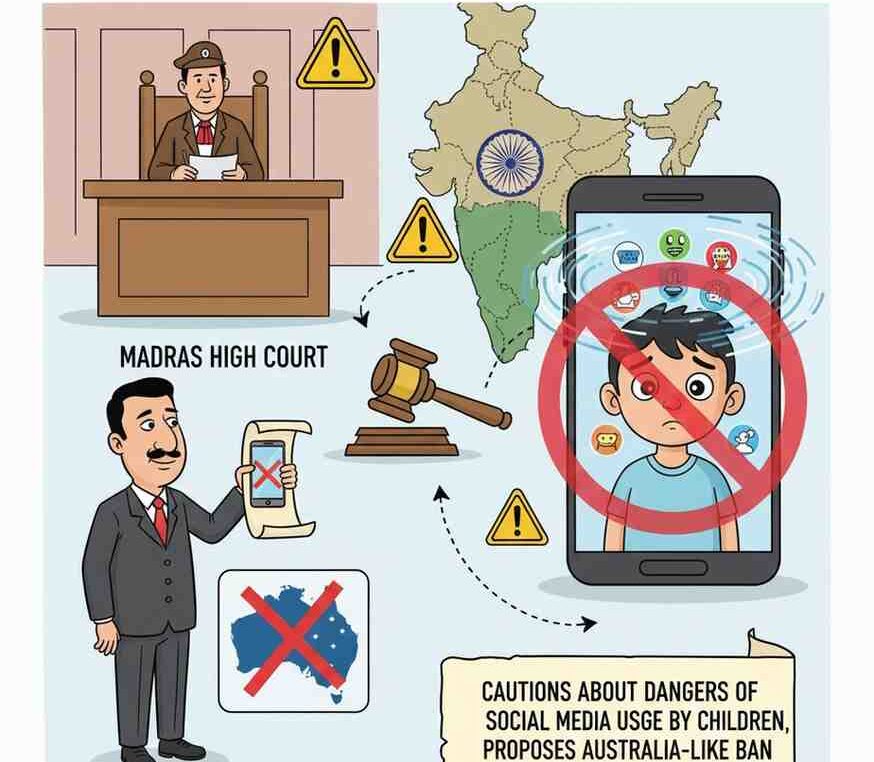
The Madras High Court on Wednesday expressed alarm at how even children are growing up with devices and, most likely, alone, and said we should consider introducing the Australian model of a blanket ban for persons below a certain age. While declining to issue any binding directions, the court raised legal, constitutional, and child-safety considerations.
Introduction
In a significant judicial observation underlining the rising worldwide alarm over children’s safety in cyberspace, the Madras High Court has said India can consider banning social networking sites completely for children, just like Australia. Though the court declined to issue binding orders, it raised major issues about online harm and psychological health and acknowledged regulatory gaps that affect minors.
The comments address the unchecked power of social media platforms when it comes to young users—an issue courts, lawmakers, and child-rights advocates have been struggling to reckon with.
Background of the Case
The note was written during the hearing of a case involving:
- Social Media and Its Effect on the Perception of Beauty by Adolescents and Children
- Growth in cases of cyberbullying, online addiction, inappropriate content exposure, and mental health concerns
- Lack of a complete statutory framework on the control of access by children to social media in India
Although the petition did not explicitly ask for a nationwide ban, it forced the court to look at practices abroad as well, including Australia’s regulatory regime.
What Did the Madras High Court Say?
The court:
- Raised concerns about children being able to use social media without restriction
- Observed that minors are susceptible to:
- Online exploitation
- Psychological manipulation
- Addiction and attention disorders
- Cited Australia’s ban or regulation of children from using social media as a potential model for India
- Emphasized that its statements were suggestive rather than mandatory, and left policy decisions to the legislative and executive branches
The court didn’t impose a ban and recognized the limits of judicial intervention in policy-making.
Legal Angle: Why the Court Could Not Pass a Binding Direction
Separation of Powers
Under the Indian constitutional framework:
- Courts interpret and enforce the law
- Policy formulation lies with Parliament and the Executive
The Madras High Court observed that:
- A social media ban for kids would involve complex policy considerations
- Such regulation requires statutory authority and cannot be issued as a judicial decree
Relevant Constitutional and Legal Framework
Article 21 – Protection of Life and Personal Liberty
The right to life includes mental health, dignity, and well-being.
The bench indicated that unregulated exposure to social media could negatively impact the mental health of children, engaging Article 21.
Article 19(1)(a) – Freedom of Speech and Expression
Any restriction on social media must satisfy:
- Reasonableness
- Proportionality
A blanket prohibition might violate freedom of speech unless backed by specific legal justification.
Parens Patriae Doctrine
The state is the guardian of children.
Courts have historically acted to protect minors when their welfare is at risk.
The court’s remarks align with this doctrine, urging the State to act proactively.
Current Indian Laws for Child Online Protection
India lacks a specific law banning children’s use of social media, but several laws are relevant:
- Information Technology Act, 2000—Deals with cyber offences but not minors’ access.
- IT Rules, 2021 (Intermediary Guidelines)—Mandates due diligence for platforms with limited child protections.
- Juvenile Justice (Care and Protection of Children) Act, 2015 – Focuses on physical and social safety, not digital harm.
- Digital Personal Data Protection Act, 2023 – Requires parental consent for processing minors’ data, signaling a move toward stronger regulation.
Why the Court Looked to Australia
Australia has been discussing and implementing:
- Age-based restrictions
- Mandatory parental consent
- Greater accountability for tech platforms
By referencing Australia, the Madras High Court highlighted the need for comparative analysis and encouraged Indian lawmakers to consider global best practices.
Implications of the Court’s Observations
1. Policy Push
- May influence government policy
- Could accelerate age-verification discussions
2. Platform Accountability
- Social media companies may face tighter scrutiny and compliance obligations.
3. Judicial Trend
- Reflects a growing trend of treating digital harm as a legal issue
- Expands child-rights jurisprudence into the online sphere
Conclusion
The Madras High Court’s suggestion of an Australia-style social media ban for children is a cautionary note rather than an order. It underscores the need for legislation that balances:
- Children’s safety and mental health
- Freedom of expression
- Technological innovation
While the judiciary may not impose such bans directly, its observations can inspire legislative change. The ruling represents a vital step in India’s evolving legal approach to raising children in a digital world.