
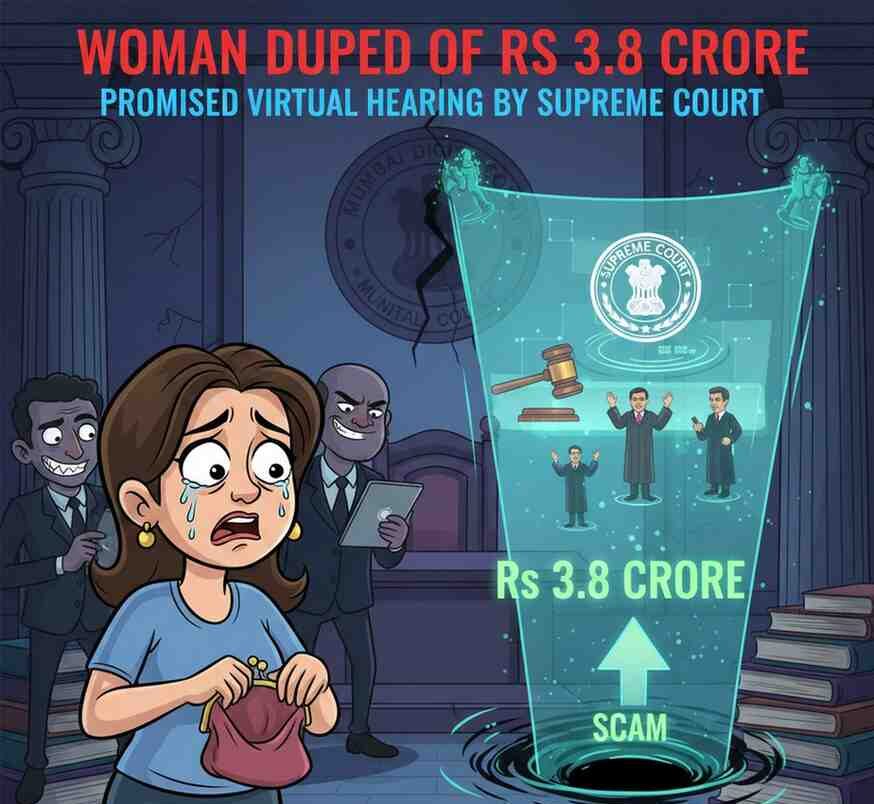
Mumbai Digital Court Scam: Woman Duped of Rs 3.8 Crore After Being Promised Virtual Hearing by Supreme Court: A woman in Mumbai lost ₹3.8 crore to a fake digital court racket where frauds posed as the Chief Justice of India during a virtual hearing. Please read the entire legal analysis, method of operation, relevant laws, and learn how to prevent it.
What Mumbai Digital Court Scam Is: How a Woman Lost ₹3.8 Crore in ‘Virtual’ Hearing
An appalling instance of cybercrime involving a bogus virtual court has emerged in Mumbai, where a woman was duped to the tune of ₹3.8 crore by fraudsters posing as top judiciary members, including the Chief Justice of India (CJI). The case has gone viral over its clever maneuvering and what is seen as a grotesque abuse of digital legal systems.
The case spotlights the rise of a fresh threat in cybercrime – fake online court appearances on India’s judicial Twitter handle.
What Happened in the Digital Court Scam?
The fraudsters contacted the victim, suggesting that she was involved in a serious legal matter, which may have been financially or criminally based. She said it was to be resolved through an online court hearing, part of a process that has become routine during the pandemic.
Key Elements of the Scam:
- Fake video conferencing court setup
- Individuals impersonating judges and court officials
- One impersonator stated that he was the Chief Justice of India
- Use of jargon, legalistic language, and intimidation
- Threat of immediate payment to “avert arrest or conviction.n”
The woman, under fear and mental torture, deposited nearly 3.8 cr in various bank accounts held by the scammers.
How the Scammers Pulled Off the Bogus Virtual Court Hearing
The perpetrators simulated a relatively realistic online court setting with the help of videoconferencing technologies. They:
- Used fake judicial backgrounds
- Dressed in suits like judges and lawyers
- Produced false court documents with judicial seals
- Claimed it was a private, secret session
A threat was made that if the victim did not comply, they would be immediately arrested, have their bank accounts frozen, or be publicly reported as criminals.
Why This Fraud Is Especially Perilous
This isn’t just a case of cyber fraud; this is an all-out assault on the integrity of the Indian judiciary.
Reasons It’s Alarming:
- The highest constitutional authority is being impersonated
- Abuse of digital courts established for public convenience
- Fear of law enforcement is used to psychologically manipulate victims
- Focusing on the white-collar and affluent market
Scam artists like these are more challenging to detect because most people don’t think twice about a court proceeding or a meeting with a judge.
Relevant Legal Provisions Under Indian Laws
The perpetrator (if identified) could be charged with:
- Indian Penal Code (IPC) / Bharatiya Nyaya Sanhita (BNS): Cheating, impersonation, forgery, criminal conspiracy
- Information Technology Act, 2000: Identity theft, online fraud, misuse of computer resources
- Additional Serious Offence: Pretending to be a constitutional officer, which courts consider an aggravating factor
What Real Courts in India Really Look Like Online
It is crucial to understand:
- Courts do NOT request direct payment of fees or fines
- Judges do not send unsolicited WhatsApp or Zoom links for “private hearings”
- No judge will sentence you over a video call
- Payments are made only on official court portals or challans
If anyone claims otherwise, it’s 100% a scam.
Protect Yourself From Digital Court Scams
Do’s:
- Double-check any legal notice with a real lawyer or court registry
- Monitor case status on official court websites
- Report to local police or cybercrime cells immediately
Don’ts:
- Don’t ever transfer money based on video calls
- Never give away Aadhaar, PAN, or bank details
- Don’t panic—courts don’t operate through fear
Government & Police Response
Cybercrime cells have warned people against fake digital arrest and virtual court scams. Enforcement agencies are tracking IP addresses, bank trails, and mule accounts used by fraudsters.
This case might lead to stricter authentication procedures for digital courts.
Conclusion
Mumbai’s digital court scam is a wake-up call for Indian citizens navigating a rapidly digitizing legal system. Though online courts bring efficiency, they also expose users to new forms of exploitation. Awareness, verification, and calm decision-making remain the best defenses against sophisticated cyber frauds.
FAQs: Internet Fraud in India
What is a digital court scam?
Fraudsters impersonate judges or court officials online to extort money under the guise of legal proceedings.
Are virtual courts a real thing in India?
Yes, but only through official court platforms under strict procedures.
What do I do if I get a fake court call?
Disconnect immediately, preserve evidence, and report it to the cybercrime helpline (1930) or cybercrime.gov.in.
Can any money be recovered in these scams?
Recovery depends on early reporting — the sooner you act, the better the chances of freezing fraudulent accounts.