The Supreme Court orders the status quo on the Delhi High Court order that granted bail to Kuldeep Singh Sengar in the Unnao rape case. POCSO Act details, court controversy, and legal issues explained: What is not considered a public servant, an explanation of the POCSO Act − Click to read more.
Introduction
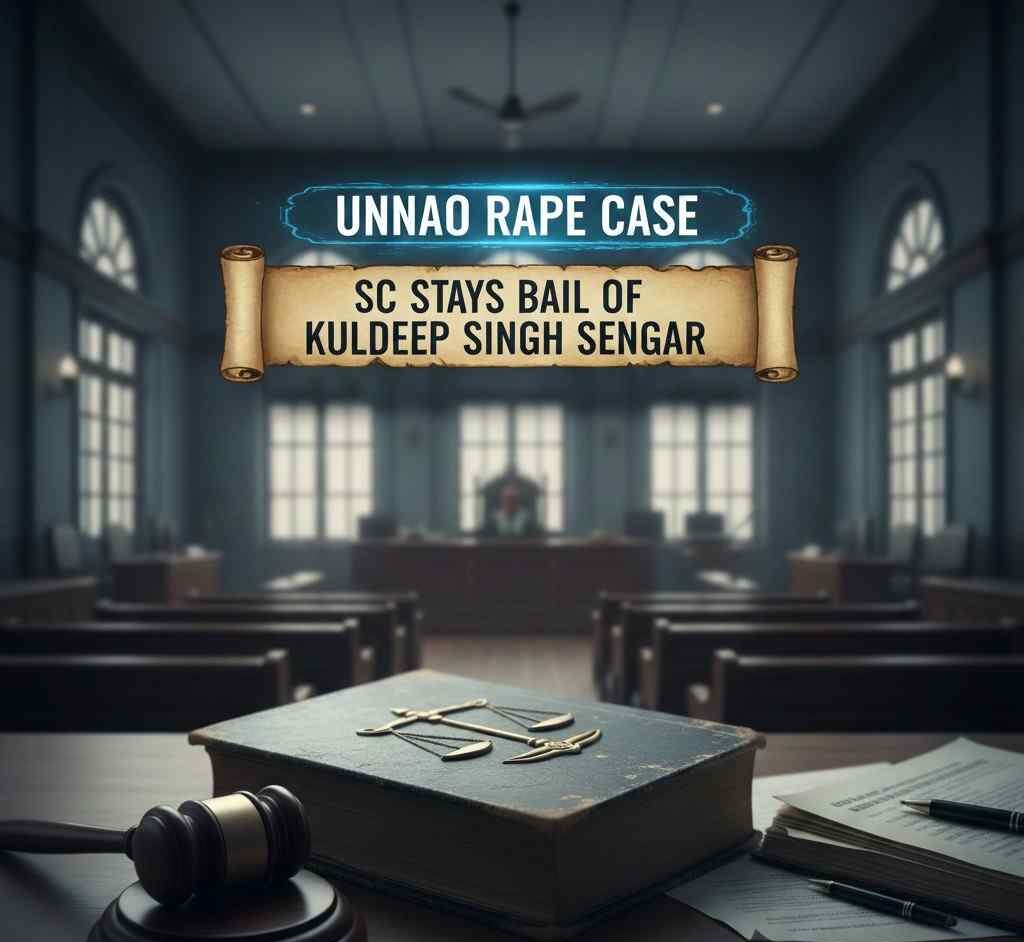
One of the most shocking and consequential criminal cases in recent Indian history, involving political power and sexual violence against a minor: The Unnao rape case saw a crucial legal development occur on 29th Dec 2025. The Supreme Court of India issued a notice to the Centre on pleas challenging certain amendments made in the SC/ST Act and stayed a Delhi High Court order that had suspended the sentence and granted bail to former BJP MLA Kuldeep Singh Sengar, prompting questions on how to interpret the POCSO Act and who should be called a “public servant.”
Background: Kuldeep Singh Sengar’s conviction
A former MLA from Uttar Pradesh, Kuldeep Singh Sengar, was convicted for kidnapping and raping a minor girl in 2017. The survivor was said to have been called to Sengar’s home on the pretext of a job.
Besides the rape case, Sengar is guilty of another case involving the custodial death of the survivor’s father, and that has had a profound impact on judicial scrutiny in all his bail hearings.
Delhi High Court Order: Bail (November 23, 2025)
Sengar’s sentence was suspended, and he was granted bail until November 2025 by the Delhi High Court. It was based on a technical reading of the POCSO Act, which is
The HC observed that the expression “public servant” as used under Section 5(c) of POCSO was not stipulated in the said enactment.
It was added to the definition of the Indian Penal Code (IPC).
The IPC definition does not specifically cover MLAs and MPs as public servants.
Accordingly, the court considered that Sengar should have been convicted under Section 3 (penetrative sexual assault) and not under Section 5(c) (aggravated penetrative sexual assault).
The High Court held that as the minimum punishment prescribed when Section 3 of the IPC was invoked in 2017 was seven years, and Sengar had already spent such a period behind jail bars, he was entitled to bail.
Supreme Court Intervention and Bail Stay
On December 29, 2025, a three-judge bench of the Supreme Court, led by Chief Justice of India Surya Kant, stayed the operation of the Delhi High Court’s order.
While the Supreme Court tries to stay away from any bail order, it said that Unnao is a case of “unique and exceptional circumstances,” having these facts:
- The seriousness of the crime
- The victim’s age (15 years)
- The custodial death of the survivor’s father, for which Sengar has been convicted
- The fact that Sengar could effectively not be behind bars at all if released on bail, even in one case
The Court found that those circumstances required immediate judicial action.
CBI’s submission: Justice for the victim
Opposing the bail, Solicitor General Tushar Mehta appeared for CBI. He emphasized that:
- The child survivor is the “client” of the state and the investigatory agency.
- Since Sengar was a powerful MLA, he had a position, existence, and influence.
- The object of the POCSO Act is to be universally applied, and it ought not to be interpreted in a pedantic manner.
CBI has submitted that a person who exercises control or dominance over a child should be regarded as falling in the category of an aggravated assault offender, regardless of whether an accused is declared to be a public servant under the IPC.
Critical Finding of the Supreme Court on “Public Servant”
An important part of the hearing was when the Chief Justice challenged the logic behind leaving out MLAs from the purview of “public servant” contained in POCSO.
The Court noted that a contrary approach would result in an incongruous and inequitable position, whereby:
- Aggravated assault carries a penalty of life imprisonment.
- But a well-connected MLA or MP could come out unscathed from harsher punishment under a narrow legal meaning.
This is evidence of the Court’s penchant for substance over form in child welfare legislation.
Defense Argument by Sengar’s Lawyers
Senior advocates appearing for Sengar had contended that:
- The POCSO Act specifically incorporates these definitions of IPC.
- As far as MLAs are concerned, since they do not come within the definition of ‘public servant’ under IPC, courts cannot stretch their meaning with retroactive effect.
- The offence took place before the 2019 amendment in the POCSO Act, providing for stringent punishment.
They have argued that the high court’s logic was legally unassailable and that the CBI should have made its contention at an earlier stage.
What Happens Next?
The Supreme Court has:
- Bail and suspension of sentence were maintained
- Directed to lodge Sengar in jail
- Set the next hearing for Jan. 20
The survivor is also entitled to free legal aid and cannot be left with just this—she has been granted the liberty to pursue her remedies in the apex court on her own.
Conclusion
The Supreme Court stepping into the Unnao rape case is a landmark moment in India’s legal warfare against sexual crimes, compounding power and political patronage. In staying the bail order and challenging a myopic reading of the POCSO Act, the Court has re-emphasized that justice for child survivors should not succumb to technicalities.
Why This Hearing Is Significant Legally
While this case may have lasting effects on:
- Interpretation of “public servant” in special enactments punishing criminal acts
- Treatment of politics as a dominance situation
- Bail Jurisprudence in Offenses Against Minors
- Strengthening survivor-centric justice under POCSO
Frequently Asked Questions (FAQs) Unnao Rape Case Supreme Court Hearing
Why did the Supreme Court cancel Kuldeep Sengar’s bail?
In view of several reasons—the seriousness of the crime, the age of the victim, Sengar’s clout, and his conviction in the related case about custodial death.
What is the legal question before this hearing?
Whether an MLA is a “public servant” within the meaning of Section 5(c) of the POCSO Act.
What’s the significance of the POCSO Act?
It imposes a higher penalty for sexual crimes against minors, particularly by those in authority.
When is the next hearing?
The Supreme Court has scheduled a hearing in the case for January 20.