
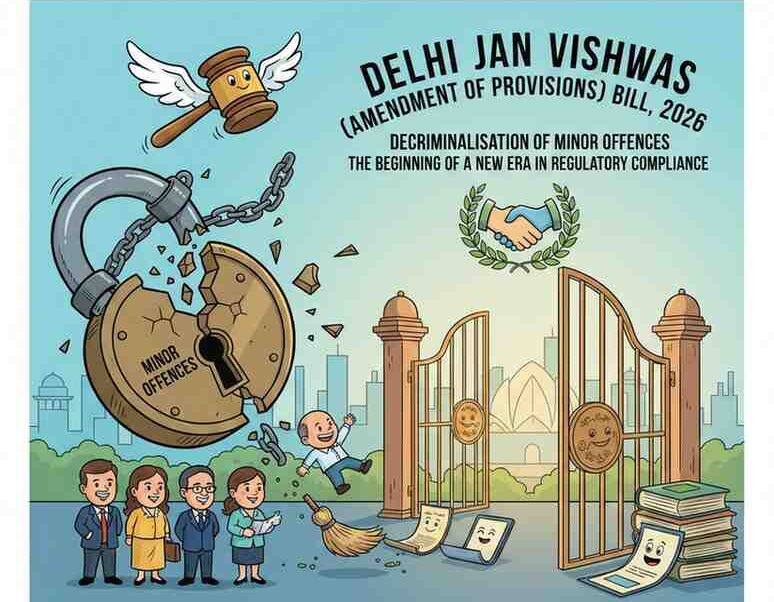
The Delhi Jan Vishwas (Amendment of Provisions) Bill, 2026, is a legislative initiative that seeks to eliminate criminal penalties associated with minor regulatory breaches and substitute them with civil fines. The article elucidates the bill’s intent, range, influence on business, and its significance in terms of the Constitution.
Introduction
The Delhi Jan Vishwas (Amendment of Provisions) Bill, 2026, is a legislative initiative that seeks to eliminate criminal penalties associated with minor regulatory breaches and substitute them with civil fines. The article elucidates the bill’s intent, range, influence on business, and significance in terms of the Constitution.
With the enactment of the Delhi Jan Vishwas (Amendment of Provisions) Bill, 2026, the Indian regulatory and criminal justice systems have undergone a substantial transformation. It is a significant move towards the wider agenda of enhancing the ease of doing business and bringing reforms to obsolete laws. The Bill detaches criminal penalties for small, technical, and procedural lapses in laws specific to Delhi and, instead, provides for the imposition of civil fines or administrative penalties.
India is aligning with an international trend of decriminalizing economic and regulatory laws, thereby relegating criminal prosecution to only those cases of serious offences such as fraud, causing harm to the public, or moral wrongdoing.
Background and Legislative Intent
In the past, many regulatory laws in India—especially those related to trade, labour, environment, and municipal administration—imposed criminal penalties for minor non-compliance, such as delays in filing documents or late renewal of licences.
These provisions caused:
- Overloaded courts
- Harassment of small businesses and entrepreneurs
- Fear of unnecessary prosecution
- Misuse of criminal law as a pressure tactic
The central Jan Vishwas framework aims to promote trust between the government and citizens. The Delhi Bill adopts this model for the capital’s local and municipal laws.
Key Objectives of the Bill
- Decriminalization of Minor Offences: Abolishing jail terms for small and technical mistakes.
- Shift from Criminal to Civil Liability: Changing criminal prosecution to monetary fines.
- Ease of Doing Business: Simplifying regulations by removing unnecessary compliance requirements.
- Judicial Efficiency: Saving the courts from minor, low-impact cases.
- Proportionate Punishment: Ensuring that penalties are just and correspond to the level of the offence.
Scope and Applicability
The bill amends various Delhi-specific laws covering:
- Municipal operations
- Trade and licensing
- Environmental and health compliance
- Labour welfare (procedural aspects)
- Building and urban development
It only targets minor, non-serious breaches. Serious crimes involving fraud, public safety, or deliberate misconduct will remain punishable under criminal law.
Legal Mechanisms Introduced
- Abolition of Imprisonment Clauses—Many offences earlier punishable with jail terms of up to a year will now only incur fines.
- Compounding of Offences—Allows violators to settle matters quickly by paying a fine without lengthy litigation.
- Adjudicating Authorities—Appointed officers will handle these cases for faster and more efficient outcomes.
- Graded Penalties – Penalties will vary depending on severity, duration, and whether it’s a repeat offence.
Legal and Constitutional Perspective
- Principle of Proportionality: The principle of proportionality is the one that guarantees that the sanction corresponds to the level of damage caused. Imprisoning individuals for petty mistakes is going against this principle and Article 14 (Right to Equality) as well.
- The right to liberty (Article 21) minimizes the number of arrests that are carried out without any necessity, and thus, personal freedom is safeguarded.
- Clear Division Between Criminal and Regulatory Wrongs: Differentiates deliberate crimes from mistakes in documentation, thus, being in harmony with modern international norms.
Impact on Businesses and Professionals
Positive Effects:
- Lower fear of prosecution
- Quicker dispute settlements
- Reduced legal costs
- Improved investor confidence
- Encouragement for startups and MSMEs
For Legal and Compliance Experts:
- Shift from criminal defence to advisory roles
- More focus on compliance audits and penalty reviews
- Increased participation in administrative adjudication
Safeguards and Limitations
To prevent misuse, the bill includes:
- Stricter penalties for repeat offenders
- Criminal punishment is retained for willful or fraudulent acts
- Mandatory adherence to natural justice
- Right to appeal penalty orders
This ensures a balance between leniency and accountability.
Comparison with the Central Jan Vishwas Act
| Aspect | Central Act | Delhi Bill 2026 |
|---|---|---|
| Jurisdiction | Central laws | Delhi-specific laws |
| Objective | Decriminalisation | Decriminalisation |
| Penalty Type | Civil fines | Civil fines |
| Court Burden | Reduced | Reduced |
The Delhi Bill complements national policy while maintaining strong enforcement standards.
Criticism and Concerns
Some critics caution that:
- Too much decriminalisation might reduce deterrence.
- Administrative discretion could lead to inconsistency.
- Regulatory authorities may need capacity-building.
These can be addressed with clear procedural rules, transparency, and judicial oversight.
Conclusion:
The Delhi Jan Vishwas (Amendment of Provisions) Bill, 2026, is a forward-looking reform that makes regulatory systems more efficient and business-friendly. It restores criminal law’s core purpose—punishing serious offenses—while encouraging voluntary compliance and mutual trust between the state and businesses.
This Bill stands for constitutional fairness, proportional justice, and practical governance, making Delhi a more progressive and investor-friendly region.
Frequently Asked Questions (FAQs) on the Delhi Jan Vishwas (Amendment of Provisions) Bill, 2026
What is the Delhi Jan Vishwas (Amendment of Provisions) Bill, 2026?
It’s a reform that replaces criminal penalties for minor regulatory breaches in Delhi with civil fines.
Does it remove all criminal offences?
No. Serious crimes involving fraud or public danger remain criminal
Will courts still handle these cases?
No. Decriminalised matters will be decided by adjudicating officers, not criminal courts.
