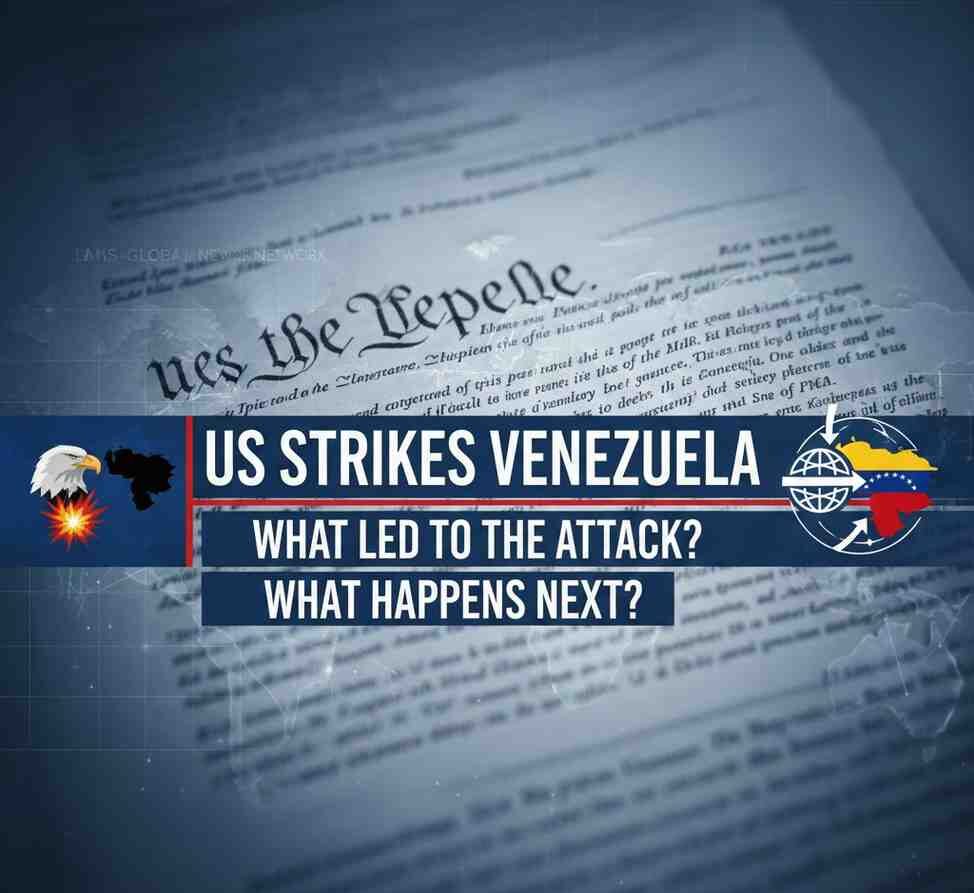
legality, why did the US strike Venezuela? Read a full breakdown of the attack, its legality, its impact on Venezuela, and what comes next for global politics.
Introduction
In early January 2026, the United States of America shocked and horrified the world with its dramatic and controversial military move against Venezuela. The strikes and the subsequent seizure of the Venezuelan president, Nicolás Maduro, had represented one of the most dramatic actions in U.S.–Latin America relations for decades. The operation quickly prompted a global debate on sovereignty, international law, regional stability, and even the fate of Venezuela itself.
This article is a thorough, concise explanation of the U.S. attacks on Venezuela. It recaps the timeline leading up to the attack, legal arguments for and against it, its effect inside Venezuela, and global implications for geopolitics and oil markets.
Background: Relations Between the US and Venezuela in the run-up to the Strikes
Tensions between the United States and Venezuela have been high for more than two decades. Venezuelan governments have charged Washington with meddling in the country since at least the early 2000s, and the U.S. has accused Venezuela of authoritarian rule, human rights abuses, and corruption.
Under President Nicolás Maduro, the strains worsened. The United States imposed sweeping sanctions against Venezuela’s oil industry, government officials, and financial system. American prosecutors also named Maduro and top officials in international drug-trafficking networks, claims that Caracas always rejected.
Towards the end of 2025, diplomatic contacts were minimal, sanctions were being tightened once more, and military tensions in the Caribbean area had shot up.
Timeline: The Sequence of Events Leading to the US Strikes
Long-Term Escalation (2020–2025)
- Nicolás Maduro and senior Venezuelan officials were officially charged in US courts for narco-terrorism and drug trafficking.
- Economic sanctions broadened, sharply limiting Venezuela’s access to international markets.
- US warships and aircraft patrolled the Caribbean as drug operations were ramped up.
- Venezuela deepened engagement with Russia, China, Iran, and Cuba, which made Washington even more uncomfortable.
Late 2025: Military Signals Increase
- American power was repositioned in the Caribbean and adjacent bases.
- There were alleged warnings to the Venezuelan leadership.
- Intelligence reports claimed Venezuelan territory, known for drug trafficking, posed a growing security threat.
January 2026: The Strikes
During the morning of January 3, 2026, US air and special operations strikes directly followed.
- Targets included military installations and air bases, as well as communications facilities near Caracas.
- President Nicolás Maduro and his wife were seized during the raid by US forces.
- They were brought to the United States and faced criminal charges.
Immediate Aftermath
- Explosions rang out in segments of Caracas, inducing fear and confusion.
- The Venezuelan government announced a state of emergency.
- International responses came quickly, just hours after the announcement—with condemnation combined with more cautious support.
Legal Analysis: Did the U.S. Strikes Violate International Law?
Under US Domestic Law
The US administration described the operation as a law-enforcement action, not a military war. By characterizing Maduro as a criminal suspect rather than a head of state, officials said, the use of military force was justified to carry out current indictments.
However, critics argue:
- Congress was neither formally consulted nor permitted to authorize the use of force.
- The War Powers Resolution may have been skirted.
- The use of military power to arrest a foreign leader is a perilous precedent.
- And there were some doubts about the strength and legality of the reasoning among constitutional scholars, who argue that it remains weak and contested under American law.
Under International Law
The US rationalization is even more dubious under international law.
Key points:
- The UN Charter bans the use of force against another sovereign member state except in self-defence or with Security Council authorization.
- Venezuela did not launch a military attack on the United States.
- No UN authorization was granted.
As a result, many international law experts contend that the strikes violated international law and could amount to an illegal use of force. A number of governments called the action a violation of Venezuelan sovereignty.
Impact on Venezuela: What Happens Inside Venezuela Now?
Political Power Vacuum
Remove President Maduro, and Venezuela is in the grip of a profound political crisis. There are rival claims to authority, such as
- Claims of acting leadership according to the constitutional order
- Opposition leaders seeking international recognition
- Military commanders asserting regional control
This fragmentation risks prolonged instability.
Military and Security Situation
The Venezuelan military is split between the two. Although some units are still loyal to allies of Maduro, others could side with the interim leadership or even defect and operate on their own. This raises concerns about:
- Internal conflict
- Armed clashes between factions
- Rising power of non-state, armed groups
Security analysts say a divided armed forces would bring greater instability to an already precarious Lebanon.
Economic Consequences
Venezuela’s economy was in tatters even before the strikes. The immediate effects include
- Damage to oil production and exports
- Currency instability
- Capital flight and investor uncertainty
Independent of this, political stability, sanctions policy, and international support will determine the long-term recovery.
Global Proportions: Why It’s Bigger Than Venezuela
Impact on Latin America
Many Latin American countries responded with alarm or censure, with dire predictions of the resurgence of direct military meddling in the region. The strikes have
- Resurfaced memories of Cold War interventions
- Growing distrust of the US abroad
- Driven some governments closer to competing with global powers
Oil Markets and Energy Security
Venezuela is home to one of the largest proven oil reserves on earth. The situation creates uncertainty:
- Oil prices could rise in the short term because of geopolitical risk
- Production over a longer period could be higher if political stability returns
Energy markets are sensitive to an escalation.
Conclusion
The US attacks on Venezuela have changed the game for modern geopolitics. Whatever the perspective of one or another faction—as a law enforcement action or an illegal intervention—both new and old have recast Venezuela’s future and introduced once more troubling questions about international legal norms, sovereignty, and even global stability. In the months ahead, we shall see whether this moment will produce reform, chaos, or a new geopolitical order.
Frequently Asked Questions (FAQ): US Strikes on Venezuela
What were the US strikes on Venezuela?
The US strikes on Venezuela were a military operation carried out in January 2026 in which American forces targeted Venezuelan military infrastructure and captured President Nicolás Maduro. The US government described the action as part of a law-enforcement effort tied to drug trafficking charges, while critics viewed it as a military intervention.
Why did the United States attack Venezuela?
The United States stated that the strikes were necessary to combat international drug trafficking networks and enforce long-standing criminal indictments against Venezuelan leadership. Opponents argue the real reasons include political pressure, regional influence, and regime change objectives.
What will this do to oil prices?
The markets could remain under pressure depending on the degree of uncertainty over Venezuelan production and regional stability.
Was the US action legal under international law?
Most international law experts say the strikes were not legal under international law because they lacked United Nations approval and were not justified by self-defense. The UN Charter generally prohibits military force against a sovereign nation without clear authorization.
Who is governing Venezuela now?
Venezuela is facing a political power vacuum. Various factions, including interim leaders, opposition figures, and military commanders, are asserting authority. No single leadership structure has yet gained universal recognition.