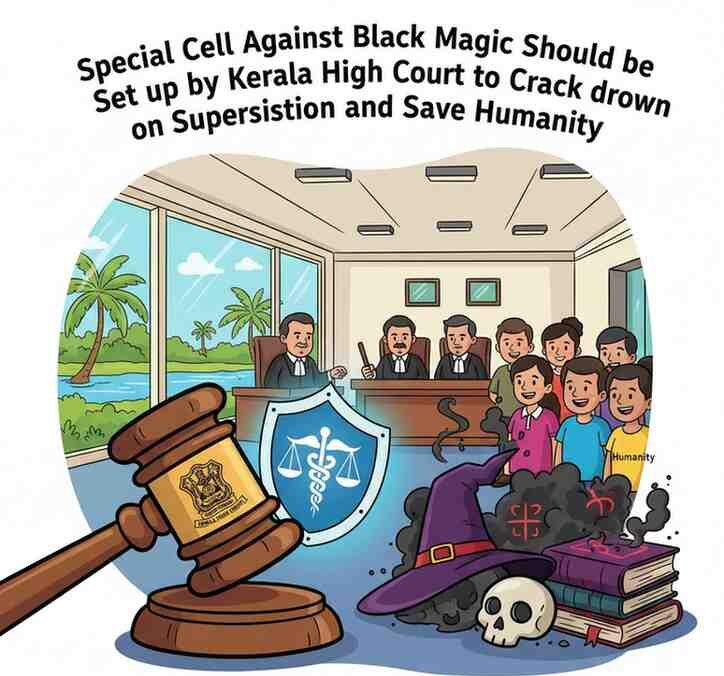
The Kerala HC has proposed forming a special cell against black magic, witchcraft, and superstitious practices.
Introduction
In a major order, the Kerala High Court has recommended forming an exclusive special cell to handle grievances related to black magic, witchcraft, and other superstition-based practices. This move comes amid rising concerns about crimes carried out in the name of superstition—from physical abuse and social exclusion to human sacrifice and murder.
Although Kerala is known for its literacy and progressive values, such incidents tied to blind beliefs persist. The court’s intervention highlights a broader constitutional issue: balancing freedom of belief with the protection of life, dignity, and rationality.
This article outlines the background, the court’s observations, legal gaps, the proposed cell’s purpose, and its social and legal implications.
Background of the Kerala High Court’s Observation
The suggestion arose during hearings of petitions related to crimes involving black magic and witchcraft. Kerala has witnessed violent acts, often targeting women, children, and marginalized groups, due to witchcraft accusations.
The court noted:
- Current laws act reactively, not preventively.
- Investigating such crimes requires specialized expertise.
- Police often lack the training to recognize and record superstition-motivated offenses.
To address these issues, the court proposed a special institutional mechanism.
Black Magic and Witchcraft in Legal Context
India lacks a central law defining black magic and witchcraft. Generally, these refer to practices claiming supernatural powers to:
- Control people or events
- Treat illnesses through rituals rather than medicine
- Harm others using occult means
- Justify exploitation or violence
Legally, belief isn’t criminal, but harmful acts in its name are—such as assault, murder, sexual abuse, fraud, or social humiliation. The court stressed that while belief itself isn’t punishable, violating fundamental rights is.
Why a Special Cell?
- Complex Crimes: These are often hidden, justified through faith, and underreported due to stigma. A specialized cell can handle such sensitive cases.
- No Specific Law in Kerala: Unlike Maharashtra and Karnataka, Kerala lacks a dedicated anti-superstition law. General laws punish outcomes but not the root causes.
- Preventive Action: The cell could track patterns, monitor self-proclaimed godmen, and act before violence occurs.
- Protection of Vulnerable Groups: Women, elderly people, and tribal communities are often victims. A focused approach ensures justice and rehabilitation.
Functions of the Special Cell
- Investigation: Handle black magic-related FIRs with help from psychologists and forensic experts.
- Monitoring: Keep records of repeat offenders and groups exploiting superstition.
- Awareness: Promote scientific thinking and conduct rural outreach programs.
- Legislative Support: Provide insights to lawmakers drafting related laws.
Toward a New Law
A legislative committee is reviewing the need for an anti-superstition law in Kerala. It may include:
- Definitions of banned practices
- Penalties for exploitation
- Protection for genuine religious practices
- Support for victims
Any new law must uphold Articles 25 and 26 (religious freedom) while ensuring Article 21 (life and dignity) is not violated.
Faith vs. Fundamental Rights
The court reaffirmed that religious freedom isn’t absolute—practices harming health, morality, or public order can be restricted. Article 51A(h) of the Constitution promotes scientific temper. The special cell aligns with this duty by protecting citizens and promoting rational thinking.
Comparison with Other States
Maharashtra, Karnataka, and Odisha already have laws against superstition. Kerala may soon follow, tailoring its law to local needs.
Impact on Society and Law Enforcement
Positive: Faster investigations, deterrence, greater public trust.
Challenges: Risk of misuse, need for training, and ensuring religious freedom remains intact.
Conclusion
The Kerala High Court’s proposal to form a special cell against black magic marks a crucial step in tackling superstition through institutional reform. It bridges legal gaps and encourages both preventive policing and rational awareness. The state now faces an opportunity to strengthen human rights and constitutional values without suppressing genuine faith.
Frequently Asked Questions (FAQs): Kerala High Court and the Proposed Special Cell Against Black Magic
What did the Kerala High Court suggest regarding black magic?
The Kerala High Court suggested the creation of a dedicated special cell to deal with crimes related to black magic, witchcraft, and harmful superstitious practices. The recommendation aims to improve investigation, prevention, and victim protection in cases where superstition leads to exploitation or violence.
Why did the Kerala High Court feel a special cell was necessary?
The court observed that crimes linked to witchcraft and superstition are often complex, hidden within communities, and difficult to investigate using ordinary policing methods. A special cell would allow trained officers to handle such cases with greater sensitivity, expertise, and preventive focus.
What role will the proposed special cell play?
The special cell may:
-Investigate superstition-related crimes
-Monitor repeat offenders and exploitative practitioners
-Coordinate with experts like psychologists and forensic teams
-Support victims and promote awareness
-Assist lawmakers with data for future legislation.