
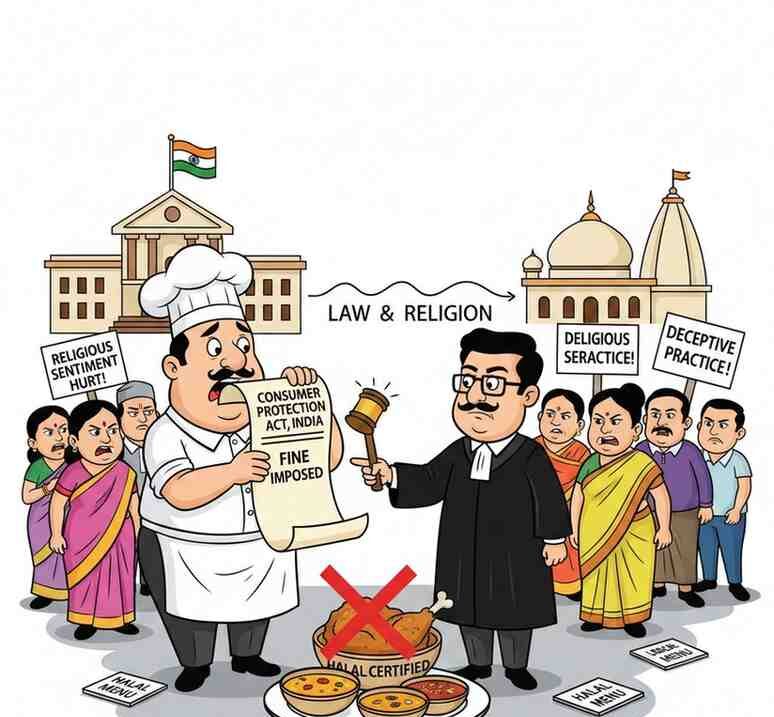
A report on the consumer law precedents where a hotel was penalized for serving non-veg food to a veg customer that offended religious equations.
Introduction
The consumer laws in India have been enacted to safeguard consumers from unscrupulous trade practices, inferior products, and substandard services. In a recent, much-discussed case, a consumer disputes redressal commission penalized a restaurant for serving non-vegetarian food to a customer who had ordered vegetarian food, invoking “hurt religious sentiments” and “deficiency in service.”
The case has sparked a national debate about where consumer rights, religious beliefs, and service responsibilities intersect—particularly in the Indian subcontinent, where dietary preferences are often linked to faith.
Background of the Case
The complainant had specifically asked for vegetarian food. But the served dish had a non-vegetarian substance in it, which he consumed without knowing. Realizing his gaffe later, the customer lodged a complaint with the Consumer Disputes Redressal Commission:
- Violation of consumer trust
- Deficiency in service
- Hurt religious sentiments
The forum directed the hotel to pay the amount along with a fine.
Legal Issues Involved
Consumer Law: Failure/Defect in Service
According to the Consumer Protection Act, 2019, “deficiency” is defined as any fault, imperfection, or shortcoming in the quality, nature, or manner of performance that is required to be maintained by a law in force or has been under a contract.
Bringing out something you didn’t order obviously fits into the latter category.
Consumer Rights Violated
The following rights were affected:
- Right to know: The customer was not informed of what they were really eating.
- Right to Safety: Religious and moral safety were offended.
- Right of choice: The freedom of the consumer to choose was denied.
Religious Sentiments and Food Practice
In India, dietary habits are often guided by religion, culture, and personal belief. Courts and consumer forums have repeatedly acknowledged that food contamination involving religious beliefs can cause mental agony, even if there is no physical harm.
The forum recognized that serving non-veg food to a person who avoids it for religious reasons amounts to serious emotional and spiritual harm.
Why the Restaurant Is Liable
The restaurant is to blame for this because:
- The order was explicitly vegetarian.
- Food was prepared or served under unsanitary conditions.
- Restaurants are held to a standard of care for their guests.
- There wasn’t enough in the way of an apology to make it right for the spiritual and emotional harm done.
The ruling underscored that businesses should show respect for religious feelings, particularly in the food industry.
Compensation and Penalty
The restaurant was ordered to:
- Pay the complainant monetary compensation.
- Cover litigation costs.
- Face reputational consequences.
The damages were for mental distress and infringement of religious beliefs—a crucial legal precedent.
Legal Significance of the Case
Includes Consumer Protections
The case extends the definition of consumer harm to include emotional, cultural, and religious injury—rather than just physical or financial harm.
Sets Accountability Standards for Restaurants
Restaurants must now ensure:
- Clear food labeling
- Separate cooking utensils where required
- Proper staff training
- Strict order verification
Reinforces Faith Sensitivity in Commerce
The decision is thus another testament to the principle that business as usual must be consistent with constitutional values of religious freedom and human dignity.
Effects on the Food & Hospitality Sector
The ruling is a reminder to serve:
- Restaurants
- Cafes
- Food delivery platforms
- Cloud kitchens
Businesses will have to implement strict quality controls and disclosures, or they risk defending lawsuits under consumer protection laws.
Conclusion
This case has become symbolic of the evolution of Indian consumer law, beyond conventional ideas of loss and damage. It now recognizes that faith and belief are part of consumer dignity.
By holding the restaurant responsible for religious insensitivity, the forum empowered consumers and reminded everyone of the duty to ethical, respectful business practices. This precedent-setting ruling is likely to become a touchstone for future cases involving food, faith, and consumer rights.
Frequently Asked Questions (FAQs) on Consumer Law & Religious Sentiments
Is serving incorrect food a crime in the country?
Yes. Serving food that is not ordered is a “deficiency in service” under the Consumer Protection Act, 2019.
Can a consumer demand damages for injured religious feelings?
Yes. Indian consumer courts even set a precedent for mental agony and emotional harm—including religious hurt—as grounds for compensation.
What steps can restaurants take to minimize liability?
They should:
-Mark food as veg and non-veg clearly.
-Train staff properly.
– Maintain separate cooking areas.
-Verify orders before serving.