
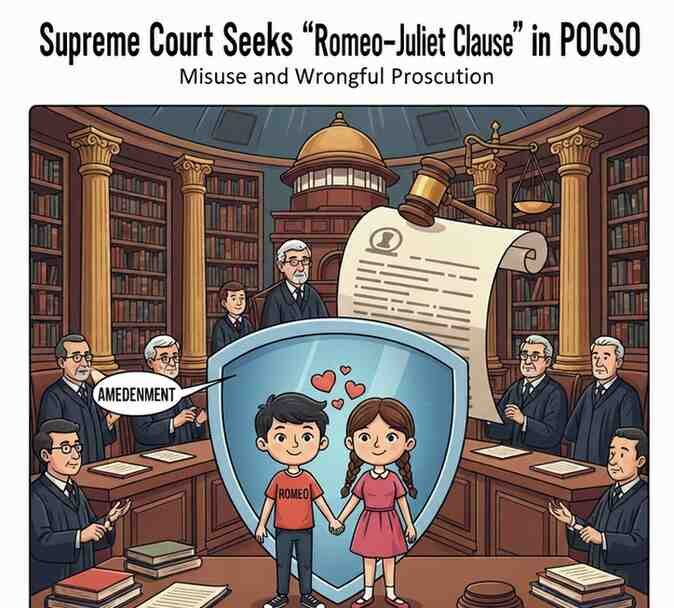
SC favours ‘Romeo-Juliet clause’ to protect teenage lovers in POCSO. The Supreme Court has asked the Centre to bring in a “Romeo-Juliet” provision in the POCSO Act, which criminalizes consensual sexual activity between youth where only one of them is below 18 years of age.
Introduction
On January 9, 2026, the Supreme Court delivered a landmark observation on the misuse of the Protection of Children from Sexual Offences (POCSO) Act, 2012, particularly in consensual teenage relationships. The court proposed that the Union Government amend the POCSO Act through a “Romeo-Juliet clause” to distinguish between consensual adolescent relationships and exploitative sexual offences.
The court raised this concern to prevent families from misusing the law to file false POCSO cases against boys when they disapprove of their teenage daughters’ romantic choices. Such misuse, the court said, is a “menace,” and it directed that the judgment be circulated to the Law Secretary for necessary action.
Why the Supreme Court Recommended a Romeo-Juliet Clause
Misuse of POCSO by Families
The court observed that POCSO, which was enacted to protect minors from heinous sexual crimes, is being wrongly applied by families who oppose their daughters’ romantic involvement with boys. These cases often label consensual relationships between teens of similar ages as statutory rape.
Such misuse can:
- Lead to wrongful arrests and prosecution,
- Causes emotional and psychological trauma,
- Tarnish the young boy’s image and future.
Justice Sanjay Karol added that this kind of misuse is a mockery of the justice system.
Stark Societal Inequality
The court highlighted a “grim societal divide” between:
- Actual victims of sexual abuse, often silenced by poverty and stigma, and
- Privileged youth whose families misuse the law for personal motives.
This disparity, the court said, reveals how a child protection law can be weaponized.
Age Inconsistencies and Evidentiary Challenges
In the case before the court, there were conflicting records about the girl’s age. The High Court had ordered medical tests, such as ossification, to determine bone age, but the Supreme Court clarified that documentary evidence—including municipal records—should be the first step in verifying age. Medical tests should only be used when such records are missing or unreliable.
This aligns with Section 94 of the Juvenile Justice (Care and Protection of Children) Act, 2015.
What Is a “Romeo-Juliet Clause”?
A “Romeo-Juliet clause” is a legal safeguard that:
- Exempts consensual relationships between teenagers close in age from being treated as criminal offences, and
- Prevents such acts from being classified as statutory rape when both parties willingly engage and are of near-equal age.
Many countries have already adopted similar provisions to prevent harsh penalties for consensual teenage relationships.
How Would It Work in POCSO?
If implemented, the clause would:
- Leave genuine child abuse or exploitation cases untouched,
- Recognize consensual teen relationships with small age differences (1–3 years) as separate from criminal offences,
- Prevent misuse of POCSO to settle personal scores.
This would help keep the Act strong in protecting children while preventing its wrongful application.
Supreme Court’s Recommendation and Follow-Up
The court, beyond observation, it directed the judgment to be sent to the Union Law Secretary to encourage:
- Drafting of a POCSO amendment,
- Introduction of a Romeo-Juliet clause,
- Clearer guidelines for police and prosecutors to distinguish between consensual teenage relationships and actual offences.
Impact on Juvenile Justice and Society
Positive Outcomes
- Protects teenagers in consensual relationships from unfair prosecution
- Reduces unnecessary criminal records for minors
- Helps direct POCSO’s focus toward real abuse cases
- Encourages fair and informed court judgments
Challenges Ahead
- Defining precise age limits for exemption
- Ensuring unbiased law enforcement
- Balancing protection with teenage autonomy
Conclusion
The Supreme Court’s recommendation to include a Romeo-Juliet clause in POCSO is a progressive step toward balancing adolescent autonomy with child protection. It aims to prevent misuse of the law and ensure genuine victims of sexual crimes receive justice.
This ruling could set a vital precedent in Indian law—aligning legal safeguards with social realities of teenage relationships and development.
FAQs on the Supreme Court’s Romeo‑Juliet Clause in POCSO
What is the POCSO Act?
A special law to protect children under 18 from sexual offences like abuse, exploitation, and harassment.
What is meant by “misuse” of POCSO?
When families file false complaints or exaggerate consensual teenage interactions as crimes, often due to social stigma or personal disputes.
Why is a Romeo-Juliet clause needed?
To prevent criminalizing consensual relationships between teens close in age and reduce wrongful arrests.
Will this affect real abuse cases?
No. The clause would only apply to consensual relationships between minors of similar ages.