
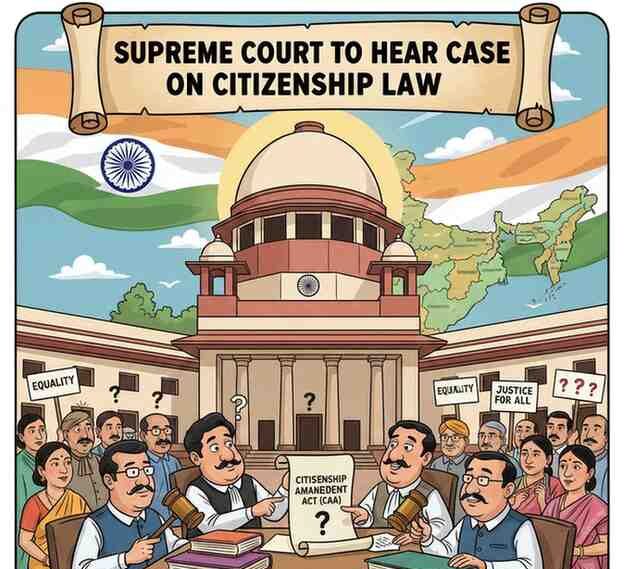
The Supreme Court of India has agreed to examine the constitutional validity of certain aspects of the citizenship law and has issued a notice to the Union government.
Introduction
The Supreme Court of India has taken a crucial step by deciding to consider legal challenges regarding some provisions of India’s citizenship law. In the process, it has issued a notice to the Union government and sent out a stronger indication that the issue itself involves substantial constitutional and legal issues. On a somewhat more significant note, the apex court has dismissed an earlier judgment by a lower court to interpret the expression “person of Indian origin” (PIO) as being a misreading of the statute.
This step now opens the citizenship framework to fresh judicial scrutiny and has implications that reach far beyond questions of constitutional law, immigration policy, and individual rights in India.
Backdrop of the Citizenship Law Controversy
The citizenship laws of India relating to the acquisition of Indian citizenship specify who can become a citizen of India by birth, descent, registration, or naturalization. Over the years, revisions and executive orders on citizenship have led to litigation whenever issues of equality, basic rights, and interpretation of the Constitution come up.
In the case at bar, petitioners have objected to concrete norms and constructions of that statute, alleging violations of the Constitution. Centrally contested is the translation of “person of Indian origin,” which has legal significance when it comes to who is entitled to claim citizenship and associated rights.
Notice by the Supreme Court
If the Supreme Court sends notice to the Union government, it means that the court takes a particular legal challenge seriously and expects the government to respond in detail. This is not to say that the law has been invalidated or enjoined, but it does indicate that the Court will look at the constitutional validity and statutory construction of the matter.
By issuing notice, the Court has:
- Admitted that the petitions present debatable constitutional issues.
- Demanded that the legal position taken by the Union government be explained.
- Enabled the door to be opened for a proper hearing on the reason in support of the case.
That takes the issue beyond a procedural dispute and turns it into a substantive constitutional review.
Re-definition of “Person of Indian Origin”
Among the most notable aspects of the Supreme Court’s involvement is its refusal to accept an inferior court’s interpretation of “person of Indian origin.” The SC stated that the trial court had misinterpreted the legal provision by stretching or misunderstanding the expression beyond what was intended under the law.
The Supreme Court clarification serves to underscore a critical legal principle: that statutory terms must be viewed through the prism of legislative purpose and constitutional limits. A wrong interpretation can lead to disastrous consequences, such as refusal or delay in recognition of one’s entitlement and claim.
Such a correction ensures the appropriate application of citizenship-related provisions and avoids dissimilar judicial pronouncements across the country.
Constitutional Issues Involved
The case involves some critical constitutional issues, namely:
Equality Before Law
Petitioners contend that some of the interpretations or applications of the citizenship law may violate Article 14 of the Constitution, which guarantees equality before law and equal protection of laws.
Due Process and Fairness
A decision (or non-decision) with respect to citizenship has immediate implications for status, rights, and identity. Any ambivalence or subjective interpretation may run the risk of offending provisions in Articles 19 and 21 that deal with liberty and fair procedure.
Limits of Judicial Interpretation
The Supreme Court’s comments underscore how judges are circumscribed in their discretion to interpret statutes, particularly in sensitive areas like citizenship, where policy considerations lie almost entirely with Parliament.
Why This Case Matters
The Supreme Court’s decision to consider the citizenship law is significant on several levels:
- Constitutional High Impact: Citizenship legislation impacts both sovereignty and national identity as well as individual rights.
- Precedential Value: The Court’s reading will influence future citizenship and immigration cases.
- Balance of Powers: The case probes the balance between the legislature’s desire and judicial discretion.
- Consistency in Law: A clear decision will mean courts are less likely to interpret issues inconsistently.
And the fallout could affect how bureaucratic officials enforce provisions related to citizenship on the ground.
Potential Consequences of the Final Judgment
Some of the potential outcomes, depending on the Supreme Court’s decision, are:
- Enlightenment or restriction of the standards for citizenship.
- Clarity on how phrases like “person of Indian origin” will be interpreted.
- Tighter court control on the determination of citizenship.
- Legislative consideration or revision if constitutional issues are confirmed.
It is not established yet: the Court has not ruled upon the merits, but such an approach implies a serious and long-lasting legal outcome.
Conclusion
The Supreme Court’s decision to take up challenges to the citizenship law is a critical moment in India’s constitutional jurisprudence. In seeking a response from the Union government and setting right a lower court’s wrongful reading, the SC has once again shown fealty to its constitutional duty as guardians of both constitutional legality and statutory purpose. And as the proceedings advance, it will have implications for not just citizenship law in the future but also broader issues of equality, fairness, and judicial interpretation in India.
FAQs: Questions on Supreme Court Scrutiny Of Citizenship Law
What is the meaning of the Supreme Court’s notice to the government?
To issue notice is to tell the government that it regards the legal challenge as sufficiently serious to require an official response from it. That does not make the law void.
Has the Supreme Court rejected the citizenship law?
No, the Supreme Court has not invalidated the law. It has merely consented to hear the legal challenges and ask for the government’s side of things.
Can the Supreme Court alter citizenship policy?
The Court cannot make policy, but it can interpret laws and invalidate those that conflict with the Constitution, leading Parliament either to reconsider or to change them.