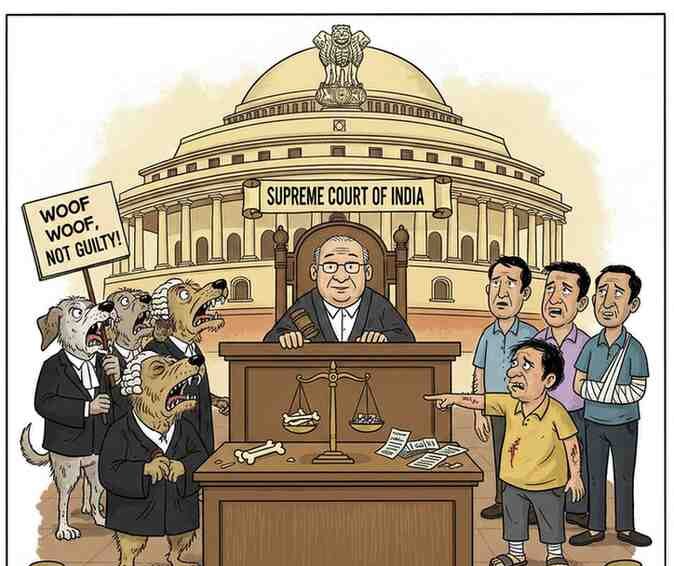
The Indian Supreme Court is considering a matter of who should be held legally accountable in cases relating to injuries and deaths from stray dogs.
Introduction
The menace of stray dog attacks has turned into a major public safety scare in India. Meanwhile, cases of stray dogs biting or even killing children, the elderly, and pedestrians have sparked public fury and legal disputes. Faced with this ballooning problem, the Supreme Court of India is mulling over a fundamental question:
Who is to blame when stray dogs cause injuries or deaths?
The Court is inquiring into who can actually be pinned down under law for not controlling the stray dog menace, whether it’s the state, municipal bodies, or even individuals.
What’s the Stray Dog Liability Case About?
What the Supreme Court Case Is About:
- Increase in the number of dog bite cases
- Inadequate enforcement of laws regarding animals
- Uncertainty about legal responsibility in the event of injury or death from such attacks
The petitions before the Court contend that random dog populations hurt citizens’ right to life and safety under Article 21 of the Constitution.
Key Issue for the Supreme Court
The central issue is:
Whether state governments, municipal corporations, and other authorities can be held liable for damages on account of attacks by stray dogs on the victims due to administrative laxity.
The Court is examining whether liability may lie for:
- Local authorities who fail to act
- Officials who neglect statutory duties
- In some cases, private individuals shelter aggressive stray dogs without safety measures.
Legal Framework Involved
Article 21 – Right to Life
The petitioners argue that:
The right to live means the right not to worry as you go about your daily life in public spaces.
Not containing dog bites is tantamount to a violation of Article 21.
The Prevention of Cruelty to Animals Act, 1960
This law is aimed at preventing cruelty to animals and promoting humane treatment. Stray dogs cannot be killed except in some very exceptional cases.
Animal Birth Control (ABC) Rules
Under these rules:
- Stray dogs need to be sterilized and vaccinated by local governments.
- Dogs should be released back in the same place after sterilization.
Dogs may not be killed, removed, or relocated arbitrarily.
The Supreme Court is hearing whether lax enforcement of these rules has contributed to the problem.
Why Does the Supreme Court Care?
The Court remains troubled because:
- Incidents of stray dog attacks are on the rise despite existing laws.
- Civic bodies cite a shortage of funds and manpower.
- Victims are left without compensation or recourse.
- There is no established system of accountability.
The Court believes that this absence of responsibility is encouraging negligence.
Possible Paths the Supreme Court Could Take
Pending the final determination, the Court may:
- Put clear responsibility on state and local authorities.
- Direct compensation for victims or family members of the deceased.
- Mandate the enforcement of sterilization and vaccination programs.
- Establish rules for dealing with aggressive or rabid dogs.
- Explain the importance. ramifications of inaction.
Balancing Animal Welfare and Human Safety
One key challenge in this scenario is balancing:
- Animal welfare, and
- Public safety
The Court has repeatedly stated:
- Animal rights are important,
- But we can’t put human life and safety at risk.
It’s not about animal cruelty; it’s about good governance and effective control.
Why This Case Matters
This case is potentially significant because it may:
- Establish precedent for government liability in animal attacks.
- Clarify the duties of municipal corporations.
- Empower citizens to safely use public spaces.
- Urge authorities to enforce animal control laws.
A definitive ruling is required to avoid confusion and ensure accountability.
Effects on Citizens and Local Authorities
If liability is fixed:
- Victims may receive compensation.
- Officials could be legally liable for inaction.
- Improved planning and financing of animal control services.
- Enhanced safety in homes and public areas.
This may facilitate long-term solutions, not just temporary responses.
Conclusion
The stray dog liability matter currently before the Supreme Court of India reflects a very serious governance and public safety concern. The Court is seeking accountability, clarity, and balance on who should be accountable for injuries and deaths caused by stray dogs.
The verdict is likely to be a landmark judgment, influencing India’s policy and approach toward managing stray animals and ensuring public safety
.
Frequently Asked Questions (FAQs): Stray Dog Liability Case in the Supreme Court
What is the stray dog liability matter in the Supreme Court?
It is a case where the Supreme Court is looking into who should be held liable for injuries or deaths caused by stray dogs due to the failure of authorities to control their population.
Who is responsible if you get mauled by a stray dog?
The Court is considering the responsibility of:
State governments
Municipal corporations
Local authorities
Officials responsible for animal control
Is it legal to kill stray dogs in India?
No. Indian law protects stray dogs. They can only be euthanized in cases of terminal disease or rabies and through prescribed procedures.