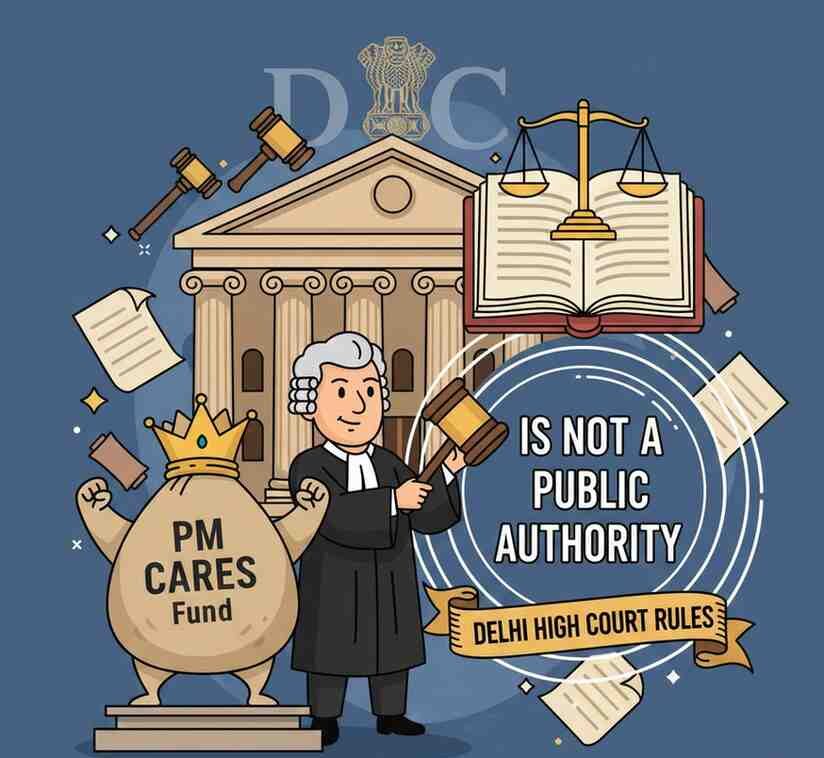
The Delhi High Court has ruled that the PM CARES Fund enjoys statutory privacy protection and does not qualify as a “public authority” under the RTI Act.
Introduction
In an important decision shaping India’s transparency laws, the Delhi High Court has held that the PM CARES Fund cannot be compelled to share information under the Right to Information (RTI) Act.
The judgment has sparked wide debate among law students, RTI activists, constitutional lawyers, and civil society. It highlights the ongoing tension between public accountability and the right to donor privacy.
Background of the Case
The PM CARES (Prime Minister’s Citizen Assistance and Relief in Emergency Situations) Fund was created in March 2020 to support national emergencies such as the COVID-19 pandemic.
Several RTI requests sought details on:
- Donations received
- Identities of donors
- Use of funds
- Audit reports
When these requests were denied, the issue reached the Delhi High Court.
The Legal Question
The core question before the court was
Is the PM CARES Fund a “public authority” under Section 2(h) of the RTI Act, 2005?
Only organizations classified as public authorities are legally required to disclose information under RTI.
What the Court Held
PM CARES Fund is NOT a Public Authority
- It was not set up by the Constitution, Parliament, or any state legislature.
- It is not substantially financed by the government as defined in the RTI Act.
Privacy Protection Applies
- The court recognized a legal obligation to protect donor privacy.
- Forced disclosure could deter future voluntary donations.
RTI Act Cannot Be Applied to It
Since the Fund does not fit the statutory definition of a public authority, it is not bound by RTI disclosure rules.
Court’s Reasoning (Simplified)
Nature of the Fund
PM CARES functions as a charitable trust, not a government department.
The presence of government officials as trustees does not turn it into a public authority.
Funding Test
Voluntary donations ≠ government funding.
Corporate CSR contributions are private, not budgetary grants.
Transparency vs Privacy
RTI laws exist to make state actions transparent—not private charitable work.
Donor confidentiality was seen as a legitimate interest.
Why the Judgment Matters
Clarifies the Scope of RTI
The ruling narrowly defines what qualifies as a public authority, preventing automatic RTI coverage for all entities linked to the government.
Sets a Precedent
It will guide future RTI cases involving trusts, societies, and public-private bodies.
Ignites Policy Debate
The verdict has renewed calls to amend the RTI Act to address modern governance structures.
Criticism and Public Debate
Critics say:
- PM CARES performs public welfare functions.
- It uses government branding and infrastructure.
- Public trust demands transparency even beyond legal mandates.
Supporters argue:
- Legal definitions must be strictly interpreted.
- Protecting donor privacy is vital for raising emergency funds.
Impact on RTI Activists and Law Students
- RTI applicants can no longer seek PM CARES data through RTI.
- Attention is likely to shift from litigation to legislative reform.
The case is now frequently cited in administrative, constitutional, and transparency law studies.
FAQs: Delhi High Court Ruling on PM CARES Fund and RTI
Is PM CARES Fund now completely unaccountable?
No. It is audited by independent auditors and regulated by trust law, but it is not obligated under RTI.
Can Parliament bring PM CARES under RTI?
Yes. Parliament can amend the RTI Act or pass a new law to require disclosure.
Does this apply to PMNRF too?
Not automatically—each fund must be evaluated separately under Section 2(h) of the RTI Act.
What does this mean for transparency laws?
It underscores the limits of RTI and suggests policy-based reform over judicial expansion.
Conclusion
The Delhi High Court’s decision on the PM CARES Fund is a landmark moment in India’s transparency jurisprudence. It clarifies the legal position under the RTI Act but leaves an open question for democracy:
Should entities performing public functions remain outside transparency laws?
The next move lies with Parliament, not the courts.