Highlights of Union Budget 2026–27: Three Kartavyas are economic development, human capacity building and inclusive development. All the key fiscal numbers, sectoral announcements, infrastructure push, agriculture, education and regional development explained in detail.
Union Budget 2026–27 Overview
The Union Budget 2026–27, introduced in Parliament by the Union Finance Minister and formulated for the very first time at Kartavya Bhawan, charts out a clear and consistent roadmap for India’s progress against the backdrop of global economic instability.
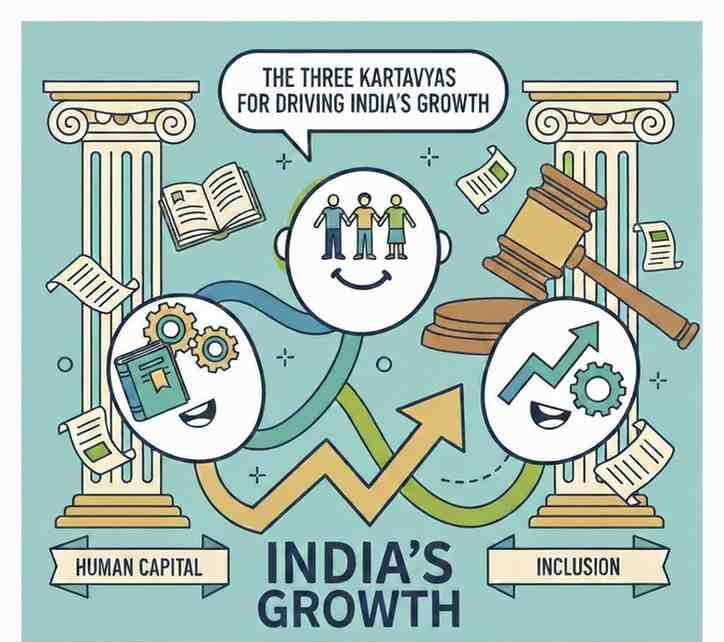
The Budget is built around Three core Kartavyas: lt will further accelerate growth; it will create opportunities; and, with a humane touch, it will enhance security for every citizen third amongst ten promises made. These Kartavyas will collectively contribute to a development-oriented and inclusive India as envisioned under the twin mantras of Viksit Bharat and Sabka Saath, Sabka Vikas.
Union Budget 2026–27: Other Fiscal Estimates
Receipts and Expenditure
- Non-debt receipts: ₹36.5 lakh crore
- Total expenditure: ₹53.5 lakh crore
- Centre’s net tax revenue: ₹28.7 lakh crore
Borrowings
- Gross market borrowings: ₹17.2 trillion
- Net market borrowings (dated securities): ₹11.7 trillion
Revised Estimates (2025–26)
- Non-debt receipts: ₹34 lakh crore
- Net tax receipts: 26.7 lakh crore
- Total expenditure: ₹49.6 lakh crore
- Capital expenditure: ~₹11 lakh crore
Fiscal Deficit
- FY 2026–27 (BE): 4.3% of GDP
- FY 2025–26 (RE): 4.4% of GDP
Debt Position
- Gradual fiscal consolidation to mitigate risks of further debt build-up, with the debt-to-GDP ratio set to decline from 56.1% in FY 2025–26 to reach about 55.6% by FY 2026–27.
First Kartavya: Strengthen and sustain economic growth.
The first Kartavya is centred on increasing productivity, competitive-ness and economic resilience through targeted investments and structural reforms.
Up-Scaling, of Manufacturing in Strategic and Frontier Areas
Biopharma and Healthcare
- Biopharma SHAKTI introduced with an investment of ₹10,000 crore over 5years.
- Setting up of 3 new NIPERs and strengthening of 7 existing institutes.
- Formation of 1,000+ accredited clinical trial sites across the country.
Semiconductors and Electronics
- India Semiconductor Mission (ISM) 2.0 for support of equipment manufacturing, Indian IP, and industry-driven R&D.
- Electronics Components Manufacturing Scheme allocation raised to ₹40,000 crore.
Critical Minerals and Chemicals
- Areas for Rare Earths Corridor identified in Odisha, Kerala, Andhra Prades and Tamil Nadu.
- A support to the States for setting up 3 Chemical parks through the Challenge method based cluster approach.
Strengthening Capital Goods and Textiles
- Hi-Tech Tool Rooms (HTRs) established by CPSEs.
- Construction and Infrastructure Equipment (CIE) Scheme.
- Container Manufacturing Scheme with an investment of over ₹10,000 crore.
- National Fibre Scheme and Mega Textile Parks for the technical textiles.
- Mahatma Gandhi Gram Swaraj Yojana for khadi and village industries.
Reviving Legacy Industrial Clusters
- Reviving of 200 old industrial clusters through improved infrastructure, urban reforms and technology upgradation.
Champion SMEs and Micro Enterprises
- ₹10,000 crore SME Growth Fund to support high growth SMEs.
- Extra ₹2,000 crore to the Self-Reliant India Fund.
- Professional bodies to create ‘Corporate Mitras’ in Tier-II,III towns.
Infrastructure Push
- Public capex moved up to Rs 12.2 lakh crore.
- Infrastructure Risk Guarantee Fund for private investors.
- New Dedicated Freight Corridor (DFC) from Dankuni to Surat.
- Operationalisation of 20 National Waterways.
- Coastal Cargo Promotion Scheme to increase the share of waterways in cargo transport to 12% by 2047.
Energy Security and Urban Growth
- ₹ 20,000 crore for Carbon Capture, Utilisation and Storage (CCUS).
- Development of City Economic Regions (CERs) with ₹5,000/ Cere.
- Seven such high-speed rail corridors, including Mumbai–Pune and Delhi–Varanasi.
- Municipal bond credit enhancement of ₹100 crore for projects above ₹1,000 crore.
Second Kartavya: Aspiration in the time of building human capacity
The other Kartavya is people at the heart of development; in which we invest more in education, skills, healthcare and travel & creative industries.
Education–Employment–Enterprise Linkage
- Creation of a High-Powered Standing Committee to promote services-led growth.
Healthcare and Allied Professions
- Invest in Allied Health Professional schools.
- Addition of 1 lakh AHPs over five years.
- Establishment of five Regional Medical Hubs.
- Three new All India Institutes of Ayurveda.
Animal Husbandry
- Scaling up 20,000 veterinary professionals.
- Interest-Linked Capital Subsidy for Veterinary facilities.
Orange Economy and Creative Industries
AVGC Content Creator Labs in:
- 15,000 schools
- 500 colleges
Tourism, Culture and Sports
- National Institute of Hospitality creation.
- Upskilling 10,000 tourist guides.
- National Destination Digital Knowledge Grid.
- 15 heritage sites including Lothal, Dholavira to be developed.
- Khelo India Mission initiated.
Third Kartavya: Sabka Saath, Sabka Vikas through Specific Inclusion
The third Kartavya is of inclusive development for farmers, weaker sections and underdeveloped areas.
Farmer Income and Agriculture
- Integrated development of 500 ponds and Amrit Sarovars.
- Introduction of high value crops such as Coconut and Cocoa.
- Introduction of the Coconut Promotion Scheme.
- Bharat–VISTAAR, a multilingual AI-driven digital agriculture platform.
Empowering Divyangjan
- Divyangjan Kaushal Yojana for job in IT, AVGC, hospitality and F& B.
Mental Health Infrastructure
- Establishing an NIMHANS-2 in the North.
- Modernisation of mental institutes in Ranchi and Tezpur.
Purvodaya States and North-East Focus
- East Coast Industrial Corridor with Durgapur as a major node.
- Five new tourism places in Purvodaya States.
- Deployment of 4,000 e-buses.
- Development of Buddhist Circuit in North-Eastern states.
Fiscal Support to States
- ₹1.4 lakh croređ Finance Commission grants for FY 2026–27 by the 16th Finance Commission.
Frequently Asked Questions (FAQs): Union Budget 2026–27 Highlights
What are the 3 Kartavyas of Union Budget 2026–27?
These kartavyas are the three driving forces of economic development, human development as well as inclusive development for a balanced and sustainable development.
What is Bharat-VISTAAR?
Bharat-VISTAAR The AI driven digital agri-platform is moving ahead integrating the AgriStack and ICAR resources for better farm decision making.
Why are the Three Kartavyas Important?
The three Kartavyas provide a clear policy framework that links economic expansion with human development and social inclusion, ensuring balanced and sustainable growth towards the goal of Viksit Bharat.