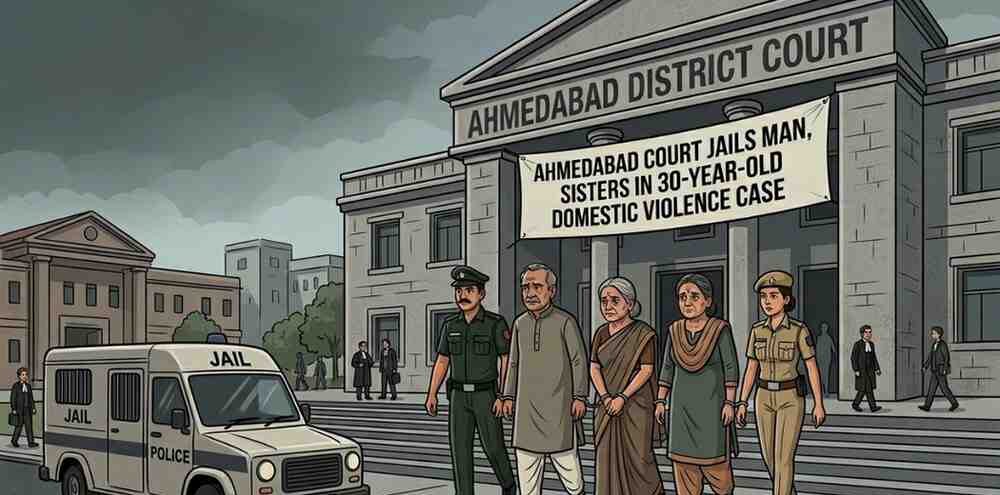
A sessions court in Ahmedabad sentenced a husband and his sisters to three years in prison in a domestic violence case filed nearly 30 years ago. Read a detailed legal analysis of IPC Sections 498A, 323, and 506.
Introduction
In a significant ruling that underscores the enduring power of the criminal justice system, a court in Ahmedabad convicted a man and his two sisters in a domestic violence case originally filed almost three decades ago. The accused were sentenced to three years of imprisonment under relevant provisions of the Indian Penal Code (IPC).
The judgment has sparked widespread discussion across India about delayed justice, women’s legal protections, and the accountability of extended family members in matrimonial disputes. While the case itself dates back to the mid-1990s, the verdict delivered in 2026 serves as a powerful reminder that serious allegations of cruelty and harassment within marriage remain punishable, regardless of how much time has passed.
Background of the Case
The complaint was filed by a married woman alleging sustained harassment, cruelty, and abuse by her husband and his sisters shortly after her marriage. According to court records, the accusations included:
- Physical assault
- Mental harassment
- Threats and intimidation
- Allegations of dowry-related pressure
Following the complaint, a First Information Report (FIR) was registered, and the matter proceeded through the criminal trial system. However, like many cases in India’s overburdened judicial system, it encountered significant delays. Witness examinations, procedural adjournments, evidence evaluation, and appeals contributed to the prolonged timeline.
Despite the long pendency, the court ultimately found sufficient evidence to convict the accused and impose a three-year prison sentence.
Legal Provisions Applied in the Case
The conviction was based primarily on the following IPC sections:
Section 498A – Cruelty by Husband or Relatives
Section 498A IPC criminalizes cruelty inflicted upon a married woman by her husband or his relatives. Cruelty under this provision includes:
- Physical harm
- Mental or emotional harassment
- Coercion related to dowry demands
- Conduct likely to drive a woman to suicide
Punishment: Up to three years’ imprisonment and fine.
This provision was introduced in 1983 to address the alarming rise in dowry deaths and domestic cruelty cases in India.
Section 323 – Voluntarily Causing Hurt
Section 323 deals with physical assault resulting in bodily harm. Even minor injuries can fall under this section if proven in court.
Punishment: Up to one year imprisonment or fine, or both.
Section 506 – Criminal Intimidation
Section 506 IPC applies when threats are issued to cause harm to a person, their reputation, or property.
Punishment: Varies depending on the gravity of the threat.
Why This Verdict Is Legally Significant
Reinforcement of Accountability Despite Delay
One of the most important aspects of this judgment is the court’s clear stance that delay does not nullify criminal responsibility. While India faces severe judicial backlog—with millions of cases pending—the judiciary continues to uphold the principle that justice must ultimately prevail.
This case demonstrates that even if proceedings extend for decades, courts will evaluate evidence based on merit rather than time elapsed.
Recognition of Mental and Emotional Cruelty
Indian courts have increasingly recognized that cruelty is not limited to physical violence. Mental harassment, humiliation, and sustained intimidation are equally serious forms of abuse.
By convicting the accused after detailed evidence review, the court reaffirmed that emotional abuse carries legal consequences.
Accountability of In-Laws
A key dimension of the ruling is the conviction of the husband’s sisters. Courts are cautious in implicating extended family members in matrimonial disputes due to concerns about false implication. However, where evidence establishes active participation in harassment, relatives can be held criminally liable.
This judgment emphasizes that:
- Mere familial relationship does not automatically imply guilt.
- But active involvement in cruelty will attract punishment.
The Issue of Judicial Delays in India
India’s judicial system is one of the largest in the world but is also burdened by heavy caseloads. Factors contributing to delay include:
- Frequent adjournments
- Transfer of judges
- Witness unavailability
- Procedural complexity
- Appeals and revisions
While judicial reforms and digitization efforts are underway, cases like this highlight the urgent need for faster resolution of matrimonial and criminal disputes.
Impact on Survivors of Domestic Violence
For survivors, long trials can be emotionally exhausting. The stigma surrounding domestic disputes often discourages women from pursuing legal remedies. Financial hardship and social pressure further complicate matters.
However, this verdict sends a strong message:
- The legal system can provide relief, even after prolonged struggle.
- Persistence in seeking justice can lead to accountability.
- Legal protections under IPC remain robust.
Broader Legal Context: Domestic Violence Law in India
Apart from IPC provisions, women in India are protected under:
- The Protection of Women from Domestic Violence Act, 2005 (PWDVA)
- Dowry Prohibition Act, 1961
- Maintenance laws under the Criminal Procedure Code
While Section 498A deals with criminal punishment, the Domestic Violence Act provides civil remedies such as:
- Protection orders
- Residence rights
- Monetary relief
- Custody orders
Together, these laws form a comprehensive legal framework against domestic abuse.
Criticism and Debate Around Section 498A
Section 498A has been subject to debate over alleged misuse. Courts, including the Supreme Court of India, have issued guidelines to prevent automatic arrests and ensure proper investigation.
However, the existence of potential misuse does not diminish the importance of the law. Courts evaluate each case independently based on evidence.
The Ahmedabad verdict reinforces that when credible proof exists, convictions will follow.
Key Legal Takeaways
- Domestic violence cases can result in conviction even after decades.
- Extended family members can be punished if evidence proves involvement.
- Emotional cruelty is legally recognized.
- Judicial delay does not erase criminal liability.
- Section 498A continues to serve as a crucial safeguard for married women.
Conclusion
The Ahmedabad court’s decision to convict a husband and his sisters in a nearly 30-year-old domestic violence case marks a powerful moment in India’s legal landscape. It reinforces the principle that justice, even if delayed, remains achievable.
While systemic reforms are necessary to reduce pendency and accelerate trials, this verdict strengthens public faith in the judiciary’s commitment to protecting victims of domestic cruelty.
In a country where domestic violence continues to be a pressing social issue, such judgments send a clear message: accountability has no expiry date.
FAQs: Ahmedabad Domestic Violence Verdict Explained
What sentence was awarded in the Ahmedabad case?
The husband and his two sisters were sentenced to three years of imprisonment under IPC provisions.
Why did the case take 30 years to conclude?
The delay was due to judicial backlog, procedural adjournments, evidence evaluation, and trial processes common in India’s court system.
What is Section 498A IPC?
Section 498A criminalizes cruelty by a husband or his relatives against a married woman, including physical and mental harassment.
What other legal remedies exist for domestic violence victims?
Victims can seek protection orders, maintenance, and residence rights under the Protection of Women from Domestic Violence Act, 2005.