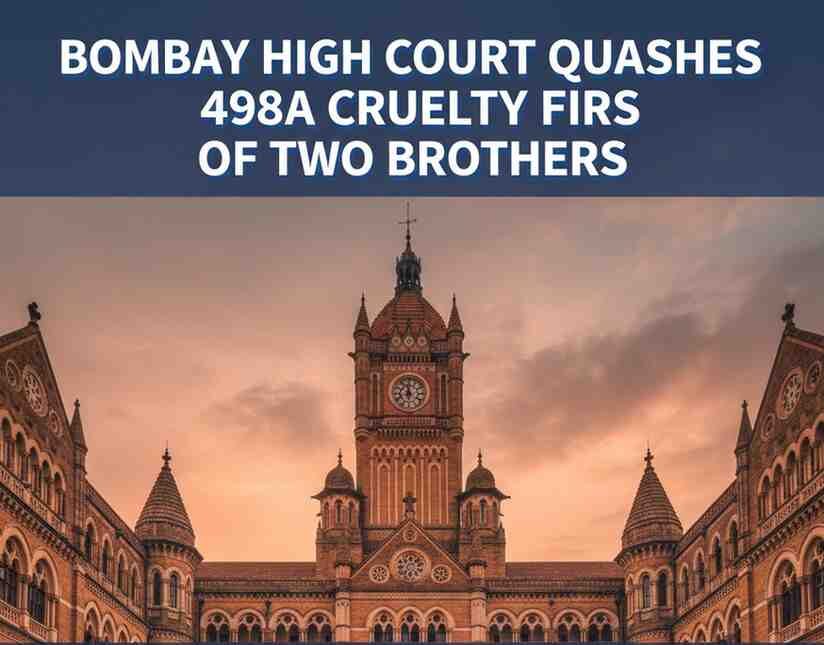
Bombay High Court Quashes 498A Cruelty FIRs of Two Brothers: Why “Mere Cruelty” is not Sufficient for Criminal Prosecution: The Bombay High Court quashes FIRs in 2 cases u/s 498A IPC. “Vague, general, or omnibus allegations of harassment and atrocities can’t be a ground to rope in relations.” It states that such unproven, non-specific contentions are unrealistic eons from the truth.
Introduction
Recently, the Bombay High Court set aside two First Information Reports (FIRs) registered under Section 498A of the Indian Penal Code—dealing with cruel conduct by a husband or his relative(s). In its pronouncements the Court has made clear that every act of cruelty is not an offence. The act of cruelty has to be willful and not accidental, it must also be intentional and of a degree that a woman can commit suicide or cause grave injury.
These judgments once again bring to notice the uneasiness in the judiciary over the abuse and misuse witnessed in 498A cases, especially against distant relatives, dower demand by elders or those having a very limited role appearing even where matrimonial discord exists.
Understanding Section 498A IPC
Section 498A penalizes:
Any “intentional act” which is capable of making a woman commit suicide or injure her body/health.
Harassment for dowry demands in excess of law.
But not every marital spat or family squabble is criminalized by the provision. The allegations must include:
- Specific acts
- Dates or timeframes
- Direct involvement
- A stated purpose to injure
Key Comments of Bombay High Court
Vague Accusations Cannot Stand as Basis for Criminal Trial
In both there were FIRs which leveled nebulous and vague accusations against an extended family—parents-in-law, spouses’ brothers or sisters and such like.
The complaints also did not detail different acts of cruelty or specify how each student supposedly participated in the reported harassment, documents show.
The Hon’ble Court held that the law is not to set in motion criminal law into action on the basis of unverified, broad allegations.
No “Willful Conduct” As Required Under 498A
The High Court clarified that:
- Intentional and focused conduct for an offence u/s 498A.
- Regular quarrels, domestic unhappiness, or common insults do not suffice.
There was no evidence to prove that the accused had an intention to commit grievous hurt or that the cruelty meted out by the accused was of so intense a degree as would drive his wife to suicide. Accordingly, the FIRs fell back on components essential for a criminal trial.
Over-Implicating In-Laws Is Abuse of Process
One common trend found in most 498A cases filed is that everyone in the family is named, whether or not he was directly involved!
The Court noted that the criminal justice system must not be employed as an instrument of either vengeance or coercion and that when false and inflated accusations are made, there are two victims:
- The accused, who is wrongfully convicted
- The true victim in need of vindication.
Power of Court Under Section 482 CrPC
The High Court had exercised its inherent powers under Section 482 of the Criminal Procedure Code to set aside the FIRs. They provide the Court with power to stay:
- Abuse of process, and
- Wastage of resources in harassing persons where the act complained of does not amount to an offence.
Impact of the Judgment
For Families and Society
- Prevents misuse of Section 498A
- Promotes impartial investigations, not ones driven by anger
- Saves innocent family members from becoming entangled in criminal cases
For Genuine Victims
- The law is reasonable and operative when real cruelty or dowry harassment occurs
- Illustrates the importance of thorough and honest coverage
Frequently Asked Questions (FAQs)
Why are FIRs filed against in-laws quashed so frequently?
As many complaints over-implicate the entire family without specifying the part played or conduct of each. Courts need concrete, specific allegations—not categorical charges.
What evidence is required for a 498A case to be strong?
-Specific incidents with dates
-Medical records
-Messages or audio recordings
-Witness testimonies
-Proof of dowry demands
-Vague allegations may be rejected without those specifics.
Is it possible to quash an FIR before the trial?
Yes. The High Court may, under Section 482 CrPC, quash the FIR if:
-The charge alleged is not an offense, or
-The action is patently frivolous, malicious, or commenced for harassment.
Is mental torture under 498A considered cruelty?
Only if it’s extreme and intentional and very likely to result in severe harm. Petty arguments or routine marital spats don’t count.
Conclusion
The judgment of the Bombay High Court upholds an important principle: that criminal prosecution under s.498A cannot be allowed to rest on a mere dissatisfaction, unspecified accusations, or family conflict. The law is fashioned to save women from real cruelty—not to punish their relatives on the basis of broad, unverified claims.
These judgments provide a balance between protecting victims and preventing abuse of an important legal provision.