Decriminalization of 300–400 Minor Offences in India: Meaning, Scope, Impact, and Legal Significance: India is decriminalizing 300–400 minor offences across laws to replace jail terms with fines. Learn its meaning, objectives, benefits, and challenges.
Introduction
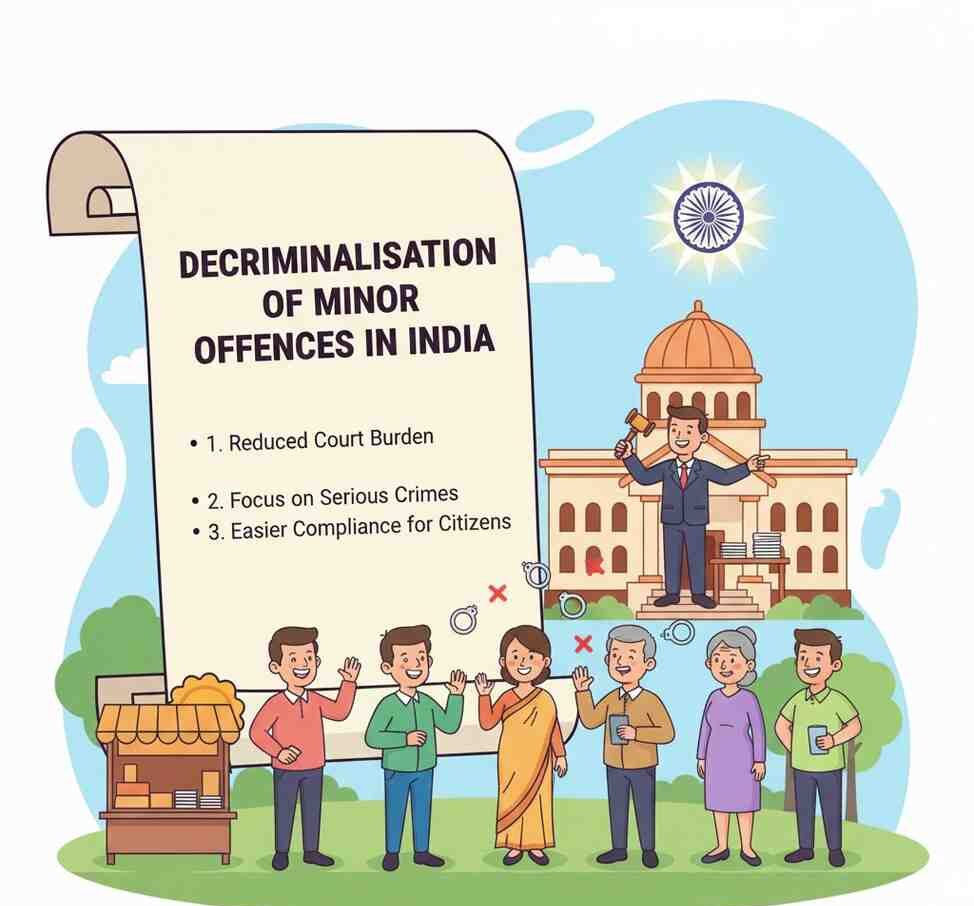
The Indian legal system has been controversial for a long time due to the excessive number of criminal offenses, its complicated nature, and the heavy burden it places on both the citizens and the justice machinery. There are still thousands of minor violations, many of which are only technical or procedural, that carry criminal penalties such as imprisonment, even though no serious harm has been caused. The Indian government, realizing the gravity of the situation, has launched a reform programme to decriminalize 300–400 minor legal provisions spread across different statutes.
It is expected that the abolition of imprisonment and criminal prosecution through the replacement with monetary penalties, civil liabilities, or administrative sanctions will be staged as part of broader legal simplification and ease-of-doing-business reforms. The measure is a landmark in India’s regulatory compliance, governance, and criminal law.
This article provides a comprehensive understanding of the decriminalization of minor offences, with aspects such as its definition, reasons, extent, examples, benefits, challenges, and the future impact.
What Is Decriminalization of Minor Offences?
Decriminalization means changing the most severe criminal penalties that go hand in hand with specific conduct, such as jail or criminal prosecution, by reducing such penalties and replacing them with:
- Fines
- Civil penalties
- Administrative sanctions
- Warning or compliance mechanism
Decriminalization should be regarded as a step short of legalization, i.e., it does not convey legal status to illegal activities. Rather, it changes the type of sanction, i.e., the mentioned minor, non-serious offences will no longer be dealt with under criminal law but rather will be punished by some other less severe consequences.
Why Is India Decriminalizing Minor Offences?
Overburdened Criminal Justice System
Indian courts face:
- Over 5 crore pending cases
- A large percentage involving minor regulatory violations
Decriminalization helps reduce unnecessary litigation.
Colonial-Era Laws
Many criminal provisions originate from:
- British-era statutes
- Outdated economic and administrative laws
These laws criminalize acts that are no longer socially harmful.
Ease of Doing Business
Criminal penalties for minor non-compliance discourage:
- Entrepreneurs
- MSMEs
- Foreign investors
Replacing jail terms with fines promotes a business-friendly environment.
Human Rights and Proportionality
Imprisonment for small technical violations violates the principle of proportional punishment.
Government’s Decriminalisation Initiative: Key Highlights
- Target: 300–400 minor offences
- Scope: Multiple central laws
- Nature: Replace imprisonment with fines
- Focus: Procedural and technical violations
- Objective: Simplify laws and improve compliance
This reform is being carried out through legislative amendments rather than a single umbrella law.
Laws and Sectors Affected
The decriminalization drive covers various areas, including
Economic and Business Laws
- Companies Act
- LLP Act
- Insolvency regulations
- Foreign exchange compliance
Labour and Employment Laws
- Minor reporting failures
- Technical registration lapses
- Documentation delays
Environmental and Regulatory Laws
- Procedural non-compliance
- Late filings and disclosures
Tax and Financial Laws
- Small defaults
- Clerical errors
- Non-fraudulent omissions
Serious offences like fraud, corruption, or public harm remain criminal.
Examples of Minor Offences Being Decriminalised
| Offence Type | Earlier Penalty | Proposed Penalty |
|---|---|---|
| Late filing of returns | Jail + fine | Monetary fine |
| Failure to update records | Criminal case | Administrative penalty |
| Procedural licensing lapses | Imprisonment | Compounding fee |
| Delayed disclosures | Criminal liability | Civil fine |
Objectives of Decriminalisation of Minor Offences
Promote Compliance Over Punishment
Encourage voluntary compliance rather than fear-based enforcement.
Reduce Judicial Burden
Free courts to focus on serious crimes.
Protect Citizens and Businesses
Prevent harassment and misuse of criminal law.
Improve Governance
Shift from criminal enforcement to regulatory oversight.
Difference Between Decriminalisation and Legalisation
| Aspect | Decriminalisation | Legalisation |
|---|---|---|
| Act status | Still unlawful | Lawful |
| Punishment | Civil/fine-based | No penalty |
| Objective | Proportionality | Permission |
Decriminalization does not condone violations.
Impact on Businesses and MSMEs
Positive Impact
- Reduced fear of imprisonment
- Lower compliance costs
- Increased investor confidence
- Faster dispute resolution
Boost to Entrepreneurship
Startups can innovate without excessive legal risk.
Impact on Individuals and Citizens
- Less harassment for technical errors
- Reduced criminal records
- Faster administrative resolution
- Greater trust in governance
Impact on the Criminal Justice System
Reduced Case Load
Courts can prioritize:
- Violent crimes
- Economic offences
- Constitutional matters
Efficient Policing
Police resources redirected to serious crimes.
Concerns and Criticisms
Risk of Weak Enforcement
Critics fear fines may not deter violations.
Regulatory Capture
Powerful entities may treat fines as a cost of business.
Inconsistent Implementation
Different departments may apply rules unevenly.
To address this, the government proposes:
- Higher fines
- Repeat-offender penalties
- Digital monitoring systems
International Perspective
Many countries have already adopted decriminalization:
- United Kingdom: Civil penalties for regulatory breaches
- Singapore: Administrative enforcement
- Australia: Proportional sanctions
- OECD nations: Compliance-focused governance
India’s move aligns with global best practices.
Legal and Constitutional Perspective
Decriminalization supports:
- Article 21 (Right to Life and Personal Liberty)
- Doctrine of proportionality
- Principle of natural justice
It reinforces the idea that criminal law should be a last resort.
Current Status of the Decriminalisation Drive
- Ongoing legislative amendments
- Implemented through multiple bills
- Reviewed by law ministries and committees
- Gradual rollout across sectors
This is a continuous reform process, not a one-time change.
Future Scope and Importance
The initiative may lead to:
- Modernised criminal law framework
- Fewer arrests for minor violations
- Greater public trust
- A more rational justice system
It also complements:
- Labour law reforms
- New criminal codes
- Digital governance initiatives
FAQs: Decriminalization of 300–400 Minor Offences in India
Does decriminalization mean offences are no longer illegal?
No. The act remains unlawful, but punishment changes from jail to fines.
Will serious crimes be decriminalized?
No. Fraud, corruption, violence, and public harm offences remain criminal.
Can fines be increased after decriminalization?
Yes. Fines may be substantial to ensure deterrence.
Conclusion
Delinking minor offences from criminal law marks a fundamental change to the Indian legal system that is quite revolutionary. Through the substitution of incarceration by a mere money fine for technical and non-serious violations, the administration is ushering in a justice system that is more in line with the ideals of humanity, efficiency, and reason.
Such a move is consistent with the notion that criminal law is one that should penalize actual illegal conduct, not mere mistakes in the procedure. It is going to be a very great step in the right direction if, by the end of the day, this policy of decriminalization is implemented effectively. In that scenario, it will become a tool for lessening the caseload, stimulating the economy, safeguarding individual freedom, and regaining people’s trust in the rule of law.