A PIL in the Delhi High Court challenges the Centre’s appointment of 650+ government lawyers without mandatory AIBE clearance. The court seeks a full response by Dec 11.
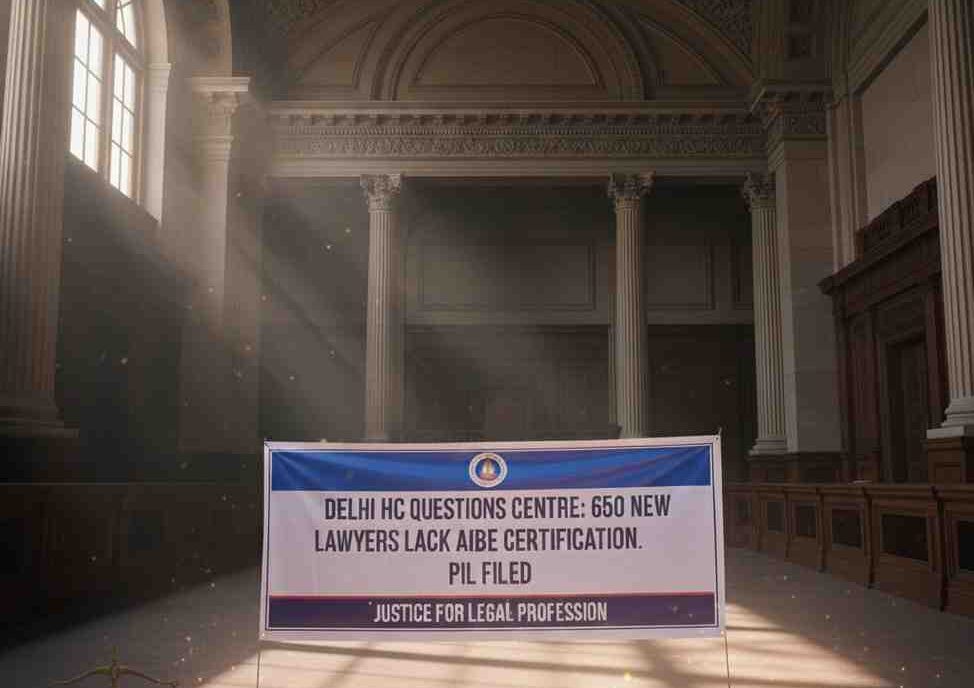
In response to a Public Interest Litigation (PIL) challenging the recent appointment of more than 650 lawyers to represent the Union of India before the Supreme Court, the Delhi High Court has requested that the Central government provide a thorough explanation. The First Generation Lawyers’ Association filed a PIL alleging that a number of these advocates failed the required All India Bar Examination (AIBE), raising concerns about the selection process’s transparency as well as their eligibility.
Chief Justice Devendra Kumar Upadhyaya and Justice Tushar Rao Gedela led a Division Bench that emphasized the necessity of a comprehensive and satisfactory response from the Center. In order to give the government time to confirm whether lawyers without the required training or experience were included in the list, a follow-up hearing is set for December 11.
During the proceedings, the Court instructed Additional Solicitor General (ASG) Chetan Sharma to consult with the Ministry of Law and Justice and verify the allegations. The Court’s directive—“List it next week on Thursday to enable the ASG to obtain instructions”—reflected its commitment to ensuring transparency and accountability in government lawyer appointments.
Background of the PIL
The PIL focuses on a list of over 650 lawyers who were named Central Government Counsel for the Supreme Court by the Ministry of Law and Justice on November 21. The petitioner argues that because of purported irregularities and a lack of transparency in the selection process, the list has caused an enormous amount of concern among legal professionals.
The First Generation Lawyers’ Association asserts that many of the empanelled attorneys have not yet passed the AIBE because they joined State Bar Councils as late as 2024 or 2025. Their appointment raises questions regarding qualifications because the AIBE is required to practice law in India. According to the petition, some of these advocates have less than a year of experience, which is a significant change from previous standards that called for years of experience before being included on such esteemed panels.
The association contends that easing these requirements violates the fairness principles protected by Article 14 of the Constitution by lowering the legitimacy of the selection process and the caliber of representation given to the Union government.
Key Arguments in the PIL
The petition is grounded on three main points—lack of AIBE certification, inadequate experience, and an arbitrary selection process.
Absence of Mandatory AIBE Qualification
The PIL claims that many names on the new panel belong to advocates who have not cleared the AIBE. Since passing the AIBE is a legal prerequisite for practicing law in India, appointing unqualified individuals to represent the Union before the Supreme Court is seen as both unlawful and unethical.
Insufficient Professional Experience
Traditionally, government panel lawyers are required to have several years of courtroom experience. However, the petitioner alleges that many newly appointed counsel have barely one or two years of practice. Representing the central government in the Supreme Court demands deep legal acumen and familiarity with constitutional and policy issues—something the petitioners argue cannot be expected from such inexperienced professionals.
Opaque and Arbitrary Selection Process
The PIL points out that the government’s notification does not explain how the appointments were made or the criteria used. It is unclear whether an open call for applications was issued, how candidates were shortlisted, or what standards determined inclusion in categories like Panel Counsel, Senior Panel Counsel, or Central Government Counsel. “The inclusion of advocates with less than one or two years of practice, and in some cases without AIBE certification, indicates an arbitrary exercise of power,” the petition asserts.
The petitioner contends that such arbitrariness not only breaches constitutional norms but also affects public interest, since government litigation involves public funds and issues of national importance.
Court Proceedings and the Government’s Position
The Court was told by advocate Rudra Vikram Singh, appearing for the petitioners, that several advocates on the new panel were recent entrants to the profession—some of whom had enrolled this year or last. Since AIBE follows enrollment, many of them have not yet cleared the examination.
The Bench promptly questioned the government, asking:
“Is it correct that there are advocates with only a year of practice? Have they been empanelled for the Supreme Court? ”
The Court also sought clarity on whether minimum qualifications like years of experience or AIBE certification were part of the empanelment process.
Central Government Standing Counsel Radhik Dubey, however, maintained that the PIL was not maintainable, asserting that the government has the inherent right to choose its legal representatives. “It is the discretion of the government to decide who stays on the panel,” she said, adding that ASG Chetan Sharma would later address the matter.
During the afternoon session, ASG Sharma assured the Court that he would personally review the list and confirm whether the allegations were accurate. On this assurance, the Bench adjourned the matter to December 11, expecting a detailed report from the Centre.
The petitioner was represented by advocates Rudra Vikram Singh, Ashirvad Kumar Yadav, Neetu Rani, Rashmi Mehta, and Anirudh Tyagi.
Broader Implications
This case has generated significant discussion within the legal community. Appointing government lawyers is far from a routine administrative task — it directly impacts the quality of representation the Union of India receives in the Supreme Court. The apex court handles cases involving constitutional interpretation, national security, and major policy decisions, making the competence and experience of government counsel extremely important.
Moreover, the controversy casts doubt on the credibility of the AIBE itself. If lawyers without this certification are being empanelled to represent the government, it undermines the very purpose of the examination—ensuring that only qualified professionals are allowed to practice law in India.
The case also raises broader questions of fairness and equal opportunity within the legal profession, particularly for first-generation lawyers—the very group that filed the petition in the first place.
FAQs: Delhi High Court Questions Centre Over 650 Newly Appointed Government Lawyers—PIL Alleges Absence of Mandatory AIBE Certification
Does the government have the right to choose its lawyers?
While the government has discretion in appointing its counsel, that discretion must comply with constitutional principles such as fairness, transparency, and non-arbitrariness.
Why is experience important for government lawyers?
Government counsel handle complex and high-stakes cases with national implications. Adequate experience ensures effective advocacy and well-reasoned legal strategy.
What is the AIBE?
The AIBE is a certification test for practicing advocates in India. A Certificate of Practice is awarded to those who pass the exam, allowing them to advocate in Indian courts.
Why was the PIL filed to challenge the appointment of 650 lawyers?
The PIL claims that many of the recently appointed lawyers lacked the qualification of having taken the AIBE or had little or no experience. The PIL also asserts that the application process for hiring these lawyers was arbitrary and did not provide transparency in the hiring process.