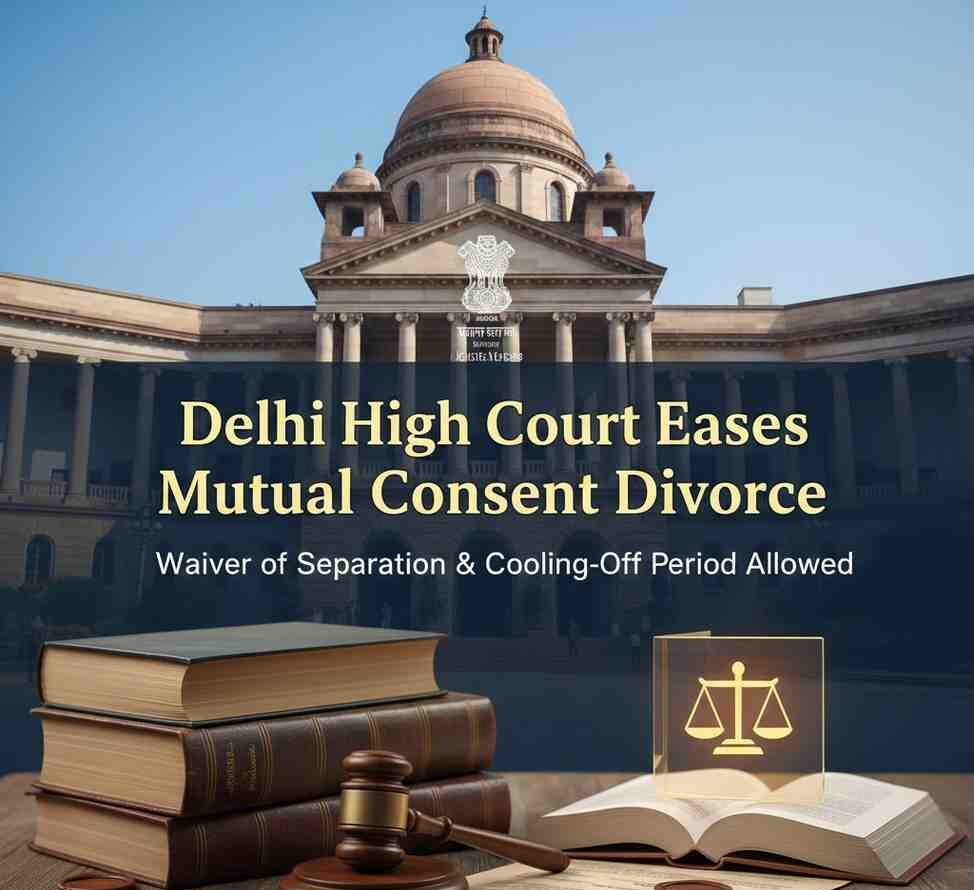
The Delhi High Court has ruled that the one-year separation and six-month cooling-off period in mutual consent divorce cases under Section 13B of the Hindu Marriage Act can be waived.
Introduction
Mutual Consent Divorce—An Exit Route from an Unworkable Marriage. Mutual consent divorce was thus incorporated into the Indian matrimonial law to accord couples a dignified and peaceful passage out of their dysfunctional union. However, with the passage of time, the required waiting periods—especially the one-year separation and six-month cooling-off period—were increasingly used as delay tactics rather than opportunities for reconciliation.
Allaying this fear, the Delhi High Court has explained that courts have the discretionary power to relax such periods in deserving cases. This is a key step in the direction towards a humane and realistic interpretation of family law.
The Legal Framework—Section 13B, Hindu Marriage Act
Section 13B(1)
A man and wife cannot file a joint petition for divorce by mutual consent unless they have lived apart for at least one year.
Section 13B(2)
Six-month gap between first and second motions to allow for reconciliation.
Although the legislation sought a measure of reconciliation among the parties, judicial experience demonstrated that frequently these periods served only to protract emotional suffering.
The Issue in Law for the Court
The reference before the Delhi High Court stemmed from conflicting views by the judiciary as to
- Whether a one-year separation under S. 13B(1) is mandatory
- On the issue of waiver of a six-month cooling-off period under Section 13B(2)
- Whether scheduled timelines should be strictly followed by courts in the interest of both parties
The Delhi High Court’s Ruling
The three-judge bench of Justice Navin Chawla, Justice Anup J. Bhambhani, and Justice Renu Bhatnagar observed that:
- The 13B time bar is directory, not mandatory
- Both waiting periods are waivable at the discretion of the courts
- Judges should not reject divorce only because of non-completion timings mechanically
- The facts of each case should be carefully weighed
Emphasis on Decisional Autonomy
The court relied heavily on personal autonomy, noting that:
- Marriage is based on the stuff of free, happy consent
- Marriage by mutual consent must also respect that freedom
- The law shouldn’t force adults to make a go of a marriage that is clearly irrevocably broken
The bench also warned that forced continuation of a broken marriage simply cannot preserve sanctity and, on the contrary, serves only to inflict irreparable emotional and social destruction.
Judicial Recognition of Social Realities
The court recognized that extended divorce litigation can:
- Prevent parties from getting their lives back together
- Affect prospects of remarriage
- Disrupt social reintegration
- Promote abuse of legal delays as a means of torture
The court observed that an unreasonably prolonged process can be detrimental to future happiness, rendering prompt dissolution indispensable in the case of real consent.
When Can Courts Grant a Waiver?
However, courts might relax some of the waiting periods if:
- Both spouses give unambiguous consent
- Marriage has irretrievably broken down
- There is no possibility of reconciliation
- All matters of maintenance, custody, and property have been amicably resolved
- More delay may cause serious suffering or injustice
Significantly, a waiver is a matter of discretion, not something the court grants automatically.
Impact of the Judgment
- Resolution Of Mutual Divorce Cases In Less Time
And it can help prevent needless litigation and court congestion. - Progressive Interpretation of Family Law
Brings legal procedure in line with social reality and mental health concerns. - Persuasive Value Nationwide
While it is binding in the territory of Delhi, the judgment will have a persuasive effect on family courts and high courts elsewhere in India.
Does This Decision Change the Law?
There is no statutory modification. However:
- Judicial interpretation has been clarified
- Courts can now be flexibly enabled
- Excessive procedural formalism has been disapproved of
Conclusion
The judgment of the Delhi High Court, therefore, marks a welcome development in Indian matrimonial jurisprudence. Over procedure runs rampant; the court has reaffirmed this session that the law should serve human realities, not stand in front of them.
This judgment reinforces the legal principle of mutual consent divorce and establishes a progressive precedent in such cases that there should be no delay of justice when reconciliation is not an option.
FAQs: One-Year Separation And Cooling-Off Period Can Be Waived
Is one-year separation completely abolished?
Courts can waive it only in appropriate cases.
Can every mutual divorce skip the cooling-off period?
Waiver depends on facts, consent, and settlement.
Is mutual consent divorce now instant?
No. Court satisfaction and legal procedure still apply.