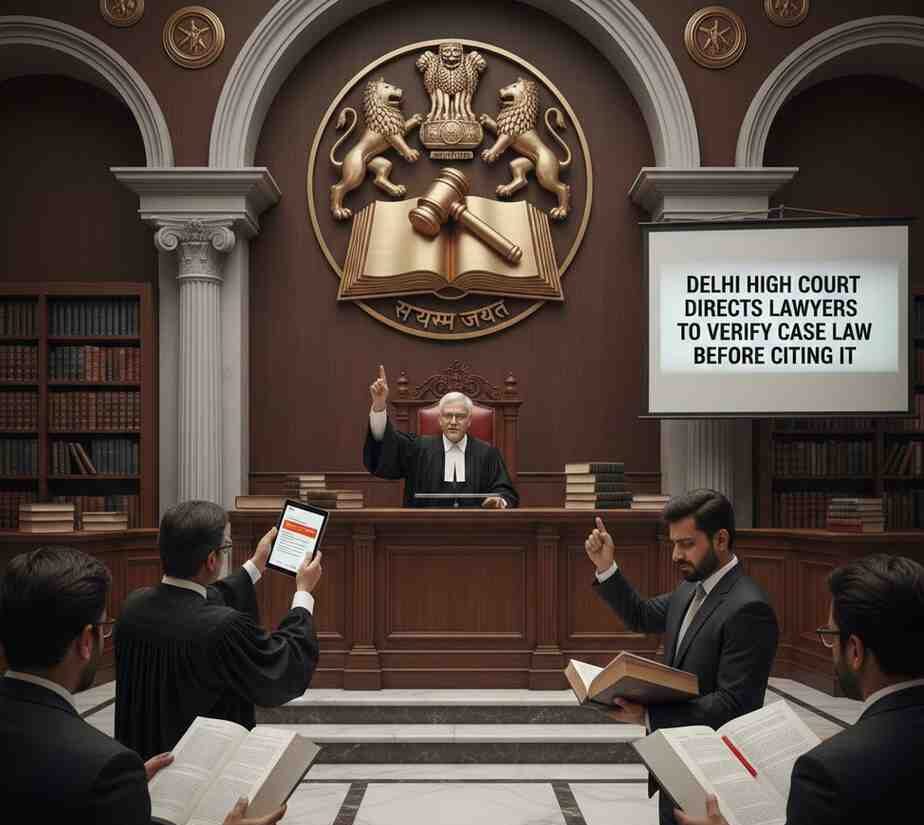
The Delhi High Court has ordered lawyers to check whether case laws are good in the eyes of the law before seeking reliance on such cited cases.
Introduction
The integrity of the legal process is inextricably linked to the court’s reliance on valid arguments. Realizing this, the Delhi High Court has given a significant direction that lawyers have to check case laws before quoting them at the time of arguments. The guidance further promotes professional self-discipline in advocacy and emphasizes the advocate’s obligation to aid the court with sound and always reliable authorities.
It’s a timely rule in an age when digital research (and, simply put, lack of thorough editing), coupled with time-saving tools like automatic citation software, make it all too easy to unwittingly rely upon opinion law from 2015 whose holding was subsequently reversed or non-binding. Through verification, the court ensures judicial purity and the delivery of justice on sound legal premises.
What the Delhi High Court Ordered
In its order, the Delhi High Court noted that lawyers/briefing counsel/law firms cannot be heard making excuses for citing a non-binding or interim judgment. If a cited case has been:
- Overruled
- Stayed
- Reversed
- Or is it under appeal or review
Such status shall be disclosed to the court.
The Court ruled that telling the court a judgment is settled law if it actually isn’t, whether unintentional or not, constitutes misleading the court.
Why This Directive Was Necessary
- Increasing Errors in Legal Citations
Judges have begun to see more and more cases in which lawyers invoke:
- Good law at the time, but not now
- Orders directed to particular facts only
- Erroneous interlocutory decisions as final orders
These mistakes are a waste of the courts’ time and make adjudication more cumbersome.
- Over-Reliance on Technology
The application of judicial standards as legal research tools, although useful, may also create:
- Incomplete legal histories
- Incorrect case references
- Non-existent or wrongly attributed judgments
The memo is a reminder that technology will not supplant professional judgement.
- Protection of Judicial Decision-Making
The court depends on lawyers to help it along. A false citation can have ripple effects that change outcomes and shake confidence in the system. Verification guarantees that we are choosing from well-reasoned law.
Professional Responsibility of Lawyers
An attorney is not just there to represent the client, but they also serve as an officer of the court. This includes:
- Presenting facts honestly
- Citing law accurately
- Disclosing adverse legal developments
Non-verification of case law is, in fact, a professional misconduct that may be subject to, however inadvertent.
The Nature of Verification of Case Law
Lawyers are expected to check:
- Legal Status
- Whether the judgment is final
- If it has been stayed, modified, or vacated
- Jurisdictional Value
- If the decision is binding or persuasive
- If applicable to the forum in which it is offered
- Relevance
- If the legal doctrine can be applied to the facts of this case
- Whether the ratio decidendi is being applied correctly
Impact on Courtroom Practice
- Higher Quality Legal Submissions
This will require lawyers to be more diligent in their research, leading to clearer, stronger arguments. - Improved Judicial Efficiency
Courts will waste less time on correcting wrong citations and can concentrate on the substance. - Increased Accountability
Law firms and briefing counsel can be held responsible for sloppy research, further pressuring in-house review processes.
Ethical and Legal Framework
The guideline is consistent with good practice in:
- Professional conduct rules for advocates
- The court’s duty of candour
- Ethical duty not to submit misleading claims
Correct citation is not optional—it’s an essential part of ethical practice.
Challenges in Implementation
- Time Constraints
Detailed verification, in particular, may be onerous given a heavy caseload, particularly for more junior lawyers. - Resource Inequality
Solo practitioners could have a harder time complying than big law firms. But professional responsibility is the same for every kind of advocate. - Training Gaps
Law schools and legal education programs should perhaps do a better job teaching citation ethics and verification.
Long-Term Significance
This directive is likely to:
- Propagate similar habits in other courts
- Improve legal research standards nationwide
- Promote the responsible use of legal technology
- Build trust in the judicial system
It could one day serve as a model for courtroom behavior throughout India.
Conclusion
The recent Delhi High Court judgment on checking the case law before citation is a welcome and crucial direction in bolstering ethical advocacy and judicial accuracy. In a fast-paced digital world, this Court reaffirms that it is a sine qua non for the rule of law—accuracy in law cannot be sacrificed at the altar of speed.
By requiring reliable citations, the court ensures not only that arguments have standing but also that rulings are valid and the system of justice credible. This mandate is not a negative; rather, it’s simply the reminder that good lawyering is the heart of justice
Frequently Asked Questions (FAQs)
What is the case law citation being advocated by the Delhi High Court?
The Court has directly cautioned attorneys to confirm that judgments referred to in a court proceeding are valid, final, and accurately applied before presenting them.
What is the consequence if a lawyer cites a wrong judgment?
There are no prescribed sanctions in the order for misleading the courts, but lawyers who resist such a command could face ethical implications and harm their professional reputation.
How can lawyers ensure compliance?
By checking:
Latest case status
Appeal history
Binding value
Applicability to the facts
before citing in submissions.