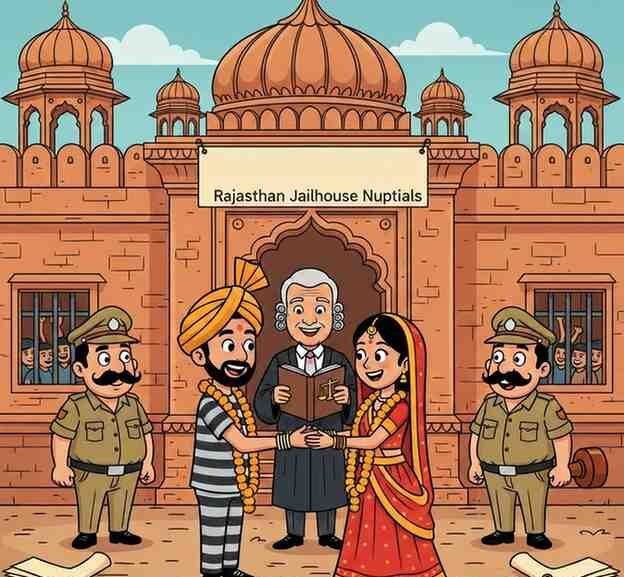
Jailhouse Wedding in Rajasthan: Two life-sentence convicts are planning to get married inside an open jail in Rajasthan, which has given rise to a debate regarding the rights of such inmates, rehabilitation, as well as the legal status quo regarding such nuptials inside a jail or behind bars. Here’s a detailed, simplified explanation regarding the same.
Jailhouse Wedding in Rajasthan: What’s the Story?
Speaking of legal affairs in the Indian state of Rajasthan, the topic of two life-term convict inmates set to marry each other while still in an open jail has recently gone viral in various forms of media and social circles. This topic has found its way into the limelight not necessarily because of popular celebrity connections but due to the conceptual significance of the rights of inmates in the context of the concept of justice and reformative justice in the country.
The main difference between an open jail and a conventional prison is that under the Open Jail Policy in Rajasthan, prisoners, particularly those who have demonstrated good conduct and whose rehabilitation is near, have the opportunity to live and work in an unfettered manner. It is under such circumstances that the jail authorities allowed the marriage.
Why Is This Jailhouse Wedding Going Viral?
This case has gone viral for several reasons:
- Life-term convicts rarely receive such permissions, making the decision unusual
- It challenges public perceptions about punishment versus reformation
- It highlights the human rights of prisoners, including the right to family life
- It revives discussion on whether imprisonment suspends or merely restricts fundamental rights
The idea of a wedding taking place inside a jail—especially involving convicts sentenced to life imprisonment—has triggered intense debate across legal, social, and political circles.
What Is an Open Jail and Why Does It Matter Here?
Rajasthan is famous for housing India’s best-organized system of an open jail. The system of an open jail is based on the principle:
- Prisons do not deprive inmates of their humanity
- Discipline, responsibility, helpfulness, good manners,
- Merging gradually into society helps prevent relapses
Inmates of the open jail may work, may receive wages for the work done, may stay with family members, and may remain associated with people, within certain limitations.
The jailhouse wedding has actually been sanctioned as part of this reformative legal theory, not as an exception to it, but as an administrative policy.
Is Marriage a Legal Right for Prisoners in India?
Indian courts have repeatedly held that prisoners do not lose their fundamental rights upon incarceration, except those restricted by the nature of imprisonment.
Key legal principles include:
- Article 21 of the Constitution protects the right to life and personal liberty
- The right to marry has been recognized as part of personal liberty
- Courts have allowed parole or special permission for marriages in past cases
In this context, jail authorities have discretionary powers to permit marriages if:
- There is no security threat
- The inmate’s conduct is satisfactory
- The request aligns with reformative objectives
Why This Case Is Important for Prison Reform
This jailhouse wedding is more than a human-interest story—it has long-term implications for prison administration and criminal justice reform:
Shift From Punishment to Rehabilitation
The case reinforces the idea that imprisonment is not only about punishment, but also about preparing inmates for lawful social life.
Recognition of Emotional and Social Needs
Allowing marriage acknowledges that emotional stability can reduce aggression, depression, and repeat offenses.
Policy Precedent
While not a judicial order, the decision may encourage other states to revisit restrictive prison policies.
Public Reaction: Support and Criticism
Supporters argue:
- Prisoners are still human beings
- Marriage can promote responsibility and reform
- Denying such rights worsens isolation and mental health
Critics argue:
- Life convicts should not receive “privileges.”
- Victims’ families may feel justice is diluted
- There isa risk of misuse of leniency
This divide reflects India’s ongoing struggle between retributive justice and reformative justice.
Conclusion
The jailhouse wedding of two life-term convicts in a Rajasthan open jail has sparked a necessary national conversation. At its core, the issue is not about celebration inside prison walls, but about how India views justice, dignity, and the purpose of incarceration.
As prison reforms gain momentum and courts increasingly emphasize human rights, such cases may become less shocking—and more accepted—as part of a modern criminal justice system.
Frequently Asked Questions (FAQ): Jailhouse Wedding in Rajasthan
Can life-term convict prisoners get legally married in India?
Yes. The law of the land does not prohibit life-term convicts. Permissions depend on the conduct and administration of the jail authorities.
What is an open jail?
An open jail is a prison facility for inmates with good behavior. Inmates in an open jail have the opportunity to work and prepare for a life outside the prison with far fewer restrictions.
Does marriage reduce a prisoner’s sentence?
No. Marriage has nothing to do with the length of the sentence. Marriage is only considered to be a social right.