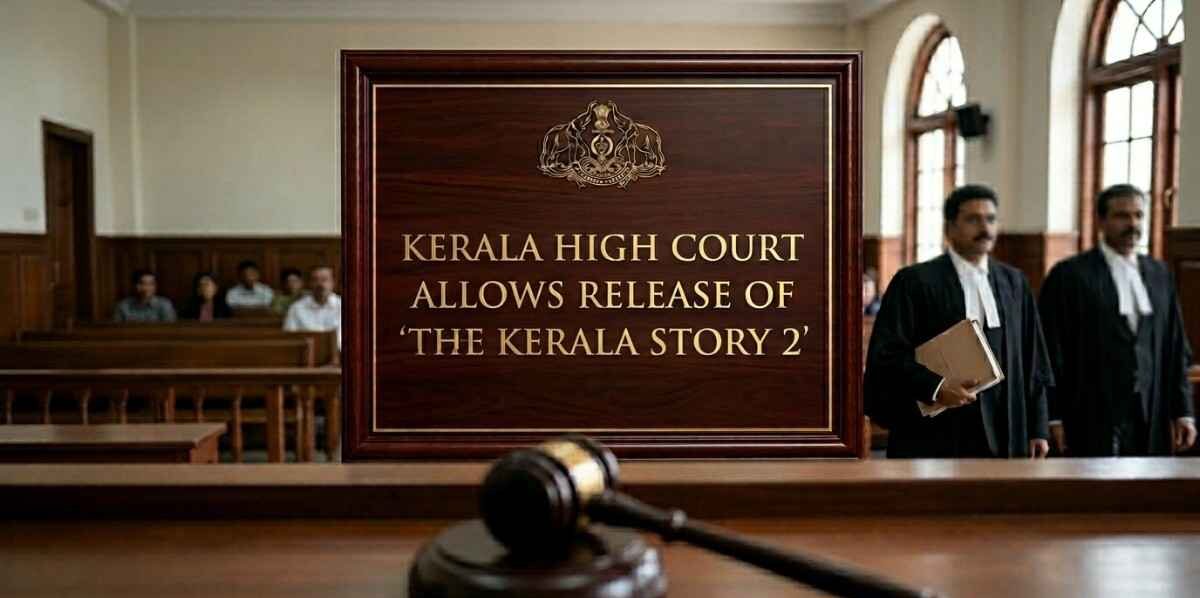
The Kerala High Court permits the release of The Kerala Story 2: Goes Beyond after a tribunal pause citing communal harmony concerns.
Introduction
In a significant development for Indian film law and constitutional jurisprudence, the Kerala High Court intervened to allow the theatrical release of the film The Kerala Story 2: Goes Beyond after a tribunal had temporarily paused its screening over concerns relating to communal harmony.
The case once again brings into sharp focus the delicate balance between freedom of expression under Article 19(1)(a) of the Indian Constitution and the reasonable restrictions under Article 19(2), particularly in matters involving sensitive religious and social themes.
This article provides a comprehensive legal breakdown of the dispute, the arguments raised, the court’s reasoning, and the broader constitutional implications.
Background of the Dispute
The Kerala Story 2: Goes Beyond is reportedly a sequel addressing controversial socio-political themes. Shortly before its scheduled release, a state-level film review tribunal intervened and paused the screening of the film, citing concerns that certain scenes might:
- Disturb communal harmony
- Aggravate religious sensitivities
- Trigger public disorder
Petitioners supporting the tribunal’s decision argued that the film contained material capable of inciting tensions in an already sensitive social climate.
The producers and distributors challenged this action before the Kerala High Court, contending that:
- The film had already obtained certification from the Central Board of Film Certification (CBFC).
- The tribunal exceeded its jurisdiction.
- The restriction amounted to unconstitutional censorship.
Legal Issues Before the Court
The High Court was required to consider several key constitutional and statutory questions:
Can a Tribunal Override CBFC Certification?
Under the Cinematograph Act, 1952, once the CBFC grants certification, a film is generally cleared for public exhibition. The court examined whether a state-level authority could effectively suspend such certification without strong legal justification.
Does the Film Violate Article 19(2)?
Article 19(1)(a) guarantees freedom of speech and expression. However, Article 19(2) permits reasonable restrictions in the interests of:
- Public order
- Decency or morality
- Sovereignty and integrity of India
- Friendly relations with foreign states
- Incitement to an offence
The court evaluated whether the tribunal had demonstrated a clear and proximate threat to public order, or whether the concerns were speculative.
Pre-Censorship vs Post-Release Liability
Indian constitutional jurisprudence traditionally disfavors prior restraint unless absolutely necessary. The court considered whether pre-release prohibition was justified or whether concerns could be addressed through law-and-order mechanisms after release if required.
Kerala High Court’s Observations
The Kerala High Court reportedly made several important observations:
Freedom of Expression Cannot Be Suppressed on Mere Apprehension
The court emphasized that mere anticipation of unrest cannot justify suppression of artistic expression. For restrictions to be valid, there must be a proximate and reasonable connection between the content and potential public disorder.
This principle has been consistently upheld in prior Supreme Court rulings where courts rejected speculative claims of disturbance.
State Must Protect Free Speech, Not Surrender to Threats
A significant constitutional doctrine reiterated by Indian courts is that the state must maintain law and order rather than silence speech because some groups threaten violence.
If restrictions were permitted solely due to threats, it would create a “heckler’s veto,” where disruptive groups could effectively control public discourse.
Certification Already Granted
Since the CBFC had already granted certification, the High Court questioned the legal authority of the tribunal to halt release without demonstrating clear statutory backing.
Balancing Communal Harmony and Artistic Freedom
The case raises a critical constitutional dilemma:
| Freedom of Expression | Public Order Concerns |
|---|---|
| Protected under Article 19(1)(a) | Restriction allowed under Article 19(2) |
| Essential to democracy | Necessary for social stability |
| Includes controversial content | Cannot incite violence |
The High Court’s intervention suggests that public order concerns must meet a high evidentiary threshold before curtailing speech.
The judiciary has consistently held that:
- Offence to sentiments alone is insufficient.
- Mature democracies must tolerate uncomfortable narratives.
- Suppression must be the last resort.
Implications for Film Industry
This ruling carries broader implications:
Reinforcement of CBFC Authority
The judgment strengthens the finality of CBFC certification and reduces uncertainty for filmmakers.
Judicial Resistance to Overreach
Courts remain cautious about administrative bodies expanding censorship powers beyond statutory limits.
Clarity on Communal Sensitivity Claims
Future challenges to film releases may require stronger, evidence-based justification rather than generalized fears.
Constitutional Principles Reaffirmed
The ruling reinforces several key constitutional doctrines:
- Proportionality Test – Restrictions must be minimal and necessary.
- Proximity Test – There must be a direct nexus between speech and disorder.
- Heckler’s Veto Doctrine Rejection – Threats cannot dictate censorship.
- Presumption in Favour of Free Speech – Especially in creative expression.
These principles strengthen India’s jurisprudence around artistic liberty.
Broader Legal Context: Film Censorship in India
Indian film law has historically seen tension between:
- Creative expression
- Political sensitivities
- Religious issues
- Electoral timing
The courts have repeatedly clarified that censorship cannot be based on:
- Hypothetical outrage
- Political pressure
- Moral paternalism
Instead, restrictions must satisfy constitutional scrutiny.
What This Means Going Forward
The Kerala High Court’s intervention signals:
- Judicial willingness to protect free speech even in sensitive cases.
- Greater scrutiny of administrative censorship.
- Continued importance of constitutional safeguards in cultural disputes.
However, it also reminds filmmakers that:
- Certification does not grant absolute immunity.
- Content that directly incites violence or hatred remains restricted under law.
Conclusion
The Kerala High Court’s decision to permit the release of The Kerala Story 2: Goes Beyond represents another important chapter in India’s evolving jurisprudence on free speech and film censorship.
The ruling underscores a fundamental constitutional principle: democracy demands tolerance of divergent and even uncomfortable narratives. While public order remains a legitimate state concern, it cannot be invoked lightly to silence artistic expression.
As debates around cinema, religion, and politics continue, this judgment serves as a reminder that constitutional safeguards remain the ultimate arbiter in conflicts between expression and order.
Frequently Asked Questions: Kerala High Court Allows Release of The Kerala Story 2
Why was The Kerala Story 2: Goes Beyond initially paused?
The film was temporarily paused by a tribunal citing concerns that it might disturb communal harmony and affect public order.
Did the film have CBFC certification?
Yes, the producers argued that the film had already received CBFC certification, making the tribunal’s intervention legally questionable.
What is the “heckler’s veto”?
It refers to a situation where speech is suppressed because of threats or objections from groups who oppose it. Indian courts generally reject this approach.