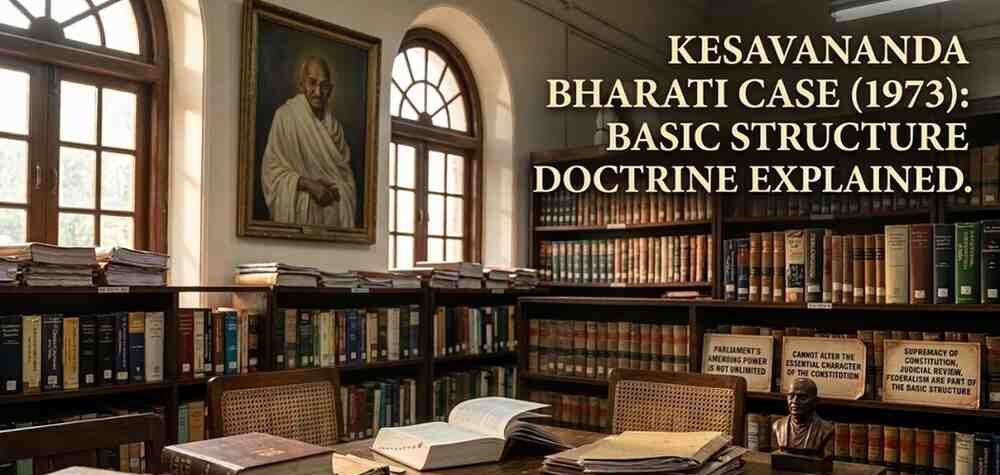
Learn about the Kesavananda Bharati case (1973), the landmark Supreme Court judgment that introduced the Basic Structure Doctrine and limited Parliament’s power to amend the Indian Constitution.
Kesavananda Bharati v. State of Kerala
The Kesavananda Bharati v. State of Kerala (1973) case is one of the most significant constitutional decisions in Indian legal history. It established the Basic Structure Doctrine, which limits the power of Parliament to amend the Constitution. The judgment ensured that while Parliament has wide authority to amend the Constitution under Article 368, it cannot alter or destroy the fundamental features that form the basic framework of the Constitution.
This case is widely regarded as a turning point in the development of Indian constitutional law because it balanced the powers of Parliament with the role of the judiciary as the guardian of the Constitution.
Historical Background
After India adopted its Constitution in 1950, the country faced serious socio-economic challenges such as inequality in land ownership, poverty, and feudal structures in agriculture. To address these issues, the government introduced land reform laws aimed at redistributing land from large landowners to landless farmers.
Many of these laws were challenged in courts because they affected the Fundamental Right to Property, which was guaranteed under Articles 19 and 31 of the Constitution (later removed in 1978).
To protect land reform laws from judicial review, Parliament passed several constitutional amendments and placed many laws under the Ninth Schedule, making them immune from court scrutiny.
Conflicts between Parliament and the judiciary increased during this period. The courts were concerned about protecting fundamental rights, while Parliament argued that constitutional amendments were necessary for social and economic reforms.
This conflict led to several important cases before the Supreme Court.
Early Constitutional Cases
Before the Kesavananda Bharati case, the Supreme Court had already examined the issue of Parliament’s power to amend the Constitution in earlier judgments.
Shankari Prasad v. Union of India
The Court held that Parliament had the power to amend Fundamental Rights through constitutional amendments under Article 368.
Sajjan Singh v. State of Rajasthan
The Court again upheld Parliament’s power to amend Fundamental Rights.
Golaknath v. State of Punjab
This case changed the legal position. The Supreme Court ruled that Parliament could not amend Fundamental Rights. According to the Court, constitutional amendments were considered “law” under Article 13, and therefore they could not violate fundamental rights.
This decision created tension between the judiciary and Parliament.
Constitutional Amendments Before the Case
In response to the Golaknath judgment, Parliament passed several constitutional amendments to restore its power to amend the Constitution.
24th Constitutional Amendment (1971)
The Twenty-fourth Amendment of the Constitution of India explicitly stated that Parliament has the power to amend any part of the Constitution, including Fundamental Rights.
25th Constitutional Amendment (1971)
The Twenty-fifth Amendment of the Constitution of India restricted the right to property and limited the scope of judicial review over certain laws implementing Directive Principles of State Policy.
These amendments were controversial because they appeared to give Parliament unlimited power to change the Constitution.
Facts of the Case
The case began when Kesavananda Bharati, the head of the Edneer Mutt, challenged the Kerala Land Reforms Act.
The state government attempted to acquire property belonging to the Mutt as part of its land reform policies. Bharati argued that these laws violated his fundamental rights, including:
- Right to property
- Freedom of religion
- Right to manage religious affairs
During the hearing, the scope of the case expanded beyond property rights. The main question became whether Parliament had unlimited authority to amend the Constitution.
Issues Before the Court
The Supreme Court of India considered several important constitutional questions:
- Does Parliament have unlimited power to amend the Constitution under Article 368?
- Can Parliament amend or remove Fundamental Rights?
- Are there any limitations on Parliament’s amending power?
These questions had deep implications for India’s constitutional system.
Composition of the Bench
The case was heard by the largest bench in the history of the Supreme Court, consisting of 13 judges.
The bench included:
- Chief Justice S.M. Sikri
- Justices J.M. Shelat
- K.S. Hegde
- A.N. Grover
- A.K. Mukherjea
- P. Jaganmohan Reddy
- H.R. Khanna
- A.N. Ray
- D.G. Palekar
- K.K. Mathew
- M.H. Beg
- S.N. Dwivedi
- Y.V. Chandrachud
The hearing lasted 68 days, making it one of the longest cases in Indian judicial history.
Judgment of the Court
The Supreme Court delivered its judgment on 24 April 1973.
The decision was extremely close, with a 7–6 majority.
The Court ruled that:
- Parliament has the power to amend the Constitution.
- However, this power is not unlimited.
- Parliament cannot alter or destroy the basic structure of the Constitution.
This principle became known as the Basic Structure Doctrine.
Basic Structure Doctrine
The Basic Structure Doctrine means that certain fundamental features of the Constitution are beyond the reach of Parliament’s amending power.
Although the Court did not provide a complete list, several elements were identified as part of the basic structure:
- Supremacy of the Constitution
- Republican and democratic form of government
- Secularism
- Federalism
- Separation of powers
- Rule of law
- Judicial review
- Independence of the judiciary
- Balance between Fundamental Rights and Directive Principles
Parliament can amend the Constitution, but it cannot destroy or damage these essential features.
Importance of Justice H.R. Khanna
One of the most crucial opinions in the case was given by Justice H.R. Khanna.
His judgment acted as the decisive vote that created the majority. He agreed that Parliament could amend Fundamental Rights but insisted that it could not alter the basic structure of the Constitution.
Without his opinion, the outcome of the case might have been different.
Impact on Indian Constitutional Law
The Kesavananda Bharati judgment had a profound impact on the Indian constitutional system.
Limitation on Parliamentary Power
The decision ensured that Parliament could not misuse its amendment powers to destroy democratic principles.
Strengthening of Judicial Review
The Supreme Court confirmed its role as the guardian of the Constitution.
Balance Between Parliament and Judiciary
The case created a balance between Parliament’s authority to amend laws and the judiciary’s responsibility to protect constitutional values.
Protection of Democracy
The Basic Structure Doctrine prevents any government from turning India into an authoritarian system through constitutional amendments.
Later Cases Applying the Doctrine
The Basic Structure Doctrine has been applied in several later cases.
Indira Nehru Gandhi v. Raj Narain
The Court used the doctrine to strike down a constitutional amendment that attempted to protect the election of the Prime Minister from judicial review.
Minerva Mills v. Union of India
The Court said again that Parliament can’t disrupt the balance between Fundamental Rights & Directive Principles.
Waman Rao v. Union of India
The Court applied the doctrine to review laws placed in the Ninth Schedule after 1973.
These cases strengthened the Basic Structure Doctrine and made it a central principle of Indian constitutional law.
Criticism of the Judgment
Although widely respected, the judgment has also faced criticism.
Some critics argue that:
- The Basic Structure Doctrine is not specifically mentioned in the Constitution.
- The doctrine gives the courts too much power.
- Judges, rather than elected representatives, decide what constitutes the basic structure.
Despite these criticisms, most constitutional scholars believe the doctrine is essential for protecting democracy.
Significance for Indian Democracy
The Kesavananda Bharati case is often described as the most important constitutional judgment in India.
Its significance includes:
- Preserving the identity of the Constitution
- Preventing misuse of constitutional amendment powers
- Protecting democratic governance
- Maintaining constitutional stability
- Strengthening the role of the judiciary
The doctrine ensures that even a powerful majority in Parliament cannot fundamentally alter the nature of the Constitution.
Conclusion
The Kesavananda Bharati v. State of Kerala (1973) case remains a landmark in the constitutional history of India. By establishing the Basic Structure Doctrine, the Supreme Court created a vital safeguard against the misuse of constitutional amendment powers.
The judgment struck a careful balance between the authority of Parliament and the responsibility of the judiciary to protect the Constitution. It ensured that essential principles such as democracy, rule of law, judicial review, and federalism remain intact.
Even decades after the decision, the Basic Structure Doctrine continues to play a crucial role in maintaining the stability and integrity of the Indian constitutional system. The case demonstrates how the judiciary can protect constitutional values while allowing the Constitution to evolve through amendments.
For this reason, the Kesavananda Bharati judgment is widely regarded as the cornerstone of Indian constitutional law and a powerful protector of democratic governance.