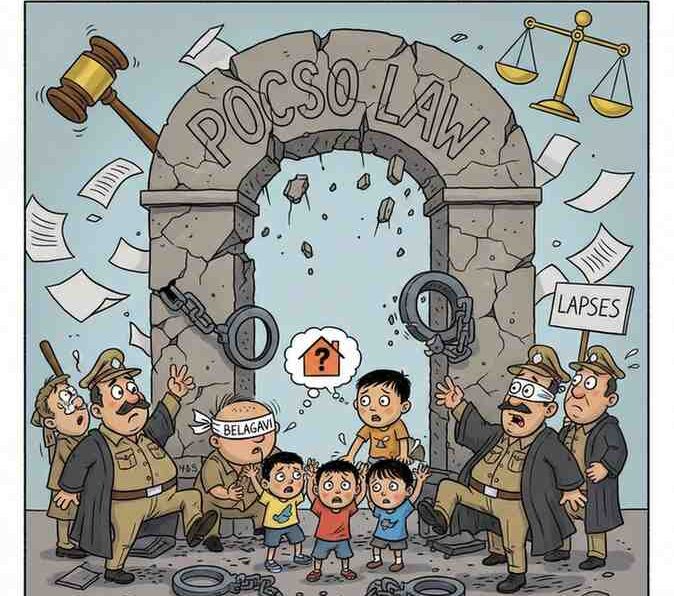
An official inquiry in Belagavi has found three police officers guilty of procedural lapses in a POCSO case.
Introduction
An official inquiry in Belagavi, Karnataka, has found three police officers guilty of procedural failures in a case filed under the Protection of Children from Sexual Offences (POCSO) Act, 2012. The investigation has found that the officers did not follow the legal protocols that are mandatory by law, resulting in the communication of the need for the imposition of disciplinary sanctions.
The matter of law enforcement once again comes to the forefront with this incident that illustrates how the police are instrumental in dealing with the sensitivity of such issues as sexual offences against minors.
What Is the POCSO Act, 2012?
The Protection of Children from Sexual Offences (POCSO) Act, 2012, is a special law that aims at protecting children below 18 years from the following:
- Sexual assault
- Sexual harassment
- Pornographic offences
The Act provides for child-friendly processes, limits the time of the investigations, and requires both the police and the judicial authorities to abide by it strictly. If the police or any other authority deviate from the steps given in the Act, they not only risk violating the child’s rights but also make it difficult for the case to be prosecuted, which, in effect, leads to the obstruction of justice.
Belagavi POCSO Case: What the Inquiry Revealed
Background
The POCSO case in Belagavi was alleged to have been mishandled by the police; hence, it was under the spotlight. After an initial investigation, it was decided to conduct a
Key Findings
The inquiry determined that three officers had committed several procedural lapses, including:
- Failure to comply with the mandatory provisions of the POCSO Act
- Delayed or negligent performance of legal duties
- Non-adherence to child-friendly procedures
- Errors in documentation and investigation
These lapses were deemed serious enough to warrant departmental disciplinary proceedings.
Common Procedural Lapses Under POCSO Law
Delay in Registering the FIR
Under the POCSO, the FIR must be registered immediately upon receiving information. Delays can cause emotional distress to the child and weaken the evidence.
Improper Recording of the Child’s Statement
Statements must be recorded:
- By a woman police officer, whenever possible
- In a child-friendly setting
- Without intimidation or coercion
Failure to Inform the Child Welfare Committee (CWC)
The police must notify the CWC within 24 hours of receiving information about a POCSO offence.
Violation of Confidentiality
Revealing the child’s identity is a serious offence under the law.
Delay in Medical Examination
Medical examinations must be carried out promptly, with proper consent and in accordance with legal procedure.
Legal Consequences for Police Officers
Departmental Action
The inquiry recommended disciplinary action, which could include:
- Suspension
- Withholding salary increments
- Adverse remarks in service records
- Dismissal in severe cases
Criminal Liability
Officers may also face criminal charges, such as
- Section 166A IPC (public servant disobeying the law)
- Contempt of court
- Action under service regulations
Why Strict Compliance With POCSO Is Essential
- Protection of Child Rights
The Act enforces the constitutional duty to protect children from abuse and exploitation. - Strengthening Prosecution
Procedural lapses can lead to acquittals, weak evidence, and loss of public trust in the justice system. - Preventing Secondary Victimization
Insensitive handling of victims can cause further trauma and defeat the very purpose of the law.
Judicial Perspective on Police Lapses
Indian courts have consistently ruled that
- Compliance with POCSO procedures is mandatory, not optional.
- Police lapses must be treated seriously.
- Accountability is crucial for justice.
High Courts and the Supreme Court have repeatedly directed action against officers found guilty of negligence in POCSO cases.
Impact of the Belagavi Case
The Belagavi inquiry stands as
- A warning to law enforcement authorities
- A reminder of the seriousness of child protection laws
- An example of accountability within the system
This case is expected to encourage better training, monitoring, and compliance within police departments across the state.
Frequently Asked Questions (FAQs) on Belagavi POCSO Police Lapses Case
What is the POCSO Act?
The POCSO Act, 2012, is a law designed to protect children under 18 from sexual offences and ensure a child-friendly justice process.
What happened in the Belagavi POCSO case?
Three police officers were found guilty of procedural lapses during the investigation of a POCSO case, leading to disciplinary recommendations.
Can police officers be punished for such lapses?
Yes. Officers may face both departmental and criminal action for failing to follow mandatory procedures.
Why are procedural lapses serious?
Because they can harm the child, weaken the prosecution, and damage public trust in the justice system.
Conclusion
The Belagavi POCSO inquiry underscores the need for a zero-tolerance approach to crimes against children. While the law provides robust protection mechanisms, its effectiveness depends on the integrity and accountability of those enforcing it.
Disciplinary action against negligent officers is not just punitive—it’s an essential step toward rebuilding trust and strengthening the child protection system.