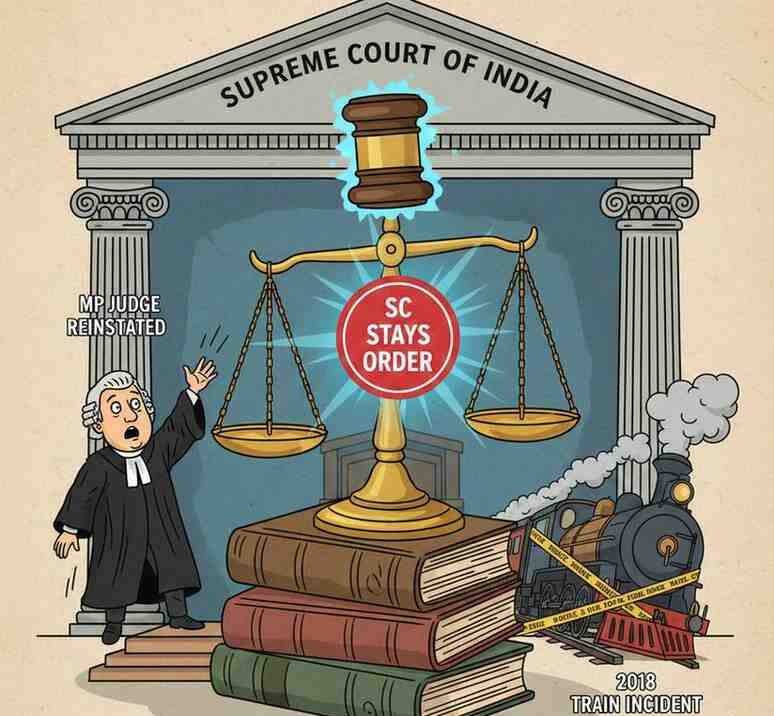
The Supreme Court has refused to set aside an order by which it stayed the reinstatement of a Madhya Pradesh-based civil judge, allegedly involved in committing indecency on board Bhopal-bound Train Number 22185. Read a comprehensive, plagiarism-free legal analysis with redacted facts and law to be up-to-date on rulings, ethics issues, and frequently asked questions.
Introduction
In a scathing intervention, the Supreme Court of India has stalled the reinstatement of Madhya Pradesh civil judge Navneet Singh Yadav, who was dismissed over serious misconduct during a train journey in 2018. Calling the alleged conduct “disgusting” and one of the “grossest grave misconducts,” observations of the apex court have resurrected discussions relating to judicial ethics, departmental discipline, and a criminal acquittal’s minimal effect on service law proceedings.
It is an important case not just because of the sordid accusations at stake, but also because it updates how courts are supposed to balance individual liberties with the institutional integrity of the judiciary.
Background of the Case
The 2018 Train Incident
The controversy dates back to 2018 when an altercation took place on a train journey from Indore to Jabalpur. Navneet Singh Yadav was then posted as Civil Judge (Class-II) in Madhya Pradesh.
And, based on allegations that were ultimately filed in departmental charges:
- The judge was on an unauthorized visit without informing his superiors in advance.
- He was believed to have been drinking on the drive.
- He was accused of misbehaving with co-passengers as well as railway workers and causing obstruction in the duty of a Travelling Ticket Examiner (TTE).
- The main charge against him is that he had thrown his underwear and urinated inside the train compartment in front of a woman passenger.
- He is also charged with ‘flashing his judicial identity card’ to intimidate others.
His arrest under the provisions of the Railways Act followed a complaint by ticket-checking staff. He was also accused of not informing the High Court or his controlling authorities after obtaining bail, thus aggravating the offence.
Criminal Case vs Departmental Inquiry
Criminal Proceedings and Acquittal
In the criminal trial, crucial witnesses—including the TTE and the woman passenger—became hostile. As the prosecution could not bring any corroborative evidence, the trial court discharged Yadav after finding that it had failed to prove the charges beyond a reasonable doubt.
Critically, this was not a judicial determination that the incident never happened; evidence of what occurred is more than legally sufficient.
Departmental Inquiry and Termination
Simultaneously, along with the criminal case, the Madhya Pradesh High Court had also ordered a departmental inquiry, which goes by a lower standard of proof than ‘beyond a reasonable doubt,’ called preponderance of probabilities.
The inquiry concluded that:
- Charges of gross misconduct, obscenity, abuse of authority, and administrative issues were substantiated.
- Multiple witnesses supported the findings.
The report of inquiry was accepted by the Administrative Committee and thereafter by the High Court, and removal from service was recommended. As a result, the governor passed an order for Yadav’s dismissal in September 2019.
Reinstatement Order of M.P. High Court in 2025
A Division Bench of the Madhya Pradesh High Court in May 2025 had quashed the Termination Order on Yadav’s writ petition under Article 226 of the Constitution.
The Bench held that:
- The dismissal of the criminal charges undermined the grounds of the departmental proceeding.
- The penalty of dismissal was excessive.
- Only procedural breaches warranted anything other than a slap on the wrist.
In view thereof, the court ordered reinstatement with full back wages, a judgment that was criticized by the High Court’s own administrative side.
Supreme Court’s Intervention and Observations
The High Court administration had taken the reinstatement to the Supreme Court. The Bench of Justices Vikram Nath and Sandeep Mehta stayed the order of reinstatement while hearing the matter.
Key Oral Observations
The Supreme Court leveled harsh comments during oral arguments, such as
- Describing the alleged behavior as “disgusting” and “shocking.”
- Pointing out there was a woman at the scene.
- Exhibiting apprehension about a witness being declared as hostile in the criminal trial.
However, the Court gave notice in this regard to the parties and clarified that judicial officers are at a higher pedestal concerning their conduct on duty and off duty.
Legal Principles Involved
Different Standards of Proof
- Criminal Procedure: Onus of proof beyond a reasonable doubt
- Departmental Proceedings: Preponderance of probabilities
The Indian precedents are clear—it is well-settled that a criminal acquittal does not ipso facto result in the squashing of disciplinary action, especially where prosecution has failed for want of evidence and not on merits.
Limited Scope of Judicial Review
The High Courts, under Article 226, would consider:
- Procedural fairness, legality of the inquiry, and manifest arbitrariness
They aren’t supposed to re-appreciate the evidence or second-guess their own sense of punishment, except when a penalty is shockingly disproportionate.
Higher Ethical Standards for Judges
Judges, restrained by normative structures like the Restatement of Values of Judicial Life, must maintain dignity, integrity, and public confidence. “Now if we can find that a judge is abusing his position by committing offenses outside of court, then the credibility of the judiciary suffers on all levels.”
Broader Implications
- Judicial Accountability: The case promotes zero tolerance against behaviour unbecoming of judicial officers.
- Lack of Legal Clarity: It reinforces the notion that administrative law is independent from criminal adjudication.
- Public Confidence: The stance of the Supreme Court is an indication that preserving confidence in the judiciary is essential.
- Future Precedent: The eventual decision may influence how courts treat proportionality and review in cases about judicial misconduct.
Conclusion
The Apex Court staying the order of reinstatement of Navneet Singh Yadav makes a strong case that judicial office requires personal and professional probity. The case recalls a familiar lesson: criminal acquittals, particularly on grounds as dubious as those involving hostile witnesses, are not an automatic eraser of findings of serious departmental misconduct.
With further development of this matter through future decisions of the Court, the final judgment will likely provide greater clarity around judicial review, disciplinary autonomy, and ethical accountability, helping to safeguard the sanctity of the judiciary.
Frequently Asked Questions (FAQ): SC Stays Order Reinstating MP Judge in 2018 Train Incident
Why did the Supreme Court stay the judge’s reinstatement?
Because the charges were seen as highly irregular under service rules and reflected poorly on judicial integrity.
Can one escape departmental punishment after criminal acquittal?
No. Criminal and departmental proceedings are independent and follow different standards of proof.
Whether the High Courts interfere in punishments awarded in disciplinary matters?
Only when the punishment is arbitrary, unlawful, or shockingly disproportionate.