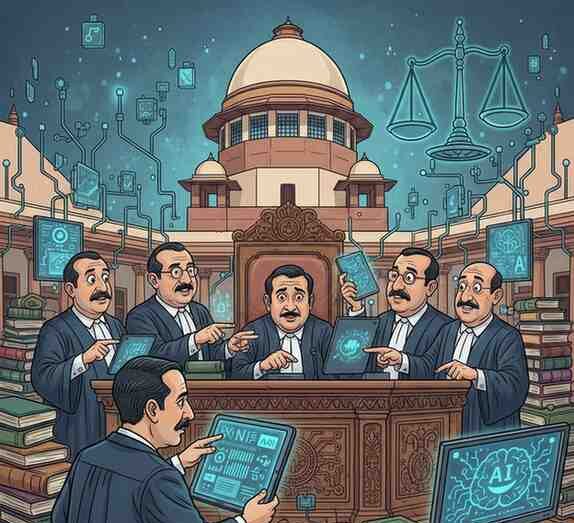
Supreme Court of India Discovers AI-Generated Judgements: Recently, India’s Supreme Court has exposed hundreds of AI-produced judgements in the context of high-profile corporate litigation, raising serious concerns about legal authenticity and document authentication while testing the future of AI regulation across India.
Introduction: A Shockwave Through India’s Legal System. The conviction sent a shock wave through India’s legal system.
AI Supreme Court Finds Record Number of AI-Generated Forgeries in Ongoing High-Stakes Corporate Battle. An unprecedented number of fake judicial documents are being deployed for shady business practices, including from an Indian Supreme Court case. This revelation—deemed one of the most grave dangers to judicial credibility—raises urgent questions about digital forgeries, AI abuse, verification standards, and possible erosion of trust in the judiciary if fraud goes unchecked.
As artificial intelligence tools become more advanced and accessible when it comes to imitating real legal writing, this episode is a telling sign of the downside of tech development and why India needs stricter AI regulation now.
What Exactly Happened? A First-of-Its-Kind AI Fraud Discovery
Several so-called “precedents” and “court orders” offered by parties in a high-profile corporate litigation were discovered to be manufactured records that had been generated using artificial intelligence text-generation tools, according to the Supreme Court’s own findings.
These documents:
- Imitated the language used in real Indian court judgements
- Included fake bench details
- Quoted non-existent case numbers
- Cited fabricated legal principles
- Referenced imaginary precedents
The documents were left unsuspected at first glance because of their high linguistic quality, themselves also reflecting the stage of advancements current generative AI is capable of.
However, discrepancies emerged when:
- Bench numbers didn’t correlate with court databases
- The case reference is lost
- Some legal reasoning diverged from settled case law
- The format of the style was slightly different from official norms
This set off an internal investigation that culminated in, as the court described them, “hundreds of AI-generated fake judgments.”
Why This Is a Landmark Moment in Indian Legal History
This is believed to be the first recorded case in which India’s top court has grappled with AI-powered legal forgery on this scale. The implications are massive:
Threat to Judicial Integrity
If manufactured judgments seep into the legal record, they can mislead judges, taint ongoing litigation, and corrupt potentially binding legal precedent.
Corporate Warfare and AI as a Weapon
The case underscores how corporate adversaries can manipulate technology to sabotage lawsuits or muddy judicial inquiry.
Distrust of Legal Documentation
Courts place great emphasis on written submissions. AI-powered forgeries have the potential to shake up this trust.
Challenges for Lawyers and Paralegals
Unaware that a team of black swans hovering above flap their wings by typing on keyboards, legal teams inadvertently cite AI-generated content and risk legal malpractice.
How the Fraud Unfolded
The registry of the Supreme Court and its research wing were instrumental in identifying anomalies. Here’s how:
Cross-Verification of Citations
Clerks discovered that several cited cases never had been, or were no longer featured in:
- SCC (Supreme Court Cases) journal
- AIR (All India Reporter) archives
- Court Information System databases
Linguistic Fingerprint Analysis
Though stylistically similar, the judgments:
- Lacked typical judicial nuance
- Contained redundant verbosity
- Used AI-like repetitive phrasings
- Omitted statutory citations that are customarily included in genuine judgments
Digital Metadata Examination
The metadata exposed:
- Non-judicial authorship
- AI model signatures
- Inconsistent timestamp patterns
Verification Against Physical Records
In several cases, decrees supposedly several years old were found, for which no physical copies could be located, raising immediate suspicions.
What Does This Say About India’s Judiciary Going Forward?
The discovery will prompt India to reconsider how it treats AI and digital documents. Some expected consequences:
Stricter Document Verification Protocols
Courts may require:
- Digital signatures
- Blockchain-backed case records
- QR-secured court orders
- Mandatory filing through authenticated portals
New AI Regulation Laws
The matter can expedite the enactment of legislation, including:
- Digital India Act (expected)
- IT Rules amendments
- AI governance frameworks
Training for Judges & Lawyers
Courts will need modules on:
- AI literacy
- Detecting machine-generated content
- Cyber-forensics
Liability and Accountability
Questions arise:
- Should lawyers be punished for the AI documents they submit?
- Should corporations face sanctions?
- What are the rules for using AI for legal drafting?
Why AI Misses What The Devices Can’t See
Modern generative AI models:
- Perfectly mimic legal writing styles
- Create realistic case citations
- Invent plausible—but false—legal arguments
- Reconstruct judge-signature formats
- Generate entire judgments within seconds
Four decades on, digital verification is struck: even the most seasoned legal experts can be snookered.
The Path Forward: Here’s What Experts Say
- Compulsory E-Signature on All Judgements
Every judgment should carry:
- A unique hash
- A verifiable digital signature
- Automated authenticity checks
- AI-Detection Tools for Courts
Courts may deploy:
- AI-content classifiers
- Citation-verification bots
- Text similarity algorithms
- A Legal AI Usage Code
Such guidelines may include:
- Including a line in drafts about being assisted by AI
- Ethical boundaries for generative tools
- Ban on AI-generated case citations
- Criminal Penalties for AI-Driven Forgery
AI-powered digital forgery might soon be treated as:
- Tampering with court evidence
- Obstruction of justice
- Cybercrime under IT Act provisions
Conclusion: A Watershed in India’s Legal Future
What the Supreme Court’s unearthing of AI-generated judgments is not just a scandal—it should serve as a wake-up call for the judiciary, legal community, and policymakers.
At a time when India is getting ready for a significantly digital future, the requirement for
- stronger AI regulation,
- better document authentication, and
- enhanced courtroom cyber-security
has never been clearer.
That AI may be an important ally in the pursuit of justice—but without guardrails, it could also become a powerful weapon against it.
Supreme Court AI-Generated Judgment Scandal FAQs
Has legal drafting now prohibited the use of AI?
No, but courts are likely to force disclosure and exercise more stringent verification.
How did the fake judgments come to light?
Through:
Citation checks
Metadata analysis
Linguistic inconsistencies
Cross-verification with official archives
Will this case change the Indian justice system?
Almost certainly. It will accelerate:
Digital authentication of documents
AI governance laws
Training in an AI detection tool