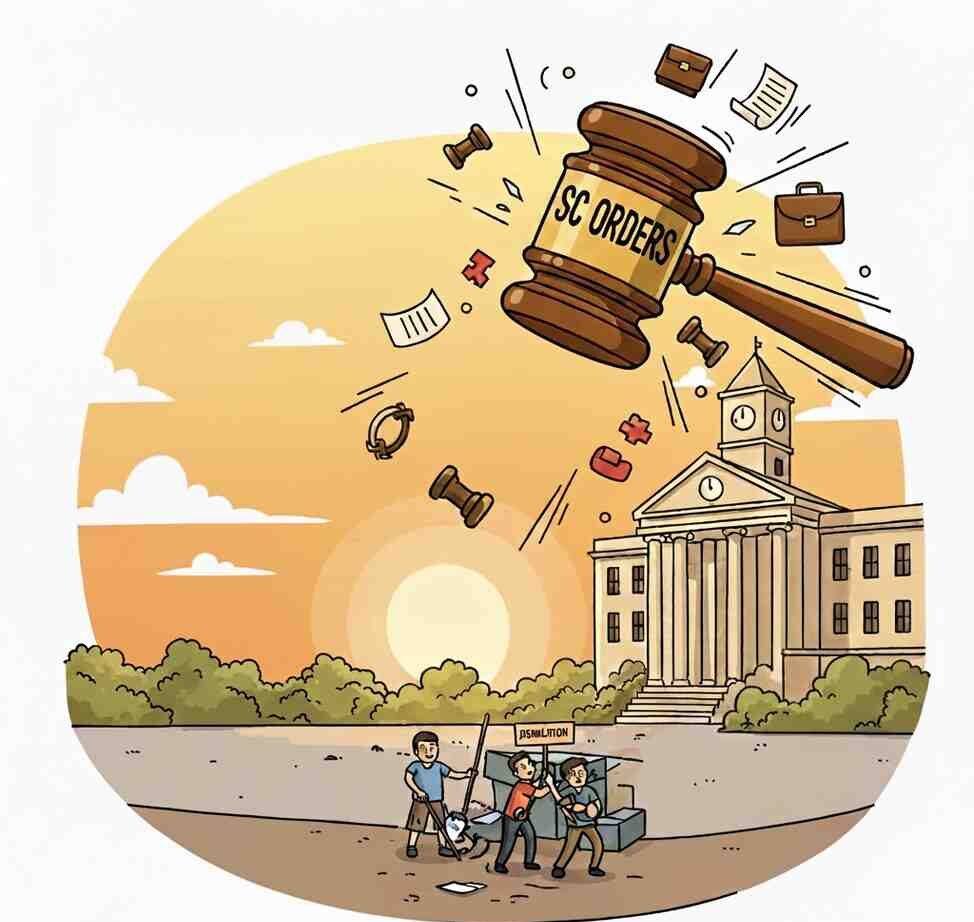
SC orders expeditious disposal of 170-odd vendor and land encroachment cases in Chandigarh: The Supreme Court of India has issued a significant directive aimed at improving judicial efficiency and strengthening urban law enforcement. In its order, the apex court instructed the Punjab & Haryana High Court to dispose of more than 170 pending cases related to unauthorized vending and illegal land occupation in Chandigarh within a strict timeline of three weeks.
Clear Vendors Fast: SC to Administration (Detailed Reasoning), 10th September, 201.
The Indian Supreme Court has given a landmark order to enhance the efficacy of the judicial process and urban police. DPO_1180911 – SC directed the Punjab & Haryana High Court to decide over 170 pending cases of unauthorized vending and illegal land possession in Chandigarh within three weeks.
This signals the Supreme Court’s increasing anxiety over endless litigation, particularly those involving urban planning, public land management, and civic order.
Background of the Case
Disputes related to the following types of disputes— Being a centrally administered Union Territory, Chandigarh has seen an increase in:
- Unauthorized street vendors
- Illegal occupation of public land
- Buildings sprawl across roads, markets, and public areas
Eventually, more than 170 such cases began to pile up before the Punjab & Haryana High Court, which led to enforcement difficulties and administrative hurdles for local administration.
Taking the gravity of the situation into account, it went to the Supreme Court on pendency, and its wider impact on governance was suitably discussed.
Supreme Court’s Observations
The key points highlighted by the Supreme Court:
- Justice delayed is justice denied: Cases languishing in courts dilute deterrent effects and fuel further violations.
- Cities need timely adjudication of claims: Cities like Chandigarh rely on efficient dispute resolution mechanisms for planned development.
- We Can’t Allow These Incursions into Public Land: Ditto that we cannot let the cancerous habit of squatting on public land continue its way through traffic, sanitation, and safety space.
While there is no dispute that procedural delays cannot come in the way of public interest, this was also set out by the Court.
Order – Punjab & Haryana High Court
The Supreme Court directed that:
- Every case of unauthorized vending and land grabbing that is pending before any authority or court would be heard and disposed of within three weeks.
- The Supreme Court should take fast-track procedures where it is legally able.
We cannot afford to let these issues drag on, including administrative inertia.
This order is obligatory and reflects the Supreme Court’s supervisory authority over the proper operation of our courts.
Impact on Vendors and Authorities
For Street Vendors
Legitimate sellers doing everything aboveboard likely would be the beneficiaries of clear rules and quicker decisions.
Illegitimate sellers could be evicted or fined for breaking the law.
For Government Authorities
Local and government authorities will have legal certainty to enforce rules.
Quicker judgments will facilitate the recovery of public land and make space for urban development schemes.
Significance of the Order
The significance of this decision lies in the fact that it:
- Establishes and budgets for deadlines on serving justice.
- Strengthens urban law enforcement
- Sends a message that public land attacks cannot be tolerated
- Urges HC to cut down the pendency of cases aggressively
It could also set a precedent for other states and cities grappling with similar problems.
conclusion
The directive of the Supreme Court also highlights the need for efficient justice delivery and improved urban regulation. The prompt disposal of long-pending vendor and land encroachment cases has reimposed the
Frequently Asked Questions (FAQs) Supreme Court Orders Quick Clearance of Vendor Cases in Chandigarh
Why did the Supreme Court step in on these cases?
The Supreme Court took suo motu cognizance of the “prolonged unauthorized-bazaar-establishment-response-litigation drawn process” and delay in deciding illegal vending/land encroachment cases, which were affecting urban governance and public interest in Chandigarh.
How many cases does this directive pertain to?
The collectorate at present has over 170 cases against unauthorized vending/illegal land occupation.
What is the Supreme Court’s timeline?
The Punjab & Haryana High Court will have to hear and adjudicate on all these cases in three weeks.
Does this order apply to all street vendors?
No. The order also remains aimed at encroachers and squatters. Then there is the issue of legality; legitimate vendors are not automatically affected.