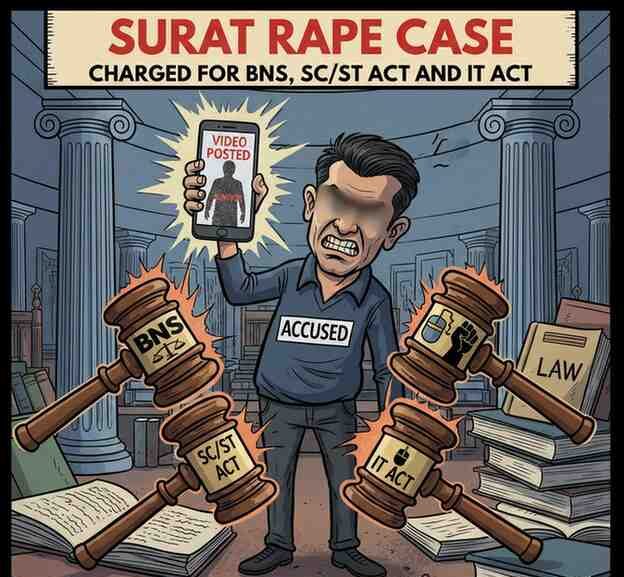
A horrifying rape incident has come to light in Varachha, Surat, where the accused took and shared the victim’s video on social media against her will. To know more details about the case, charges under the Bharatiya Nyaya Sanhita, SC/ST Act, IT Act, and ongoing police action.
Introduction
A shivery crime case in Surat’s Varachha area of Gujarat has shaken the entire nation, where a man reportedly forced himself on a woman, filmed the act, and released the video on social media to harass her by asking for sexual favours from her. The case has pointed to serious issues of digital sexual crimes, social media misuse, and victim protection in India.
Police have been quick to respond, filing a case under several stringent laws such as the Bharatiya Nyaya Sanhita (BNS), the SC/ST (Prevention of Atrocities) Act, and the Information Technology Act.
What Was the Surat Case About?
According to the police investigation:
- The suspect, a 33-year-old man, reportedly sexually assaulted the victim.
- He had filmed videos of the explicit attacks without her knowledge.
- Following the incident, he distributed the videos to others and reportedly made a fake Instagram account in the victim’s name containing the content.
- The videos, used to abuse, threaten, and blackmail the survivor, had led to her seeking external help due to extreme mental trauma.
As the content got into circulation, the police became aware of it and took prompt legal action.
Legal Provisions Invoked
The Surat police have filed an FIR within the ambit of provisions of hard-hitting laws like:
Bharatiya Nyaya Sanhita (BNS)
The new BNS includes provisions on:
- Rape
- Criminal intimidation
- Voyeurism
- Violation of privacy
These carry severe penalties, including life imprisonment.
SC/ST (Prevention of Atrocities) Act
Sections of the SC/ST Act have been included, as the victim is from a Scheduled Caste community. This law is meant to:
- Safeguard vulnerable communities from violence and exploitation
- Ensure speedy investigation and trial
- Deny bail and enforce tough punishment on the accused
Information Technology (IT) Act
Sections related to:
- Publishing or transmitting obscene material
- Violation of digital privacy
- Cyber harassment
These were inserted because of explicit content circulating on social media sites.
Police Action and Current Status
The Surat police have arrested the accused.
Computers on which the videos were recorded and shared have been confiscated for forensic analysis.
Officials are collaborating with social media companies to track, block, and take down the explicit material.
The investigation is continuing, and additional charges could be brought against him depending on the digital evidence. Police stated that there will be zero tolerance for sexual crimes and online abuse.
Impact and Public Reaction
The case garnered traction through social media and news sources because of:
- The brutal nature of the crime
- The use of social media as a blackmail tool
- The application of multiple serious laws
Women’s rights activists and legal experts have recommended:
- Faster digital content takedown mechanisms
- Stronger cybercrime enforcement
- Greater awareness around consent and online safety
Legal Significance of the Case
The case raises important concerns about India’s criminal justice system:
- The growing threat of technology-facilitated sexual crimes
- The need for new criminal laws like the Bharatiya Nyaya Sanhita
- The role of the SC/ST Act in protecting vulnerable groups
- The accountability of social media platforms in preventing abuse
It also underscores that creating or sharing sexual content without consent is a serious criminal offence—no matter the medium.
Conclusion
This incident is a grim example of how sexual violence and cybercrime can intersect, leaving lasting damage to victims. With the accused charged under the BNS, SC/ST Act, and IT Act, the case shows how seriously India’s legal system is taking these offences.
As the investigation progresses, this case will likely shape national conversations about digital safety, victim protection, and stronger penalties for tech-driven sexual crimes in India.