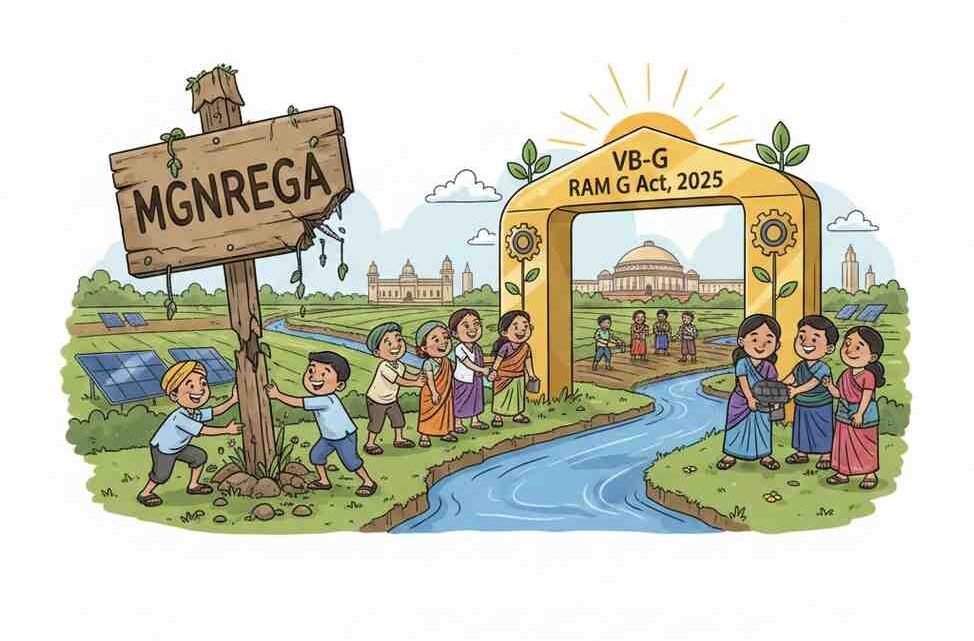
The VB-G RAM G Act, 2025, takes over from MGNREGA as India’s next rural employment act. Find out its features, objectives, differences from MGNREGA, benefits, and challenges.
Introduction
With the introduction of the Viksit Bharat—Guarantee for Rozgar and Ajeevika Mission (Gramin) Act, 2025, popularly known as the VB-G RAM G Act, rural employment policy in India is poised to go into overdrive. The law comes into force with the assent of the President, as it was approved by both houses earlier this month. This act will replace the Mahatma Gandhi National Rural Employment Guarantee Act (MGNREGA), which was enacted in 2005.
The MGNREGA was acclaimed internationally as a rights-based welfare act that provided guaranteed wage employment to rural families. The new act seeks to reorganize this framework by enhancing employment days and financial liabilities and integrating rural employment more closely with development and asset generation. But it has also prompted heated discussion on workers’ rights, federalism, and the role of social security in rural India.
Background: MGNREGA TO VB-G RAM G
MGNREGA was launched to alleviate rural poverty, unemployment, and distress migration by providing at least 100 days of unskilled manual work in a year to every rural household that required it. What made it distinctive was that workfare treated employment as a legal right, not a discretionary distribution to the deserving poor.
Twelve years back, the Conference on ‘VIVIDHA’ had passed a resolution (Resolution No. 5) calling for scrapping this two-decade-old legislation with the avowed intent of bringing rural employment in tune with India’s long-term vision of economic growth, key infrastructure, and sustainable livelihood under “Viksit Bharat.”
Aims and Objectives of the VB-G RAM G Act, 2025
The new law has several aims:
- Strengthen rural livelihood security
- Increase job prospects beyond earlier limits
- Build sustainable, productive assets in rural areas
- Improve efficiency, transparency, and accountability
- Weave job creation with climate resilience and infrastructure requirements
The government presents this Act as a move from short-term relief work to development-oriented rural employment.
Key Features of the VB-G RAM G Act
1. Enhanced Employment Guarantee
Under the VB-G RAM G Act, eligible rural households are ensured 125 days of wage employment — up from 100 days under MGNREGA. This expansion aims to provide more income stability to rural families, especially where non-farm jobs are scarce.
2. Revised Funding Structure
Funding will now follow a shared model:
- 60% from the Central Government
- 40% from State Governments
Special category states and union territories have relaxed norms. This is a major change from MGNREGA, where the Centre paid most wages, making states more fiscally responsible for implementation.
3. Seasonal Work Pauses
States can temporarily pause work during peak agricultural seasons to prevent farm labour shortages, while still ensuring workers get their full annual job quota.
4. Focused Categories of Work
Jobs will now focus on development-linked sectors such as:
- Water conservation
- Rural infrastructure and connectivity
- Livelihood asset creation
- Climate adaptation and environmental projects
This ensures that funds build lasting value instead of short-lived projects.
5. Wage Payments and Worker Protection
The law enforces prompt wage payments, generally within a fixed period after work completion, and maintains provisions for compensation in case of delays.
6. Technology-Driven Monitoring
VB-G RAM G emphasizes biometric attendance, geo-tagging, and real-time dashboards to increase transparency and curb corruption.
How VB-G RAM G Differs from MGNREGA
| Aspect | MGNREGA | VB-G RAM G Act |
|---|---|---|
| Employment days | 100 days | 125 days |
| Nature | Rights-based | Scheme-based guarantee |
| Funding | Predominantly Centre | Centre–State shared |
| Work focus | Broad categories | Development-linked sectors |
| Seasonal flexibility | Limited | Formal pause provisions |
Though the new Act adds more workdays, critics warn it transforms the “right to work” into a managed program, changing the spirit of rural employment.
Potential Benefits
- Higher Rural Incomes—More workdays boost earnings and household stability.
- Asset Creation—Long-term infrastructure and livelihood assets will strengthen rural economies.
- Better Alignment with Development Goals – Linking employment with climate and water resilience drives sustainable progress.
- Improved Transparency – Digital tracking builds trust and minimizes corruption.
Concerns and Criticisms
- Erosion of the Right to Work: Removing the explicit “right to demand work” may weaken worker protection.
- Increased Burden on States: Financially weaker states may struggle with the 40% contribution.
- Centralization: Greater central control could reduce state autonomy.
- Risk of Exclusion: Digital-only processes may exclude workers without access to technology.
Implementation and the Road Ahead
The Act has received Presidential assent, but its real success will depend on proper execution. States will need adequate funding, training, and administrative capacity to transition smoothly from MGNREGA.
The challenge lies in maintaining social security and inclusiveness while pursuing efficiency and growth.
Frequently Asked Questions (FAQs) on the VB-G RAM G Act, 2025
What is VB-G RAM G Act, 2025?
It replaces MGNREGA as India’s rural employment law, providing guaranteed jobs with updated features.
How many days of work are guaranteed?
A minimum of 125 days per household per year.
Who funds the scheme?
The Centre and states share costs in a 60:40 ratio, with special provisions for certain regions.
Are workers’ wages still protected?
Yes, the Act retains provisions for timely payment and compensation for delays.
Conclusion
The VB-G RAM G Act, 2025, marks a major reform in India’s rural employment system. It promises modernization through longer employment and development-oriented work. However, its success will depend on fair implementation and balancing efficiency with worker rights and state autonomy.