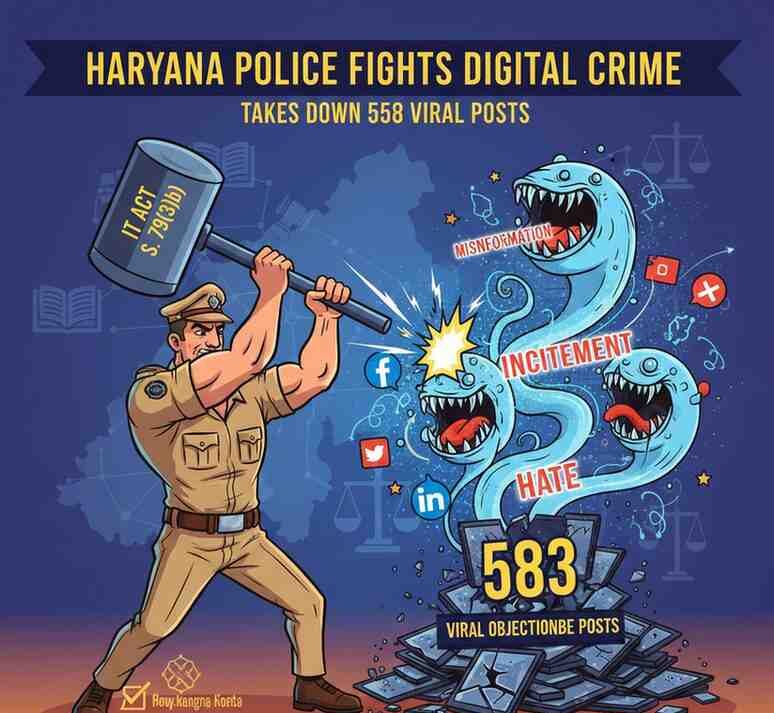
Haryana Police removes 583 viral objectionable posts under IT Act Section 79(3)(b) to curb misinformation, provocative content, and hate speech. Find out about the law and its effects.
Introduction
With the current digital era, the existence of social media platforms has proved to be a double-edged sword, as they not only enable a quick interface and engagement with groups, but they also provide a platform for the rapid spread of misinformation and hate content.
The Baggage of Offensive Online Content
The uniformed men have just struck out against the freewheeling and unbridled nature of the virtual world. It is the latest in a series of moves by the Indian law enforcement agency to keep the platforms in check through legal means, preventing the spread of viral content on social media.
Haryana Police Crackdown On Viral Objectionable Content
The Haryana Police has registered complaints related to several posts on social media containing false information, provocative material, and hate speeches against certain people or communities. On review, the authorities issued takedown notices to various platforms, including Facebook, Instagram, and Twitter (X), among others.
583 links & profiles were requested to be taken down in this time frame, proving Haryana Police’s swiftness in addressing the spread of viral objectionable content.
The flagged and removed content included:
- Misinformation: Posts/videos that are false and may result in damage to those targeted in the information.
- Seditious: Content that tends to arouse community tension, political unrest, and community discord.
- Hate speech: It refers to speech attacking or encouraging the violation of a person or group of people regarding religion, caste, gender, political ideology, or ethnicity.
By nipping these reports in the bud, Haryana Police averted potential distribution of violent content that could have led to any kind of public disorder and damage to reputation.
Legal Basis: IT Act Section 79(3) (b)
These regulations are based on the provisions of Section 79(3)(b) of the Information Technology (IT) Act, 2000. This section shields intermediaries (such as social media platforms) from legal liability, so long as they obey government orders to quickly remove illegal material.
Key aspects of Section 79(3)(b):
- Intermediaries have to take down or disable access to content deemed unlawful by a competent authority.
- The law holds platforms accountable and clarifies that safe harbor depends upon takedown treaty compliance.
- Allows law enforcers to act against postings that may cause public disorder, morality, or national security disturbance.
This tool is of increasing significance in India, where viral content can spread rapidly and have sweeping repercussions within hours.
Implications of the Action
Haryana Police’s removal of 583 social media posts and profiles has several significant implications:
- Containing misinformation: Viral messages mislead huge sections of the population. Swift action avoids further diffusion and preserves public awareness.
- Preserving trust in the community: Citizens feel confident that agencies are watching social media to prevent misuse.
- Building a deterrent: Individuals or groups might think twice about posting inflammatory, untrue, or provocative content if they know the police are watching.
- Holding platforms accountable: Social media companies are reminded of their legal responsibilities to act on takedown notices or risk losing safe harbor protection in Indian law.
This is an example of proactive digital governance, whereby government, citizens, and platforms cooperate to make sure the internet remains a safe and responsible space.
The Growing Need for Monitoring Viral Videos
“The nature of the flow of information and opinion has been completely transformed, for the better in my view, but the area is still a wilderness where inflammatory violence can suddenly appear.” Spread, for example, through misinformation or hate speech, it might incite riots, public riots, and public panics. With so many postings every day, defamatory words are not easily blocked.
On the other hand, the act of the Haryana Police is also symbolic of the shift that is required in law enforcement regarding controlling the content that might lead to societal damage. The authority reduces real consequences by suppressing viral content quickly.
The Role of Citizens in Reporting Harmful Content
Though the role of law enforcement and regulation is critical, the responsibility to keep our virtual world safe and legal also rests with the citizen. The citizen can point out objectionable content to the law enforcement in the country or through the reporting channels offered. This is especially the case where the content is reported before the virality of misinformation is achieved.
This combined effort of citizen vigilance and law enforcement initiative plays a very crucial role in addressing the challenges brought about by digital content in India.
Conclusion
The Haryana Police’s deletion of 583 viral objectionable posts marks a decisive step in India’s fight against social media misinformation, hate speech, and inciting material online. By successfully implementing IT Act Section 79(3)(b), the authorities have sent a clear message—the digital space is not beyond the reach of law. Viral content that threatens public order or morality will be swiftly dealt with.
This case could be used as a blueprint for other states, demonstrating how the partnership of law enforcement and civilians can increase safety on digital platforms. In this era of internet viralness and incessant chatter online, it’s important to do these things in order to keep the web ecosystem safe, responsible, and law-abiding.
FAQs (Frequently Asked Questions)
What type of content is removed by the Haryana Police?
Taken-down content included misinformation, hate speech, or inflammatory remarks that could inflame social tensions against communities.
Where is this takedown enshrined by law?
Internet takedown notices are issued to remove illegal content as per Section 79(3)(b) of the IT Act, 2000.
What about freedom of speech?
No. Section 79(3)(b) is aimed only at illegal content that could harm public order, safety, or morality. Lawful expression remains unaffected.
Are social media companies required by law to comply?
Yes. If a platform fails to remove flagged content promptly, it jeopardizes its safe harbor protections under Indian law.