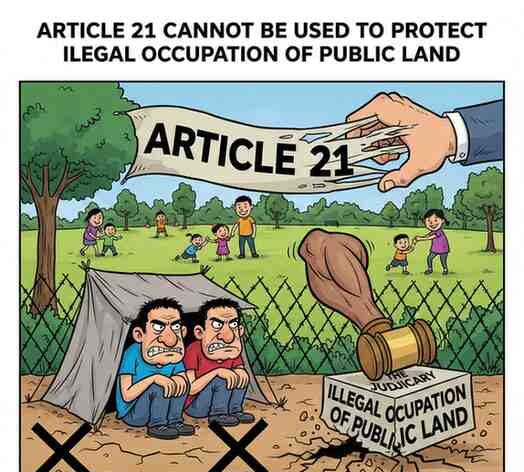
The Orissa High Court has ruled that Article 21 of the Constitution does not protect illegal occupation of public land.
Introduction
In a significant ruling clarifying the scope of constitutional protections, the Orissa High Court has held that Article 21 (Right to Life and Livelihood) cannot be invoked to legitimize or perpetuate illegal occupation of public land. The court dismissed a batch of petitions challenging eviction notices related to land acquired decades ago for a coal mining project and associated public development works.
The judgment reinforces the principle that sympathy, long stay, or poverty cannot override the rule of law, especially when land is required for a lawful public purpose.
Background of the Case
The main petitioner, Biswanath alias Bisa Gochhayat, claimed that eviction notices were sent out in 2024 regarding land that is situated within Gopalprasad village, which is part of Talcher.
- The land falls in the Hingula Open Cast Project of Mahanadi Coalfields Limited (MCL).
- Acquisition was conducted under the Coal Bearing Areas (Acquisition and Development) Act over the period 1994 to 1997.
- Physical possession was taken in 1999 by MCL.
The petitioner claimed that:
- For almost three generations, his family resided in the area adjacent to Maa Hingula Temple.
- Their livelihood depended on the traditional services provided to the temple.
- The eviction would also amount to a violation of Articles 14 and 21 of the Constitution if not accompanied by rehabilitation.
Key Legal Issues Before the Court
- Can Article 21 be used to prevent the eviction of an illegal occupant from public land?
- Does long-standing occupation create a constitutional or legal right?
- Is rehabilitation a mandatory precondition for eviction in such cases?
- Was the eviction process arbitrary or discriminatory under Article 14?
Court’s Reasoning and Observations
Justice Dr Sanjeeb K Panigrahi, while dismissing the petitions, made several crucial observations:
Article 21 Has Limits
The court categorically held that:
- The right to livelihood and shelter under Article 21 does not grant a perpetual right to occupy public land.
- Constitutional protection cannot be stretched to legalize encroachment, even if it has continued for decades.
“Protection of livelihood under Article 21 does not mean that an encroacher gets a perpetual right to occupy public land.”
Long Illegal Occupation Creates No Legal Right
- Mere passage of time or continuous stay does not convert illegal possession into a lawful entitlement.
- Documents such as identity cards or proof of residence do not establish title or adverse possession against the government.
No Violation of Article 14 (Equality)
- The petitioner was treated like any other unauthorised occupant.
- There was no evidence of selective targeting, discrimination, or arbitrariness.
- The eviction drive followed a sanctioned development plan and legal procedure.
Right to Shelter ≠ Right to Squat
The court clarified that:
- The right to shelter does not mean a right to squat indefinitely on government land.
- When a development project is lawfully implemented, an individual cannot use Article 21 to veto or stall it.
Rehabilitation Is Not a Precondition
- There is no legal mandate requiring authorities to provide rehabilitation before evicting an unauthorized occupant.
- Rehabilitation benefits are policy-driven and apply only to lawfully displaced persons, not encroachers.
Suppression of Material Facts
- The petitioner failed to disclose that his son had filed an identical writ petition concerning the same land.
- This amounted to suppression of facts, lack of clean hands, and abuse of judicial process, making the petition unsustainable.
Final Decision of the Court
- The High Court found no violation of Articles 14, 21, or 300A of the Constitution.
- All writ petitions were dismissed.
- Any interim protection against eviction previously granted was vacated.
While the court acknowledged the petitioner’s age and hardship, it emphasized that judicial sympathy cannot override statutory law or public interest.
Why This Judgment Matters
- Reaffirms that constitutional rights cannot be misused to protect illegal acts.
- Clarifies the limited scope of Article 21 in land and eviction matters.
- Strengthens the legal framework for public infrastructure and development projects.
- Sends a clear message against encroachments on public land, even if longstanding.
Conclusion
This Orissa High Court ruling draws a firm constitutional boundary: human dignity and livelihood rights cannot be used to justify illegal occupation of public land. While the judiciary remains sensitive to human hardship, it cannot rewrite the law or obstruct legitimate public development carried out through due process.
Frequently Asked Questions (FAQs): Article 21 Cannot Be Used to Protect Illegal Occupation of Public Land
Does Article 21 protect the right to shelter?
Yes, but only to a reasonable extent. Article 21 does not grant a right to illegally occupy public or government land indefinitely.
Can long-term occupation of government land become legal?
No. The court held that a long duration of illegal occupation does not create legal or constitutional rights, regardless of how many years the person has stayed.
Is rehabilitation mandatory before eviction?
No. Rehabilitation is not a constitutional right for encroachers. It depends on statutory schemes and applies primarily to lawful landowners or recognized displaced persons.
What law governed the land acquisition in this case?
The land was acquired under the Coal Bearing Areas (Acquisition and Development) Act, and possession was lawfully taken by MCL in 1999.