
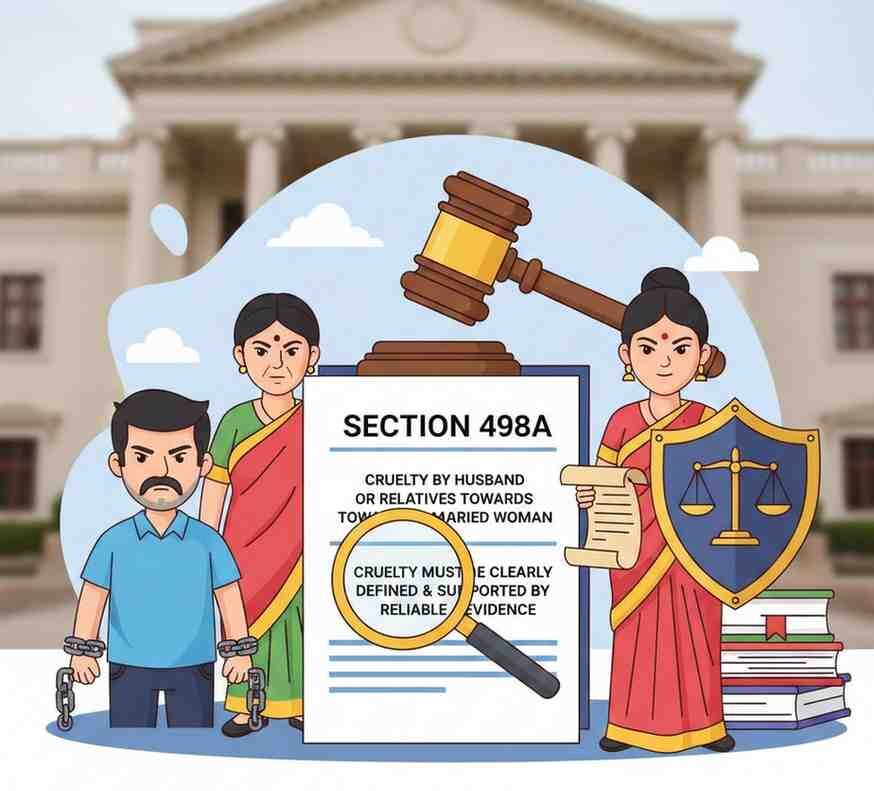
The apex court of India has set aside a dowry death conviction because of the absence of trustworthy evidence. Besides, it has also reiterated the requirement of extremely strong evidence for the convictions under IPC Sections 304B and 498A.
Introduction
In a landmark judgement dated today, the Supreme Court of India disposed of the criminal charge of a dowry death case in which the appellant was sentenced to seven years of rigorous imprisonment. The bench of the apex court observed that the prosecution had failed to prove beyond doubt the essential elements of the crime under Section 304B of the IPC.
This ruling has stirred a lot of reactions among not only lawyers but also laypeople, as it very clearly defines that criminal convictions are to be backed by strong and valid evidence and not by mere allegations and publicity, even if they are very serious and emotionally stirring.
Background of the Case
Before this, the accused had gone through the trial court and sentencing, and the High Court confirmed the judgement for offences under:
- Section 304B IPC (Dowry Death)
- Section 498A IPC (Cruelty by husband or relatives)
The conviction of the accused was primarily based on the fact that the lady had died unnaturally within seven years of marriage. The courts, on this ground only, imposed the statutory minimum punishment of seven years’ rigorous imprisonment.
Nonetheless, the Supreme Court held that this method replaced evidence with a presumption of law, thus, a gross miscarriage of justice.
Why the Supreme Court Overturned the Conviction
Failure to Prove Dowry-Linked Cruelty
The Court clarified that a dowry death conviction cannot be sustained merely because a woman dies unnaturally within seven years of marriage. The prosecution must establish that:
- The deceased was subjected to cruelty or harassment
- Such cruelty was directly linked to dowry demands
- The harassment occurred shortly before her death
In the present case, the evidence was found to be vague, inconsistent, and unsupported by independent corroboration. As a result, the mandatory legal threshold was not satisfied.
Incorrect Use of Presumption Under Evidence Law
Although Section 113B of the Indian Evidence Act empowers courts to presume dowry death, the Supreme Court pointed out that this presumption cannot be deemed automatic.
Even before that, the prosecution should have demonstrated to the court through evidence that there was dowry and related cruelty. The court was right in holding that it was not proper to invoke the presumption when such a basic factual foundation was lacking.
Section 498A Charge Also Not Proved Beyond Doubt
The Court further remarked that the charges under Section 498A IPC should be definite, logically consistent, and corroborated by trustworthy evidence. Vague or repeated allegations are not enough.
The witnesses here were unclear in their statements and were unable to prove the continuous cruelty as per the law; the charge under Section 498A also fell.
Key Legal Principles Reaffirmed
This judgment reinforces several core principles of criminal jurisprudence:
- Presumption of Innocence: Every accused is innocent until proven guilty beyond a reasonable doubt.
- Social Evil Cannot Dilute Legal Standards: While dowry is a grave societal issue, courts cannot lower evidentiary standards to secure convictions.
- Serious Charges Require Serious Proof: Grave allegations and minimum mandatory sentences demand strict scrutiny.
- Judicial Caution in Matrimonial Offences: Courts must carefully distinguish genuine cases from those lacking legal substance.
Why This Judgment Matters
This ruling does not weaken anti-dowry laws. Instead, it strengthens the justice system by ensuring that:
- Genuine victims receive justice through proper investigation
- Innocent individuals are not punished without proof
- Courts remain guided by law rather than emotion
Legal experts believe the decision will encourage investigating agencies to collect stronger evidence, record clearer statements, and avoid the mechanical application of dowry death provisions.
Impact on Future Dowry Death Cases
- Greater scrutiny of prosecution evidence
- Reduced the scope for automatic convictions
- Stronger emphasis on timelines, causation, and corroboration
- Enhanced safeguards against wrongful imprisonment
The judgment is expected to influence trial courts across India when dealing with cases under Sections 304B and 498A of the IPC.
Conclusion
The Supreme Court verdict should remind us that justice must always be informed, never presumed. While it is of course important to fight dowry-related crime, it must also be borne in mind that law and justice dictate that we must have proof in every conviction.
Thus, restoring the balance between the twin concepts of social justice and legal fairness, the ruling gives a boost to public confidence in India’s criminal justice system.
Frequently Asked Questions (FAQs): SC Sets Aside Dowry Death Conviction
What is considered a dowry death under Indian law?
A dowry death occurs when a woman dies under unnatural circumstances within seven years of marriage, and it is proven that she faced dowry-related cruelty or harassment shortly before her death.
Is death within seven years of marriage enough for conviction?
No. The prosecution must prove a direct link between dowry-related cruelty and the death.
What is Section 498A IPC?
Section 498A penalizes cruelty by a husband or his relatives toward a married woman. Cruelty must be clearly defined and supported by reliable evidence.