
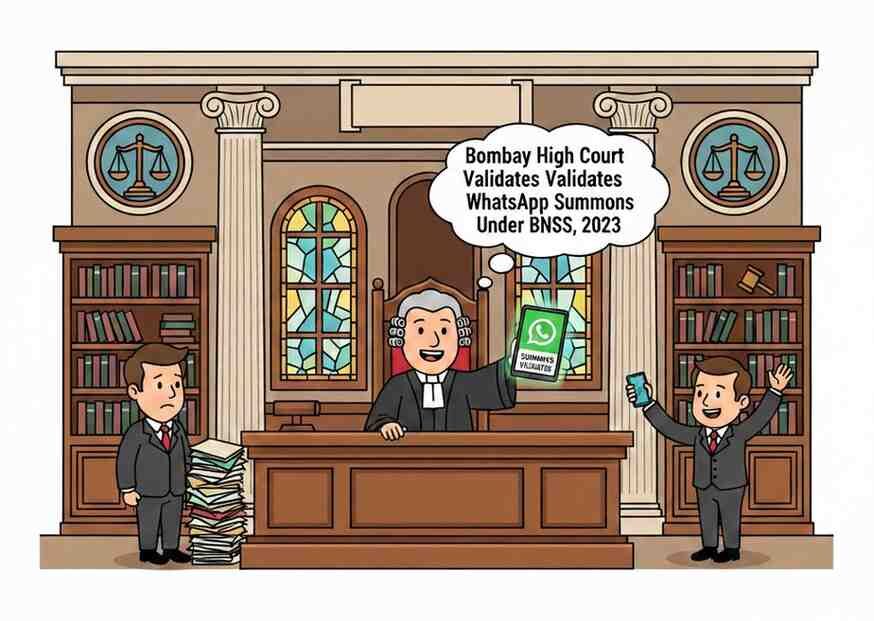
The Bombay High Court (Nagpur Bench) rules that WhatsApp summons are legally valid under the Bharatiya Nagarik Suraksha Sanhita (BNSS), 2023.
Introduction
In a significant development for India’s judicial system, the Bombay High Court (Nagpur Bench) has upheld that serving summons through WhatsApp and other electronic modes is legally valid under the Bharatiya Nagarik Suraksha Sanhita (BNSS), 2023.
This ruling reinforces the growing recognition of digital communication within criminal proceedings and reflects the judiciary’s shift toward modern, technology-driven processes.
The judgment is expected to streamline criminal trials, reduce delays in service of notices, and align procedural law with contemporary communication practices.
Background: From CrPC to BNSS
The BNSS, 2023 replaced the decades-old Code of Criminal Procedure (CrPC) as part of India’s broader criminal law reforms. One of its key objectives is modernization—introducing provisions that formally recognize electronic communication in legal procedures.
Traditionally, summons were served through:
- Physical delivery by court officers
- Registered post
- Courier services
- Police officials
However, delays, evasion tactics, and logistical challenges often slowed down proceedings. The BNSS introduced provisions explicitly allowing service of summons via electronic means, including messaging platforms like WhatsApp, email, and other digital channels.
What Did the Court Decide?
The Nagpur Bench ruled that:
- Service of summons through WhatsApp is legally valid if it complies with BNSS provisions.
- Electronic acknowledgment, such as “blue ticks” or proof of delivery, may serve as evidence of receipt.
- Digital modes cannot be dismissed solely because they are non-traditional.
- Courts must interpret procedural laws in a manner that promotes efficiency and access to justice.
This interpretation strengthens the enforceability of electronic service and removes ambiguity around its legality.
Legal Basis Under BNSS, 2023
The BNSS permits service of summons through electronic communication, provided:
- The mode ensures reliable delivery.
- Proof of transmission and receipt can be demonstrated.
- The method satisfies principles of natural justice (i.e., the accused or respondent is properly informed).
The court emphasized that procedural laws should facilitate justice rather than obstruct it through outdated formalities.
Why This Ruling Is Important
Reduces Delays in Criminal Trials
One of the biggest challenges in India’s judicial system is delay in serving summons. Accused persons often avoid physical service, leading to adjournments and prolonged litigation. Digital service reduces such bottlenecks.
Strengthens Digital Evidence Acceptance
By recognizing WhatsApp service as valid, the court indirectly reinforces the evidentiary value of digital proof such as:
- Delivery receipts
- Read confirmations
- Screenshots
- Server logs
This aligns with the Information Technology framework governing electronic records in India.
Promotes E-Governance in Judiciary
The ruling supports the judiciary’s broader push toward:
- E-courts
- Virtual hearings
- Digital filing systems
- Online case tracking
It represents a progressive interpretation of procedural law in the digital era.
Concerns and Legal Safeguards
While the ruling is progressive, certain safeguards remain critical:
Authenticity of Delivery
Courts must ensure that the number used belongs to the concerned person.
Proof of Receipt
Merely sending a message is not enough; delivery confirmation should be established.
Protection Against Misuse
Fake screenshots or manipulated messages must be scrutinized carefully.
Right to Fair Hearing
The accused must have adequate opportunity to respond after receiving the summons.
Impact on Lawyers, Litigants & Police
For Lawyers:
- Faster initiation of proceedings.
- Reduced adjournments due to non-service.
- Increased reliance on digital documentation.
For Police:
- Easier compliance with court directions.
- Reduced logistical burden.
For Accused or Respondents:
- Greater responsibility to monitor registered mobile numbers.
- Reduced ability to evade service.
Broader Implications for Indian Criminal Law
This ruling signals a broader transformation in criminal justice administration:
- Encourages digital compliance.
- Aligns procedural laws with modern communication habits.
- Sets a persuasive precedent for other High Courts.
- May influence future Supreme Court interpretations.
It also reflects judicial recognition that digital communication is now an integral part of daily life, making it unreasonable to ignore such methods in formal legal processes.
Conclusion
The Bombay High Court’s recognition of WhatsApp summons under the BNSS, 2023 marks a turning point in India’s criminal justice system. By embracing digital communication, the judiciary is signaling a commitment to efficiency, accessibility, and modernization.
As courts continue integrating technology into procedural law, this decision may serve as a foundation for broader digital transformation across India’s legal landscape.
Frequently Asked Questions: Bombay High Court Validates WhatsApp Summons Under BNSS, 2023
Is WhatsApp summons legally valid in India?
Yes. The Bombay High Court (Nagpur Bench) has ruled that service of summons through WhatsApp is valid under the BNSS, 2023, provided proper proof of delivery exists.
What is the Bharatiya Nagarik Suraksha Sanhita (BNSS), 2023?
The BNSS is India’s new criminal procedure law that replaced the Code of Criminal Procedure (CrPC). It modernizes procedural aspects, including recognition of electronic communication
Can someone challenge a WhatsApp summons?
Yes. If a person can prove they did not receive the message or that it was sent to the wrong number, they may challenge the validity of service.