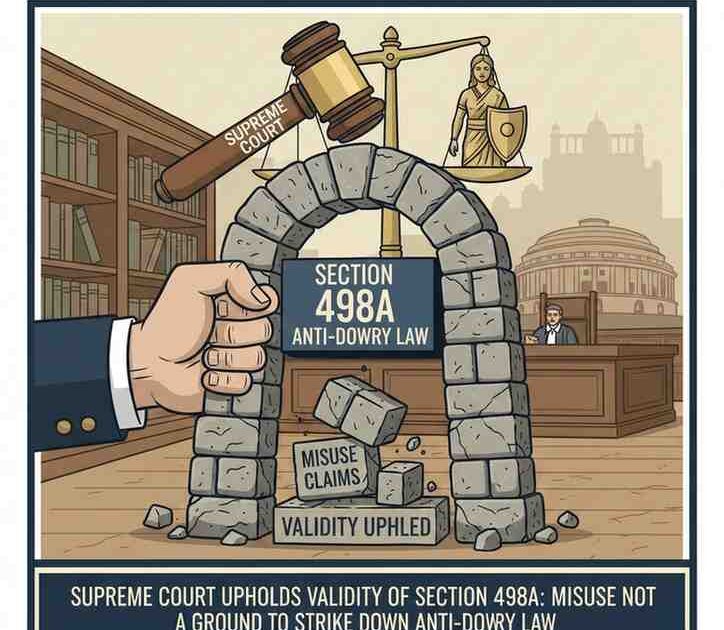
The Supreme Court of India has ruled that Section 498A is constitutionally valid and that misuse of the law cannot be a valid ground for striking down a law against dowry and domestic cruelty.
Introduction
In a major move, the Supreme Court of India has reaffirmed the constitutional validity of Section 498A of the IPC. The apex court has recently rejected the ground that the predicated misuse of the said section was enough to get it set aside. The court clearly pointed out that the few cases where the law has been misused cannot be the reason for invalidating the law, which was enacted to protect married women from cruelty and dowry harassment.
This ruling reinforces the judiciary’s long-standing position that protective legislation must be judged by its purpose and constitutional intent, not by isolated instances of misuse.
What Is Section 498A?
Section 498A was enacted to address one of the deepest, rooted social evils in our society, that is, dowry harassment and cruelty of husbands towards wives.
Main features of Section 498A:
- Applies to husband or husband’s relatives
- Physical, mental, and emotional cruelty covered.
- Includes harassment linked to dowry demands
- Classified as a cognizable and non-bailable offence
The Supreme Court of India upholds the constitutional validity of Section 498A, ruling that misuse cannot justify striking down the anti-dowry and domestic cruelty law.
The Supreme Court’s Primary Concern
The petitioners contesting Section 498A contended that:
- The clause is often abused.
- Innocent family members are frequently implicated.
- The law infringes upon equality and individual liberty.
They sought either dilution or complete invalidation of the provision on constitutional grounds.
Supreme Court’s Ruling: Misuse Cannot Invalidate the Law
The Supreme Court categorically rejected these arguments and held that:
“Misuse of a provision by some individuals cannot be a ground to strike down a law enacted to address a serious social problem.”
Key Observations by the Court:
- No statute can be protected from being misused, whether these are economic, criminal, or civil statutes.
- The solution lies in proper implementation, not repeal
- Judges should weigh individual freedom against social justice
- Section 498A is very important in protecting the vulnerable in Indian society
The court emphasized that if such a law were to be removed, it would be a great disadvantage for many women who would be helpless in the face of domestic torture without any legal remedy.
Distinction Between Misuse and Unconstitutionality
A crucial legal principle reiterated by the Court is the difference between misuse and unconstitutionality:
| Misuse | Unconstitutionality |
|---|---|
| Abuse by individuals | Inherent legal defect |
| Addressed through safeguards | Requires striking down |
| Administrative/judicial issue | Constitutional issue |
The Court clarified that misuse must be handled through judicial scrutiny, guidelines, and fair investigation, not by dismantling the law itself.
Existing Safeguards Against False Implication
The Supreme Court highlighted that several judicial safeguards already exist to prevent abuse of Section 498A, including:
- Preliminary inquiry before arrest in appropriate cases
- Judicial oversight during remand
- Grant of anticipatory bail was justified
- Power to quash false or malicious FIRs under inherent jurisdiction
These safeguards ensure that the rights of the accused are protected without weakening the law’s core purpose.
Social Importance of Section 498A
Section 498A’s Social Significance
The court recognized that:
- Domestic abuse is still pervasive.
- Despite being illegal, dowry harassment persists.
- Women are frequently under pressure to remain silent.
Section 498A serves the following purposes in this situation:
- A preventative measure against mistreatment
- A symbol of the state’s commitment to gender equality
- A legal safeguard for struggling women.
Diluting the provision, the Court warned, would send a regressive message and undermine decades of progress in women’s rights.
Impact of the Judgment
Legal Impact:
- Reinforces the constitutional validity of women-protective laws
- Limits future challenges based solely on misuse claims
- Strengthens judicial interpretation in favour of social welfare legislation
Social Impact:
- The program helps domestic violence victims restore their lost confidence.
- The system establishes better accountability standards that partners must fulfill in their marriage ties.
- Strengthens judicial interpretation in favour of social welfare legislation.
Conclusion
The Supreme Court’s decision to keep Section 498A was a smart and principled choice that protects people’s rights while keeping laws that use justice to fix big social problems.
The Court has reaffirmed the State’s constitutional duty to protect the most vulnerable groups in society by making it clear that misusing a welfare law cannot be a reason to repeal it.
The judgment underscores a vital legal truth: the answer to misuse lies in reform and restraint, not repeal.
FAQs: Supreme Court on Section 498A
What did the Supreme Court decide about Section 498A?
The Supreme Court affirmed the constitutional validity of Section 498A, which remains in effect despite allegations of misuse.
Did the Court deny that misuse occurs?
The Court recognized that misuse exists, but held that it does not justify invalidating the law.
Is Section 498A still non-bailable?
Section 498A maintains its status as a non-bailable offence subject to judicial safeguards.
Can false cases under Section 498A be challenged?
Yes. Courts can quash false FIRs, grant anticipatory bail, and prevent arbitrary arrests.