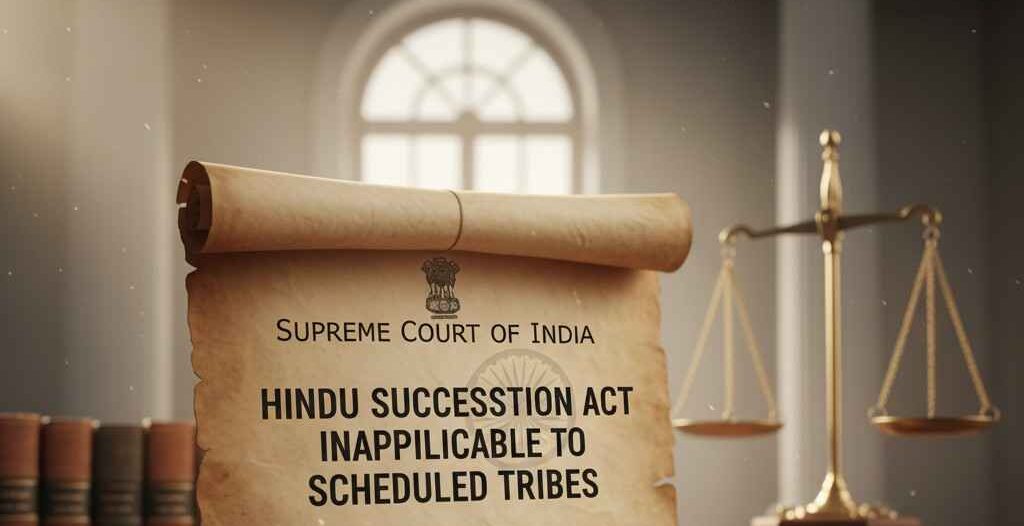
The Supreme Court of India rules that Scheduled Tribes are governed by tribal customary laws, not the Hindu Succession Act, in matters of inheritance and property.
Introduction
In a landmark judgment, the Supreme Court of India has clarified that the Hindu Succession Act, 1956 (HSA) does not automatically apply to members of Scheduled Tribes (STs). Instead, inheritance and property rights within tribal communities are governed by their respective customary laws, unless Parliament specifically extends the HSA to them through legislation.
This ruling reaffirms the autonomy of tribal communities and highlights the Indian Constitution’s recognition of their distinct identity, customs, and traditions under Article 13(3)(a) and Article 342.
Background of the Case
The case arose when daughters belonging to a Scheduled Tribe claimed rights over ancestral property under the Hindu Succession Act, 1956, which provides for equal inheritance rights to sons and daughters.
However, the opposing parties contended that tribal customs, not Hindu law, governed property inheritance among the community, and under those customs, daughters traditionally do not inherit ancestral property.
This dispute reached the Supreme Court, which had to determine whether the HSA could be applied to the Scheduled Tribes by default.
Supreme Court’s Key Observations
- Hindu Succession Act Not Automatically Applicable to STs
The Court noted that Section 2(2) of the Hindu Succession Act expressly excludes Scheduled Tribes unless the Central Government issues a specific notification extending its provisions. Members of Scheduled Tribes are subject to their own customary laws unless Parliament provides otherwise. - Recognition of Tribal Customs
Tribal laws and customs are protected under the Fifth and Sixth Schedules of the Constitution, which safeguard self-governance, local practices, and traditional institutions. - Constitutional Protection of Tribal Identity
The judgment emphasized that enforcing mainstream Hindu laws over tribal communities could erode their cultural autonomy. The Constitution deliberately provides space for tribal laws to prevail in personal and community matters. - Role of Legislature
The Court made it clear that any extension of Hindu personal law to Scheduled Tribes must come through a deliberate act of Parliament, not by judicial interpretation.
Significance of the Judgment
- Protects Tribal Autonomy: Ensures that tribal customs continue to guide inheritance, marriage, and family matters within ST communities.
- Upholds Constitutional Intent: Reinforces that laws must respect diversity, not impose uniformity where it undermines traditional rights.
- Gender Rights Context: Though it may seem to limit women’s inheritance rights, the Court maintained that reform must come from within the community or through legislation, not judicial overreach.
- Future Implications: This decision could affect several ongoing property disputes in tribal areas across India, especially in states like Jharkhand, Chhattisgarh, Odisha, and Madhya Pradesh.
Legal Foundation of the Ruling
| Legal Provision | Explanation |
|---|---|
| Section 2(2), Hindu Succession Act, 1956 | Excludes application of the Act to members of Scheduled Tribes unless directed otherwise by the Central Government. |
| Article 342, Constitution of India | Defines Scheduled Tribes for legal and constitutional purposes. |
| Fifth & Sixth Schedules | Protect tribal governance, land rights, and customs. |
| Article 13(3)(a) | Recognizes customary law as part of the “law in force” in India. |
Conclusion:
The Supreme Court’s verdict is a reminder that India’s legal system embraces pluralism — recognizing both statutory and customary laws. By reaffirming that tribal customary laws govern inheritance among Scheduled Tribes, the Court has protected the constitutional promise of respecting cultural diversity while leaving room for legislative reform that balances equality and tradition.
FAQs: Supreme Court Ruling on Inheritance Rights of Scheduled Tribes
What is the main takeaway from the Supreme Court’s ruling?
The Supreme Court held that members of Scheduled Tribes are governed by their own customary laws for inheritance and succession — not by the Hindu Succession Act, 1956.
Why doesn’t the Hindu Succession Act apply to Scheduled Tribes?
Because Section 2(2) of the Act explicitly excludes Scheduled Tribes unless the Central Government issues a notification applying it to them.
Does this mean tribal women cannot inherit property?
Not necessarily. It depends on the customary laws of the particular tribe. Some tribes allow equal inheritance rights, while others do not. The Court said any change must come from legislation, not judicial intervention.